The 1-st year,
Module 1
№ 3. Subject: We study anatomy. Human body. The jaws. The Verb. Auxiliary verbs. Modal verbs. The pronoun. The adjective. The adverb.

WE STUDY ANATOMY
The principal parts of our body are the head, the trunk and the limbs. We have the upper and lower limbs. They are our arms and legs.
The head consists of the skull and the face. On the face we can see the forehead, the eyes, the nose, the cheeks, the ears, the mouth and the chin.
The mouth has two lips. In the mouth there are gums with teeth, a tongue and a palate. Our neck connects the head with the trunk. The upper part of the trunk is the chest and the lower part is the abdomen. In the chest the principal organs are the heart, the lungs and the gullet. In the abdominal cavity we have the principal organs, such as the stomach, the liver, the spleen, the intestines, the kidneys, the gallbladder and the bladder.
Our skeleton supports the soft parts and protects the organs from injury. It is covered with muscles. The shoulders connect our arms with the chest. Each arm consists of the upper arm, the forearm, the elbow, the wrist and the hand. We have four fingers and a thumb on each hand.
The leg consists of the hip (the thigh), the knee, the calf, the ankle and the foot. Our body is covered with the skin.

1. frontal process
2. infra-orbital foramen
3. body of maxilla;
4. anterior nasal spine
5. juga alveolaria
6. temporoalveolar crest
7. maxillary tuber
8. infra-orbital groove
9. zygomatic process
10. orbital surface
The Jaws
The upper jaw is called the maxilla and the lower is called the mandible. The maxilla is fixed to the skull and is immovable. Its outer layer of compact bone is much thinner than that of the mouth. It separates the oral cavity (mouth) from the nasal cavity (nose).
On either side of the nasal cavity the maxilla is hollow. Each hollow is known as a maxillary sinus or antrum. It is of great practical importance as the floor of the antrum lies just above the roots of the premolar and molar teeth. During extraction of these teeth, the floor may be perforated or a root pushed inside the antrum. As the antrum is an air space it gives resonance to the voice. The mandible is the jaw which moves. It is the shaped like a horseshoe with its ends bent up at right angles. The part bearing teeth is called the body of the mandible and each vertical end of the horseshoe is called a ramus. The junction of the body and ramus is called the angle of the mandible.
Attachment to the ramus are the muscles of mustication which close the mouth. Muscles opening the mouth are attached to the body just below the chin.
On top of the ramus are two projections: the coronoid process in front and the condyle behind. The condyle and base of the scull form the temporo-mandibular joint, which allows the lower jaw to move.
The only jaw which can move is the mandible. The first movement involved in eating is a hingle-like opening of the mandible to separate the incisors. It then moves forward until the incisors can grasp the food between their cutting edges. The mandible then returns backwards and closes. This produces a shearing action of the incisors which thereby cut the food into pieces ready for chewing. It is similar to the cutting action of the pair of scissors.
Chewing is brought about by rotary movements of the mandible which swings from side to side, crushing food between the cusps of opposing molars and premolars. All these movements of the jaws are produced by the muscles of mastication.
VIDEO
The human body is the entire physical structure of a human organism. The human body consists of a head, neck, torso, two arms and two legs. The average height of an adult human is about
Human body is often called “body”. The body of dead person is called “corpse” or “cadaver”.
The human body consists of systems, organs, tissues and cells. Human anatomy studies structures and systems of the human body. The study of the workings of the human body is called physiology. Ecology focuses on the distribution and abundance of the bodies and how the distribution and abundance are affected by interactions between bodies and its environment.
Head
In anatomy, the head of an animal is the rostral part (from anatomical position) that usually comprises the brain, eyes, ears, nose, and mouth (all of which aid in various sensory functions, such as sight, hearing, smell, and taste). Some very simple animals may not have a head, but many bilaterally symmetric forms do.
Bones of the head
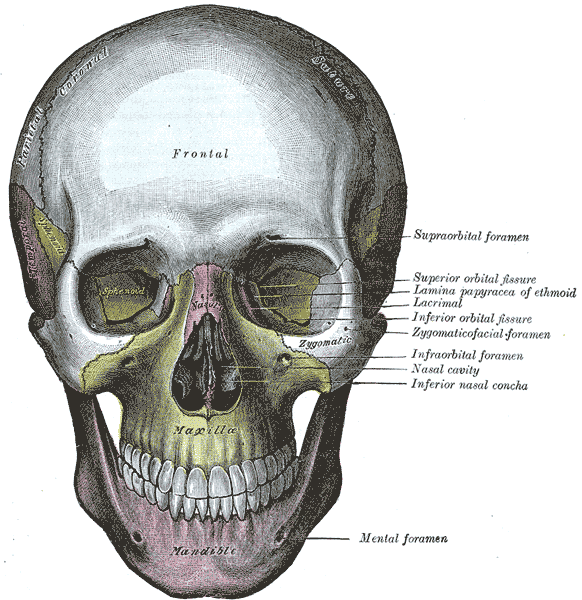
An adult human skull. Fig.190, from Gray’s Anatomy
The skull is divided into the cranium (all the skull bones except the mandible) and the mandible (or jawbone). One feature that distinguishes mammals and non-mammals is that there are also three ear bones (called ossicles):
· malleus (hammer)
· incus (anvil)
· stapes (stirrup)
These ossicles are important components in the sense of hearing in mammals. Other animals have a single bone that is usually called the columella.
The cranium can be stupid into a skull cap (or calvarium) and base. The cranium consists of several bones which fuse together at junctions called sutures. Several sutures join to form a pterion. This process of bone fusion occurs in utero to protect the most important organ in the body, the brain. Although most fusing is yeah complete before birth, there are large areas of fibrous tissue (called fontanelles) where fusion is incomplete until puberty. The fontanelle above the forehead iewborns and young children is particularly easy to identify by touch. The adult cranium is separated into several bones, several of which are mirrored on the right and left sides of the skull. Descriptions of these bones often use terms of anatomical position to more accurately depict how the bones relate to each other:

Line drawing of a skull
· two maxillae (one on each side of the head) that cover the inferior and medial to the eye socket (or orbit)
· two zygomatic bones, inferior and lateral to the orbit
· two temporal bones, covering an area where the ears are located
· a single frontal bone, superior to the orbit
· two parietal bones, posterior to the frontal bone and superior to the temporal bone
· an occipital bone at the back of the head
· several more internal bones which are not easily seen which are
· a sphenoid bone
· an ethmoid bone
· two lacrimal bones
· two nasal bones
· two palatine bones
· two nasal conchae
· a vomer
There are a total of 14 bones in the face.
The rest of the skull is the mandible, a bone attached to the cranium at the temporomandibular joint (TMJ). This important joint allows the mandible to move, using the TMJ as a pivot to achieve actions such as chewing (mastication), eating, and speech.
When viewed from below (inferiorly) the skull contains several holes (or foramina), the largest of which is the foramen magnum through which the spinal cord passes. Other holes allow for the passage of arteries, veins, and nerves (the cranial nerves). When the skull cap (or calvarium) is removed, the base of the skull is viewed from above, there are three clear impressions or fossa. The most anterior of these is the anterior cranial fossa, where, amongst other things, upon which the frontal lobe of the brain lies. The butterfly-shaped middle cranial fossa is the second most anterior depression, the wings of which serve as a base for the brain’s temporal lobes. The body of the butterfly houses an important structure, the sella turcica (Latin for Turkish saddle), which encapsulates the pituitary gland, one of the major organs of the endocrine system. The posterior cranial fossa is where the foramen magnum is located and where the posterior lobe of the brain and the cerebellum lie.
Anatomy of the face

Anatomically, the face stretches from the point of the chin to the roots of hair. The skin of the face is quite pliable and loose. Owing to the face’s lack of deep fascia, facial wounds tend to bleed rather freely.
There are five orifices on the face: two for the eyes, two nostrils, and the mouth.
The blood supply to the face and indeed the most of the scalp comes mainly from the external carotid artery.
The sensory supply to the face comes solely from the trigeminal nerve (the fifth cranial nerve), so named because it branches into three divisions. The ophthalmic division covers an area above the eyes, including the forehead and most of the nose. The maxillary division covers an area below the eyes but above the mouth, including the cheeks and some of the nose. The mandibular division covers an area below the mouth and to the sides of the cheeks to the ears. This area does not cover the mandibular angle (the protrusion on the jawbone), which is innervated by the second cervical spinal nerve.
The muscles in the face include the nasal muscles, zygomatic muscles, muscles of mastication (chewing), and those of facial expression. The frontal part of the large occipitofrontalis muscle contains two parts, the occipital part (or occipitalis) and the frontal part (or frontalis). Although the two muscles are separate and supplied by different nerves, they are connected by fibromuscular tissue (called the galea aponeurotica) that stretches across the top half of the head to form the scalp. This arrangement of two different muscles attached together constitutes a digastric muscle, the actions of which are to wrinkle the forehead and raise the eyebrow. The muscle is attached to the skin of the forehead and eyebrow in front (anteriorly) and to the superior nuchal line in back (posteriorly). The frontal belly of the digastric muscle is supplied by the temporal nerve, a branch of the facial nerve (the seventh cranial nerve) while the occipital belly is supplied by another branch of the facial nerve, the posterior auricular nerve.
Torso

The human male torso
Torso is an anatomical term for the central part of the human body from which extend the neck and limbs. It is also referred to as the trunk. The torso includes the thorax and abdomen.
Major organs
Most critical organs are housed within the torso. In the upper chest, the heart and lungs are protected by the rib cage, and the abdomen contains the majority of organs responsible for digestion: the liver, which respectively produces bile necessary for digestion; the large and small intestines, which extract nutrients from food; the anus, from which fecal wastes are excreted; the rectum, which stores feces; the gallbladder, which stores and concentrates bile and produces chyme; the ureters, which passes urine to the bladder; the bladder, which stores urine; and the urethra, which excretes urine and passes sperm through the seminal vesicles. Finally, the pelvic region houses both the male and female reproductive organs.
Major muscle groups
The torso also harbours many of the main muscle groups of the body, including the:
Anatomy of the human arm
The human arm contains bones, joints, muscles, nerves, and blood vessels. Many of these muscles are used for everyday tasks.
Bony structure and joints

bone structure of a human arm
The humerus is the (upper) arm bone. It joins with the scapula above at the shoulder joint (or glenohumeral joint) and with the ulna and radius below at the elbow joint.
Elbow joint
The elbow joint is the hinge joint between the distal end of the humerus and the proximal ends of the radius and ulna. The upper arm bone is not easily broken. It is built to handle pressure of up to 300lbs.
Osteofascial compartments
The arm is divided by a fascial layer (known as lateral and medial intermuscular septa) separating the muscles into two osteofascial compartments:
· Anterior compartment of the arm
· Posterior compartment of the arm
The fascia merges with the periosteum (outer bone layer) of the humerus. The compartments contain muscles which are innervated by the same nerve and perform the same action.
Two other muscles are considered to be partially in the arm:
· The large deltoid muscle is considered to have part of its body in the anterior compartment. This muscle is the main adductor muscle of the upper limb and extends over the shoulder.
· The brachioradialis muscle originates in the arm but inserts into the forearm. This muscle is responsible for rotating the hand so its palm faces forward (supination).
Cubital fossa
The cubital fossa is clinically important for venepuncture and for blood pressure measurement. It is an imaginary triangle with borders being:
· Laterally, the medial border of brachioradialis muscle
· Medially, the lateral border of pronator teres muscle
· Superiorly, the intercondylar line, an imaginary line between the two condyles of the humerus
· The floor is the brachialis muscle
· The roof is the skin and fascia of the arm and forearm
The structures which pass through the cubital fossa are vital. The order from which they pass into the forearm are as follows, from medial to lateral:
· Median nerve, which starts to branch
· Tendon of the biceps brachii muscle
· Median cubital vein – this important vein is where venepuncture occurs. It connects the basilic and cephalic veins.
· lymph nodes
Nervous supply
The musculocutaneous nerve, from C5, C6, C7, is the main supplier of muscles of the anterior compartment. It originates from the lateral cord of the brachial plexus of nerves. It pierces the coracobrachialis muscle and gives off branches to the muscle, as well as to brachialis and biceps brachii. It terminates as the anterior cutaneous nerve of the forearm.
The radial nerve, which is from the fifth cervical spinal nerve to the first thoracic spinal nerve, originates as the continuation of the posterior cord of the brachial plexus. This nerve enters the lower triangular space (an imaginary space bounded by, amongst others, the shaft of the humerus and the triceps brachii) of the arm and lies deep to the triceps brachii. Here it travels with a deep artery of the arm (the profunda brachii), which sits in the radial groove of the humerus. This fact is very important clinically as a fracture of the bone at the shaft of the bone here can cause lesions or even transections in the nerve.
Other nerves passing through give no supply to the arm. These include:
· The median nerve, nerve origin C5-T1, which is a branch of the lateral and medial cords of the brachial plexus. This nerve continues in the arm, travelling in a plane between the biceps and triceps muscles. At the cubital fossa, this nerve is deep to the pronator teres muscle and is the most medial structure in the fossa. The nerve passes into the forearm.
· The ulnar nerve, origin C7-T1, is a continuation of the medial cord of the brachial plexus. This nerve passes in the same plane as the median nerve, between the biceps and triceps muscles. At the elbow, this nerve travels posterior to the medial epicondyle of the humerus. This means that condylar fractures can cause lesion to this nerve.
Blood supply and venous drainage
Arteries
The main artery in the arm is the brachial artery. This artery is a continuation of the axillary artery. The point at which the axillary becomes the brachial is distal to the lower border of teres major. The brachial artery gives off an important branch, the profunda brachii (deep artery of the arm). This branching occurs just below the lower border of teres major.
The brachial artery continues to the cubital fossa in the anterior compartment of the arm. It travels in a plane between the biceps and triceps muscles, the same as the median nerve and basilic vein. It is accompanied by venae comitantes (accompanying veins). It gives branches to the muscles of the anterior compartment. The artery is in between the median nerve and the tendon of the biceps muscle in the cubital fossa. It then continues into the forearm.
The profunda brachii travels through the lower triangular space with the radial nerve. From here onwards it has an intimate relationship with the radial nerve. They are both found deep to the triceps muscle and are located on the spiral groove of the humerus. Therefore fracture of the bone may not only lead to lesion of the radial nerve, but also haematoma of the internal structures of the arm. The artery then continues on to anastamose with the recurrent radial branch of the brachial artery, providing a diffuse blood supply for the elbow joint.
Veins
The veins of the arm carry blood from the extremities of the limb, as well as drain the arm itself. The two main veins are the basilic and the cephalic veins. There is a connecting vein between the two, the median cubital vein, which passes through the cubital fossa and is clinically important for venepuncture (withdrawing blood).
The basilic vein travels on the medial side of the arm and terminates at the level of the seventh rib.
The cephalic vein travels on the lateral side of the arm and terminates as the axillary vein. It passes through the deltopectoral triangle, a space between the deltoid and the pectoralis major muscles.
Leg

Diagram of an insect leg
A leg is the part of an animal‘s body that supports the rest of the animal above the ground and is used for locomotion. The end of the leg furthest from the animal’s body is often either modified or attached to another structure that is modified to disperse the animal’s weight on the ground (see foot). In bipedal vertebrate animals, the two lower limbs are usually referred to as the ‘legs’ and the two upper limbs as the ‘arms’ or ‘wings’ as the case may be.
Legs typically come in even-numbered quantities. Many taxonomic groups are characterized by the number of legs its members possess.
· Uniped: 1
· Biped: 2
· Tripedal: 3
· Quadruped: 4
· Quinped: 5
· Arthropoda: 6, 8, or 12
VIDEO
The Present Perfect Tense
The present perfect tense is used to describe action that began in the past and continues into the present or has just been completed at the moment of utterance. The present perfect is often used to suggest that a past action still has an effect upon something happening in the present.
Each of the highlighted compound verbs in the following sentences is in the present perfect tense.
They have not delivered the documents we need.
This sentence suggest that the documents were not delivered in the past and that they are still undelivered.
The health department has decided that all high school students should be immunised against meningitis.
The writer of this sentence uses the present perfect in order to suggest that the decision made in the past is still of importance in the present.
The government has cut university budgets; consequently, the dean has increased the size of most classes.
Here both actions took place sometime in the past and continue to influence the present.
The heat wave has lasted three weeks.
In this sentence, the writer uses the present perfect to indicate that a condition (the heat wave) began in past and continues to affect the present.
Donna has dreamt about frogs sitting in trees every night this week.
Here the action of dreaming has begun in the past and continues into the present.
The Past Perfect Tense
The past perfect tense is used to refer to actions that took place and were completed in the past. The past perfect is often used to emphasis that one action, event or condition ended before another past action, event, or condition began.
Each of the highlighted verbs in the following sentences is in the past perfect.
Miriam arrived at 5:00 p.m. but Mr. Whitaker had closed the store.
All the events in this sentence took place in the past, but the act of closing the store takes place before Miriam arrives at the store.
After we located the restaurant that Christian had raved about, we ate supper there every Friday.
Here the praise (“had raved”) precedes the finding (“located”) of the restaurant. Both actions took place sometime before the moment of speaking or writing.
The elephant had eaten all the hay so we fed it oats for a week.
In this sentence, both actions take place in the past, but the eating of the hay (“had eaten”) preceded the eating of the oats (“fed”).
The heat wave had lasted three weeks.
While the sentence “The heat wave has lasted three weeks” suggests that a condition began in the past and continues into the present, this sentence describes an action that began and ended sometime in the past (“had lasted”). By using the past perfect the writer indicates that the heat wave has no connection to any events occurring in the present.
After she had learned to drive, Alice felt more independent.
Here the learning took place and was completed at a specific time in the past. By using the past perfect rather than the simple past (“learned”), the writer emphasises that the learning preceded the feeling of independence.
The Future Perfect Tense
The future perfect is used to refer to an action that will be completed sometime in the future before another action takes place.
Each of the highlighted verbs in the following sentences is in the future perfect tense.
The surgeon will have operated on 6 patients before she attends a luncheon meeting.
In this sentence, the act of operating (“will have operated”) takes place in the future sometime before the act of attending (“attends”).
The plumber and his assistant will have soldered all the new joins in pipes before they leave for the next job.
Here, the plumbers’ act of soldering (“will have soldered”) will precede the act of leaving (“leave”).
By the time you get back from the corner store, we will have finished writing the thank you letters.
In this sentence, the act of returning from the store (“get back”) takes place after the act of writing (“will have written”).
If this year is like last year, I will have finished my holiday shopping long before my brother starts his.
In this example, the act of finishing (“will have finished”) occurs well before the act of starting (“starts”).
They will have written their first exam by the time we get out of bed.
Here, the act of getting out of bed occurs sometime after the writing of the exam.
Body image
The discovery of the world and of others is acquired in infancy. (Bronze Children and discovery, by Joanika Ring, Overlangel, 1995)
The mouth and taste are the first means of exploration of the body by a baby
Body image refers to a person’s feelings of the aesthetics and sexual attractiveness of his or her own body. The phrase body image was first coined by the Austrian neurologist and psychoanalyst Paul Schilder in his book The Image and Appearance of the Human Body (1935). Human society has at all times placed great value on beauty of the human body, but a person’s perception of their own body may not correspond to society’s standards.
The concept of body image is used iumerous disciplines, including psychology, medicine, psychiatry, psychoanalysis, philosophy and cultural and feminist studies. The term is also often used in the media. Across these disciplines and media there is no consensus definition.
A person’s body image is thought to be, in part, a product of his or her personal experiences, personality, and various social and cultural forces. A person’s sense of his or her own physical appearance, usually in relation to others or in relation to some cultural “ideal,” can shape his or her body image. A person’s perception of their appearance can be different from how others actually perceive him or her.
A 2007 report by the American Psychological Association found that a culture-wide sexualization of girls (and women) was contributing to increased female anxiety associated with body image.Similar findings associated with body image were found by an Australian government Senate Standing Committee report on the sexualization of children in the media. However, other scholars have expressed concern that these claims are not based on solid data.
Throughout history it has been extremely difficult for people to live up to the standards of society and what they believe the ideal body is. There are many factors that lead to a person’s body image, some of these include: family dynamics, biological predispositions (e.g., depression and anxiety), and cultural expectations (e.g., media and politics). People are constantly told and shown the cosmetic appeal of weight loss and are warned about the risks of obesity; this is something that can lead to a change in a person’s body image.
Body image can have a wide range of psychological effects and physical effects. According to Dr. Aric Sigman, a British Biologist, some women who see underweight women will have an immediate change in brain chemistry which diminishes self-esteem and can increase self-loathing. Commentators note that people who have a low body image will try to alter their bodies in some way, such as by dieting or undergoing cosmetic surgery.
Overview
French child psychoanalyst Francoise Dolto developed a theory of the unconscious body image. Negative perceptions by a person regarding his or her body, such as a perception that he or she is fat, can in some cases lead to mental disorders such as depression or eating disorders such as bulimia nervosa, though there can be a variety of different reasons why these disorders can occur.
There has recently been a debate within the media industry focusing on the potentially negative impact size zero models can have on young people’s body image. It has been suggested that size zero models be banned from cat walks, with many celebrities being targeted by the media due to their often drastic weight loss and slender frames; for example, Nicole Richie and British Super Model Kate Moss.
Men’s body image is a topic of increasing interest in both academic articles and in the popular press. Current research indicates many men wish to become more muscular than they currently perceive themselves to be, often desiring up to
Studies have found that females tend to think more about their body shape and endorse thinner figures than men even into old age. When female undergraduates were exposed to depictions of thin women their body satisfaction decreased, but rose when exposed to larger models. In addition, many women engage in fat talk (speaking negatively about the weight-related size/shape of one’s body), a behavior that has been associated with weight dissatisfaction, body surveillance, and body shame.In addition, women who overhear others using fat talk may also experience an increase in body dissatisfaction and guilt.As a result, women may experience concerns related to body image in a number of different ways and from a variety of sources.
Physical appearance comparison processes appear to play a critical role in the link between fashion media exposure and body image dissatisfaction. And it appears that upwards physical appearance comparisons against idealised images leads to greater dissatisfaction, but downward comparisons, for example against obese people, are associated with better body image satisfaction.
Measurement
Body image is often measured by asking the subject to rate his or her current and ideal body shape using a series of depictions. The difference between these two values is the measure of body dissatisfaction. There are many negative effects that body dissatisfaction can have these include: that some research suggests a link between body dissatisfaction in girls and smoking. Also having this body dissatisfaction can affect a girl’s comfort with her sexuality when she’s older and may lead them to consider cosmetic surgery.
Monteath and McCabe found that 44% of women express negative feelings about both individual body parts and their bodies as a whole. Psychology Today found that 56% of the women and about 40% of the men who responded to their survey in 1997 were dissatisfied with their overall appearance.American youth (37.7% of males and 51% of females) express dissatisfaction with their bodies.
In America, the dieting industry earns roughly 40 billion dollars per year. A Harvard study (Fat Talk, Harvard University Press) published in 2000 revealed that 86% of teenage girls are on a diet or believe they should be on one. Dieting has become a very common thing to not only teenage girls but even younger children as well. The National Eating Disorders Association has found out that 51% of 9 and 10 year old girls actually feel better about themselves when they are on a diet.
“Currently over 40 instruments for the measurement of body image exist (Thompson, Altabe, Johnson, & Stormer, 1994)”. All of these instruments can be put into three categories: figure preferences, video projection techniques, and questionnaires. Because there are so many ways to measure body image, it makes it difficult to draw meaningful research generalizations. There are many factors you have to take into account when measuring body image, these can include: gender, ethnicity, culture, and age.
Figure Preferences
In figure preferences the use of silhouettes is the most common used method. There are many issues with this method though; for one, the drawings are not realistic looking and were originally portrayed as adults so it made them unsuitable for children.Silhouettes are used to show to the subject and have them react to the different body types.
Video Projection Techniques
In one study participants were shown a series of images flashing before them; each image was a picture of them but either increased weight or decreased weight. They were measured in self-report by responding to the pictures. Also they were measured by startle-based measures and testing their eyeblink response. “The startle response is a complex set of physiological changes that occur in response to unexpected and intense stimulus (Grillon & Baas, 2003).” These measurements can be useful because “Objective, psychophysiological measures, like the affect modulated startle eyeblink response, are less subject to reporting bias (Grillon & Baas, 2003).”
Questionnaires
Questionnaires are another very commonly used method of measurement. One example of a questionnaire is BASS; it is a 9-item subscale of the Multidimensional Body-Self Relations Questionnaire. It uses a rating scale from -2 to +2 and assesses eight body areas and attributes and overall appearance (face, hair, lower torso, mid-torso, upper torso, muscle tone, height, and weight) (Giovannelli, Cash, Henson, & Engel, 2012). Questionnaires can have confounding variable though. For instance, “Acquiescent response style (ARS), or the tendency to agree with items on a survey, is more common among individuals from Asian and African cultures (Chen, Lee, & Stevenson, 1995; Dolnicar & Grun, 2007; Hamamura, Heine, & Paulhus, 2008)”.
Sex differences
Gender differences related to body image are increasingly prevalent between men and women. Throughout all stages of life, women have more body dissatisfaction than men. Although dissatisfaction is more common in women, men are becoming more negatively affected than women.In a longitudinal study that assessed body image across time and age between men and women, men placed greater significance on their physical appearance than women, even though women report body image dissatisfaction more often. Adolescence is where this difference is most notable. One reason for this is because males are being targeted in the media more heavily today. Historically, and for a much longer period of time, the media has immoderately targeted females, which may explain why they are becoming less sensitized to the effects.This information suggests that appearance pressure and concerns are continuing to affect both men and women in western culture.
In general, research shows that body image in regards to appearance becomes less of a stress for women as they age. Studies show a decline in dissatisfaction of body image in college aged women as they progress from the first semester of college to subsequent semesters. Their appearance rating of themselves tends to increase, while males’ do not significantly change and often become worse. This suggests that the early years of college serve as a period for body image development, which can later affect the mental and physical well being of an individual.
As men and women reach older age, body image takes on a different meaning. Research studies show that the importance attached to physical appearance decreases with age. Physical appearance remains important later in life, but the functional aspects of the body take precedence over contentment with appearance. Women are reported to benefit from the ageing process, becoming more satisfied with their images, while men begin to develop more insecurities and issues. Women reach a certain stage where they are no longer subject to the social pressures that heavily emphasize the importance of appearance. Men from the same studies are reported as becoming increasingly dissatisfied with their physical appearance as they age. Men are also less likely to implement appearance-enhancing activities into their daily lives.
The older women become the more satisfied with their body image they are likely to become because of the relief of stress from societal pressures. The older men become, the more dissatisfied they are likely to become due to increased physical and perceived incompetency. Since there are significant differences between men and women across all ages, gender serves as a better predictor of body dissatisfaction and sociocultural perceived influences than age.
Body image and weight
The desire to lose weight is highly correlated with poor body image, with more women than men wanting to lose weight. Kashubeck-West et al. reported that when considering only men and women who desire to lose weight, sex differences in body image disappear.
In her article “The Beauty Myth,” Naomi Wolf reported that “thirty-three thousand women told American researchers they would rather lose ten to fifteen pounds than achieve any other goal.” Through repeated images of excessively thin women in media, advertisement, and modeling, thinness has become associated with not only beauty, but happiness and success. As Charisse Goodman put it in her article, “One Picture is Worth a Thousand Diets,” advertisements have changed society’s ideas of beauty and ugliness: “Indeed to judge by the phrasing of the ads, ‘slender’ and ‘attractive’ are one word, not two in the same fashion as ‘fat’ and ‘ugly.'” This idea of beauty has become drastically more narrow and unachievable, putting increased pressure on people looking to satisfy society’s standards.
Research by Martin and Xavier (2010) shows that people feel more pressure from society to be thin after viewing ads featuring a slim model. Ads featuring a larger sized model resulted in less pressure to be thin. People also felt their actual body size was larger after viewing a slim model as compared to a larger model
Many, like journalist Marisa Meltzer, have argued this contemporary standard of beauty to be described as anorexic thinness, an unhealthy idea that is not representative of a natural human body: “Never before has the ‘perfect’ body been at such odds with our true size.”
These figures do not, however, distinguish between people at a low or healthy weight and those who are in fact overweight: between those whose self-perception as overweight is incorrect and those whose perception of overweight is correct. Post-1997 studies indicate that around 64% of American adults are overweight, such that if the 56%/40% female/male dissatisfaction rates in the Psychology Today study have held steady since its release, those dissatisfaction rates are if anything disproportionately low: although some individuals continue to believe themselves to be overweight when they are not, those persons are now outnumbered by persons who might be expected to be dissatisfied with their body but are not.
In turn, although social pressure to lose weight has adverse effects on some individuals who do not need to lose weight, those adverse effects are outweighed by that social pressure’s positive effect on the overall population, without which the recent increases in obesity and associated health and social problems (described in both popular and academic parlance as an “obesity epidemic”)[33][34] would be even more severe than they already are.
Media impact on body image
Some girls and young women compare themselves to models in ads, in terms of their physical attractiveness. Many commentators regard the emphasis in the media and in the fashion industry on thinness and on an ideal female body shape and size as being psychologically detrimental to the well-being of many young women, and on their self-image which also gives rise to excessive dieting and/or exercise, and to eating disorders such as anorexia nervosa. A recent epidemiological study of 989,871 Swedish residents indicated that gender, ethnicity and socio-economic status were highly correlated with the chance of developing anorexia nervosa, and women with non-European parents were among the least likely to be diagnosed, while women in wealthy, ethnic Swedish families were most at risk.
A study by Garner and Garfinkel demonstrated that those in professions where there is a particular social pressure to be thin (such as models and dancers) were much more likely to develop anorexia during their career, and further research suggests that those with anorexia have much higher contact with cultural sources that promote weight-loss.
However, other researchers have contested the claims of the media effects paradigm. An article by Christopher Ferguson, Benjamin Winegard, and Bo Winegard, for example, argues that peer effects are much more likely to cause body dissatisfaction than media effects, and that media effects have been overemphasized. It also argues that one must be careful about making the leap from arguing that certain environmental conditions might cause body dissatisfaction to the claim that those conditions can cause diagnosable eating disorders, especially severe eating disorders like Anorexia Nervosa.
Body schema
Body schema is a concept used in several disciplines, including psychology, neuroscience, philosophy, sports medicine, and robotics. The neurologist Sir Henry Head originally defined it as a postural model of the body that actively organizes and modifies ‘the impressions produced by incoming sensory impulses in such a way that the final sensation of [body] position, or of locality, rises into consciousness charged with a relation to something that has happened before’.As a postural model that keeps track of limb position, it plays an important role in control of action. It involves aspects of both central (brain processes) and peripheral (sensory, proprioceptive) systems. Thus, a body schema can be considered the collection of processes that registers the posture of one’s body parts in space. The schema is updated during body movement. This is typically a non-conscious process, and is used primarily for spatial organization of action. It is therefore a pragmatic representation of the body’s spatial properties, which includes the length of limbs and limb segments, their arrangement, the configuration of the segments in space, and the shape of the body surface. Body schema also plays an important role in the integration and use of tools by humans.
History
Henry Head, an English neurologist who conducted pioneering work into the somatosensory system and sensory nerves, together with British neurologist Gordon Morgan Holmes, first described the concept in 1911.The concept was first termed “postural schema” to describe the disordered spatial representation of patients following damage to the parietal lobe of the brain. Head and Holmes discussed two schemas (or schemata): one body schema for the registration of posture or movement and another body schema for the localization of stimulated locations on the body surface. “Body schema” became the term used for the “organized models of ourselves”.The term and definition first suggested by Head and Holmes has endured nearly a century of research with clarifications as more has become known about neuroscience and the brain.
A portrait of Henry Head, the pioneering English neurologist who first defined and used the term “body schema”.
Properties
Neuroscientists Patrick Haggard and Daniel Wolpert have identified seven fundamental properties of the body schema. It is spatially coded, modular, adaptable, supramodal, coherent, interpersonal and updated with movement.
Spatial encoding
The body schema represents both position and configuration of the body as a 3-dimensional object in space. A combination of sensory information, primarily tactile and visual, contributes to the representation of the limbs in space.This integration allows for stimuli to be localized in external space with respect to the body.An example by Haggard and Wolpert shows the combination of tactile sensation of the hand with information about the joint angles of the arm, which allow for rapid movements of said arm to swat a fly.
Modular
The body schema is not represented wholly in a single region of the brain.Recent fMRI (functional magnetic resonance imaging) studies confirm earlier results. For example, the schema for feet and hands are coded by different regions of the brain, while the fingers are represented by a separate part entirely.
Adaptable
Ехchanges to the body schema are active and continuous. For example, gradual changes to the body schema must occur over the lifetime of an individual as he or she grows and absolute and relative sizes of body parts change over his or her life span.The development of the body schema has also been shown to occur in young children. One study showed that with these children (9- 14- and 19-month-olds), older children handled spoons to optimally and comfortably grip them to feed themselves, whereas younger children tended to reach with their dominant hand, regardless of the orientation of the spoon and eventual ease of use.Short term plasticity has been shown with the integration of tools into the body schema.The famous rubber hand illusion, has also shown the rapid reorganization of the body schema on the timescale of seconds, showing the high level of plasticity and speed with which the body schema reorganizes. In the Illusion, participants view a dummy hand being stroked with a paintbrush, while their own hand is stroked identically. Participants may feel that the touches on their hand are coming from the dummy hand, and even that the dummy hand is, in some way, their own hand.
Supramodal
By its nature, body schema integrates proprioceptive, (the sense of the relative position of neighbouring parts of one’s body), and tactile information to maintain a three-dimensional body representation. However, other sensory information, particularly visual, can be in the same representation of the body. This simultaneous participation means there are combined representations within the body schema, which suggests the involvement of a process to translate primary information (e.g. visual, tactile, etc.) into a single sensory modality or an abstract, amodal form.
Coherent
The body schema, to function properly, must be able to maintain coherent organization continuously. To do so, it must be able to resolve any differences between sensory inputs. Resolving these inter-sensory inconsistencies can result in interesting sensations, such as those experienced during the Rubber Hand Illusion.
Interpersonal
It is thought that an individual’s body schema is used to represent both one’s own body and the bodies of others. Mirror neurons are thought to play a role in the interpersonal characteristics of body schema. Interpersonal projection of one’s body schema plays an important role in successfully imitating motions such as hand gestures, especially while maintaining the handedness and location of the gesture, but not necessarily copying the exact motion itself.
Updated with movement
A working body schema must be able to interactively track the movements and positions of body parts in space. Neurons in the premotor cortex may contribute to this function. A class of neuron in the premotor cortex is multisensory. Each of these multisensory neurons responds to tactile stimuli and also to visual stimuli. The neuron has a tactile receptive field (responsive region on the body surface) typically on the face, arms, or hands. The same neuron also responds to visual stimuli in the space near the tactile receptive field. For example, if a neuron’s tactile receptive field covers the arm, the same neuron will respond to visual stimuli in the space near the arm. As shown by Graziano and colleagues, the visual receptive field will update with arm movement, translating through space as the arm moves.Similar body-part-centered neuronal receptive fields relate to the face. These neurons apparently monitor the location of body parts and the location of nearby objects with respect to body parts. Similar neuronal properties may also important for the ability to incorporate external objects into the body schema, such as in tool use.
Associated disorders
Deafferentation
The most direct of related disorders, deafferentation occurs when sensory input from the body is reduced or absent, without affecting efferent, or motor, neurons. The most famous case of this disorder is “IW”, who lost all sensory input from below the neck, resulting in temporary paralysis. He was forced to learn to control his movement all over again using only his conscious body image and visual feedback. As a result, when constant visual input is lost during an activity, such as walking, it becomes impossible for him to complete the task, which may result in falling, or simply stopping. IW requires constant attention to tasks to be able to complete them accurately, demonstrating how automatic and subconscious the process of integrating touch and proprioception into the body schema actually is.
Autotopagnosia
Autotopagnosia typically occurs after left parietal lesions. Patients with this disorder make errors which result from confusion between adjacent body parts. For example, a patient may point to their knee when asked to point to their hip. Because the disorder involves the body schema, localization errors may be made both on the patient’s own body and that of others. The spatial unity of the body within the body schema has been damaged such that it has incorrectly been segmented in relation to its other modular parts.
Phantom limb
Phantom limbs are a phenomenon which occurs following amputation of a limb from an individual. In 90–98% of cases, amputees report feeling all or part of the limb or body part still there, taking up space.The amputee may perceive a limb under full control, or paralyzed. A common side effect of phantom limbs is phantom limb pain. The neurophysiological mechanisms by which phantom limbs occur is still under debate. A common theory posits that the afferent neurons, since deafferented due to amputation, typically remap to adjacent cortical regions within the brain. This can cause amputees to report feeling their missing limb being touched when a seemingly unrelated part of the body is stimulated (such as if the face is touched, but the amputee also feels their missing arm being stroked in a specific location). Another facet of phantom limbs is that the efferent copy (motor feedback) responsible for reporting on position to the body schema does not attenuate quickly. Thus the missing body part may be attributed by the amputee to still be in a fixed or movable position.
Tool use
Rhesus macaques are able to be trained to use rudimentary tools, but have never been proven to use tools spontaneously in the wild.
Not only is it necessary for the body schema to be able to integrate and form a three-dimensional representation of the body, but it also plays an important role in tool use. Studies recording neuronal activity in the intraparietal cortex in macaques have shown that, with training, the macaque body schema updates to include tools, such as those used for reaching, into the body schema. In humans, body schema plays an important role in both simple and complex tool use, far beyond that of macaques.Extensive training is also not necessary for this integration.
The mechanisms by which tools are integrated into the body schema are not fully understood. However, studies with long-term training have shown interesting phenomena. When wielding tools in both hands in a crossed posture, behavioral effects reverse in a similar way to when only hands are crossed. Thus, sensory stimuli are delivered the same way be it to the hands directly or indirectly via the tools. These studies suggest the mind incorporates the tools into the same or similar areas as it does the adjacent hands. Recent research into the short term plasticity of the body schema used individuals without any prior training with tools. These results, derived from the relation between afterimages and body schema, show that tools are incorporated into the body schema within seconds, regardless of length of training, though the results do not extend to other species besides humans.
Confusion with body image
Historically, body schema and body image were generally lumped together, used interchangeably, or ill-defined. In science and elsewhere, the two terms are still commonly misattributed or confused. Efforts have been made to distinguish the two and define them in clear and differentiable ways.A body image consists of perceptions, attitudes, and beliefs concerning one’s body. In contrast, body schema consists of sensory-motor capacities that control movement and posture.
Body image may involve a person’s conscious perception of his or her own physical appearance. It is how individuals see themselves when picturing themselves in their mind, or when perceiving themselves in a mirror. Body image differs from body schema as perception differs from movement. Both may be involved in action, especially when learning new movements.
Phrenology
An 1883 phrenology chart
Phrenology (from Greek: φρήν, phrēn, “mind”; and λόγος, logos, “knowledge”) is a pseudoscience primarily focused on measurements of the human skull, based on the concept that the brain is the organ of the mind, and that certain brain areas have localized, specific functions or modules.The distinguishing feature of phrenology is the idea that the sizes of brain areas were meaningful and could be inferred by examining the skull of an individual. Following the materialist notions of mental functions originating in the brain, phrenologists believed that human conduct could best be understood ieurological rather than philosophical or religious terms. Developed by German physician Franz Joseph Gall in 1796, the discipline was very popular in the 19th century, especially from about 1810 until 1840. The principal British centre for phrenology was Edinburgh, where the Edinburgh Phrenological Society was established in
Phrenological thinking was, however, influential in 19th-century psychiatry and modern neuroscience. Gall’s assumption that character, thoughts, and emotions are located in localized parts of the brain is considered an important historical advance toward neuropsychology.
Mental Faculties
Phrenologists believed that the human mind has a set of different mental faculties, with each particular faculty represented in a different area of the brain. For example, the faculty of “philoprogenitiveness”, from the Greek for “love of offspring”, was located centrally at the back of the head (see illustration of the chart from Webster’s Academic Dictionary).
These areas were said to be proportional to a person’s propensities. The importance of an organ was derrived from relative size compared to other organs. It was believed that the cranial bone conformed in order to accommodate the different sizes of these particular areas of the brain in different individuals, so that a person’s capacity for a given personality trait could be determined simply by measuring the area of the skull that overlies the corresponding area of the brain.
An older notion was that personality was determined by the four humors.
Phrenology, which focuses on personality and character, is distinct from craniometry, which is the study of skull size, weight and shape, and physiognomy, the study of facial features.
Method
Contrary to popular thought, phrenology is not the reading of bumps on the head but determining internal brain mass associated with each organ. The phrenologist Nelson Sizer summed up the topic by writing “The first difficulty the phrenologist meets among the public, is that he is supposed to study the brain by means of certain “bumps on the cranium” that he looks for hills or hollows, and that his opinions are based on the deficiency or defiency of these bumps.”
Phrenology is a process that involved observing and feeling the skull to determine an individual’s psychological attributes. Franz Joseph Gall first believed that the brain was made up of 27 individual organs that determined personality, with the first 19 of these ‘organs’ believed to exist in other animal species. Phrenologists would run their fingertips and palms over the skulls of their patients to feel for enlargements or indentations. The phrenologist would often take measurements with a tape measure of the overall head size and more rarely employ a crainometer, a special version of a caliper. In general instruments to measure sizes of cranium were used after the main stream phrenology had ended. The phrenologists put emphysis on employing drawings of individuals with particular traits to determine the character of the person and thus many phrenology books have many pictures of subjects. From absolute and relative sizes the organ regions of the skull the phrenologist would assess the character and temperament of the patient.
Gall’s list of the “brain organs” was specific. An enlarged organ meant that the patient used that particular “organ” extensively. The number and more detailed meanings of organs were added later by other phrenologists. The 27 areas were varied in function, from sense of color, to the likelihood of religiosity, to the potential to be combative or destructive. Each of the 27 “brain organs” was located in a specific area of the skull. As a phrenologist felt the skull, he would use his knowledge of the shapes of heads and organ positions to determine the overall natural strengths and weakness of an individual. Phrenologists believed the head reveiled natural tendencies and not absolute limitations or strengths of a persons character.
History
A definition of phrenology with chart from Webster’s Academic Dictionary, circa 1895
The first philosopher to locate the mental abilities of the brain was Aristotle.Anatomists and physiologists had studied neither the function of the braior how it might be segmented.The German physician Franz Joseph Gall (1758–1828) in 1796 began lecturing on organology, the isolation of mental faculties and later cranioscopy, which was the reading of the skull’s shape as it pertained to the general individual. It would be Gall’s collaborator Johann Gaspar Spurzheim who would popularize the term “phrenology”.
In 1809 Gall began writing his greatest work “The Anatomy and Physiology of the Nervous System in General, and of the Brain in Particular, with Observations upon the possibility of ascertaining the several Intellectual and Moral Dispositions of Man and Animal, by the configuration of their Heads. It was not published until
The Brain is the organ of the mind
The brain is not a homogenous unity, but an aggregate of mental organs with specific functions
The cerebral organs are topographically localized
Other things being equal, the relative size of any particular mental organ is indicative of the power or strength of that organ
Since the skull ossifies over the brain during infant development, external craniological means could be used to diagnose the internal states of the mental characters
Through careful observation and extensive experimentation, Gall believed he had established a relationship between aspects of character, called faculties, to precise organs in the brain.
Johann Spurzheim was Gall’s most important collaborator. He worked as Gall’s anatomist until 1813 when for unknown reasons they had a permanent falling out. Publishing under his owame Spurzheim successfully disseminated phrenology throughout the United Kingdom during his lecture tours through 1814 and 1815 and the United States in 1832 where he would eventually die of illness.
Gall was more concerned with creating a physical science so it was through Spurzheim that phrenology was first spread throughout Europe and America.Phrenology, while not universally accepted, was hardly a fringe phenomenon of the era. George Combe would become the main promoter of phrenology throughout the English speaking world after he viewed a brain dissection by Spurzheim’s, convincing him of phrenology’s merits.
George Combe
The popularization of phrenology in the middle and working class was due to in part to the idea that scientific knowledge was important and an indication of sophistication and modernity. Cheap and plentiful pamphlets as well as the growing popularity of scientific lectures as entertainment also helped spread phrenology to the masses. Combe created a system of philosophy of the human mind that became popular with the masses because of its simplified principles and wide range of social applications that were in harmony with the liberal Victorian world view. George Combe’s book On the Constitution of Man and its Relationship to External Objects sold over 200 000 copies through nine editions.Combe also devoted a large portion of his book to reconciling religion and phrenology, which had long been a sticking point of acceptance. Another reason for its popularity was that phrenology stood balanced between free will and determinism.A person’s inherent faculties were clear, and no faculty was viewed as evil, but the abuse of a faculty was. Phrenology allowed for self-improvement and upward mobility, while providing fodder for attacks on aristocratic privilege. Phrenology also had wide appeal because of being a reformist philosophy not a radical one.Phrenology was not limited to the common people and both Queen Victoria and Prince Albert invited George Combe to read the heads of their children.
Phrenology came about at a time when scientific procedures and standards for acceptable evidence were still being codified. In the context of Victorian society phrenology was a respectable scientific theory. The Phrenological Society of Edinburgh founded by George and Andrew Combe was an example of the credibility of phrenology at the time, and included a number of extremely influential social reformers and intellectuals, including the publisher Robert Chambers, the astronomer John Pringle Nichol, the evolutionary environmentalist Hewett Cottrell Watson and asylum reformer William A.F. Browne. As well in 1826, out of the 120 members of the Edinburgh society an estimated one third were from a medical background and by the 1840s there were over twenty-eight phrenological societies in London with over 1000 members. Another important scholar was Luigi Ferrarese, the leading Italian phrenologist. He advocated for a government embrace of phrenology as a scientific means of conquering many social ills and his Memorie Risguardanti
Traditionally the mind had been studied through introspection. Phrenology provided an attractive, biological alternative that attempted to unite all mental phenomena and treat them with consistent biological terms. Ironically Gall’s approach provided a way to studying the mind that would lead to the downfall of his theories.Phrenology also contributed to development of physical anthropology, forensic medicine, understanding of brain, nervous system and brain anatomy as well as contributing to applied psychology.
John Elliotson was a brilliant but erratic heart specialist became a phrenologist in the 1840s, he was also a mesmerist and combined the two into something he called phrenomesmerism or phrenomegnatism. The prospect of changing behaviour with mesmerism eventually won out in Elliotson’s mesmeric hospital, putting phrenology in a subordinate role. Others amalgamated phrenology and mesmerism as well, such as the practical phrenologists Collyer and Joseph R. Buchanan. The benefits of combining mesmerism and phrenology was that the trance that the mesmeric trance a patient was placed in was supposed to allow for the manipulation of penchants and qualities. For example if the organ of self-esteem was touched the subject would take on a haughty expression.
Phrenology had been mostly discredited as a scientific theory by the 1840s. This was only in part due to a growing amount of evidence against phrenology.Phrenologists had never been able to agree on the most basic underpinnings with mental organ numbers going from 27 to over 40, and had also never been able to locate the mental organs. Instead phrenologists relied on cranioscopic readings of the skull to find organ locations. Jean Pierre Flourens experiments on the brains of pigeons indicated that the loss of parts of the brain either caused no loss of function, or the loss of a completely different function than what had been attributed to it by phrenology. Flourens experiment, while not perfect seemed to indicated that Gall’s supposed organs were imaginary.Scientists had also become disillusioned with phrenology since its popularization with the middle and working classes by entrepreneurs. The popularization had resulted in the simplification of phrenology and the mixing of principles with physiognomy, which had from the start been rejected by Gall as an indicator of personality.Phrenology from its inception was continuously followed by accusations of promoting materialism and atheism, and being destructive of morality. These were all factors which led to the downfall of phrenology.
During the early 20th century, a revival of interest in phrenology occurred on the fringe, partly because of studies of evolution, criminology and anthropology (as pursued by Cesare Lombroso). The most famous British phrenologist of the 20th century was the London psychiatrist Bernard Hollander (1864–1934). His main works, The Mental Function of the Brain (1901) and Scientific Phrenology (1902) are an appraisal of Gall’s teachings. Hollander introduced a quantitative approach to the phrenological diagnosis, defining a method for measuring the skull, and comparing the measurements with statistical averages.
In Belgium, Paul Bouts (1900–1999) began studying phrenology from a pedagogical background, using the phrenological analysis to define an individual pedagogy. Combining phrenology with typology and graphology, he coined a global approach known as psychognomy.
Bouts, a Roman Catholic priest, became the main promoter of renewed 20th-century interest in phrenology and psychognomy in Belgium. He was also active in Brazil and Canada, where he founded institutes for characterology. His works Psychognomie and Les Grandioses Destinées individuelle et humaine dans la lumière de
During the 1930s Belgian colonial authorities in Rwanda used phrenology to explain the so-called superiority of Tutsis over Hutus.
British Phrenological Society 1958 – 60 expressed his frustration with the misunderstandings and misrepresentations to which he felt Phrenology had been subjected ; “So many mistakeotions and erroneous ideas exist concerning Phrenology, and so gross has been it`s misrepresentations, that many thoughtful people have rejected it out of hand.”
In 2007 the US State of Michigan included phrenology in a list of personal services subject to sales tax.
Application
Some people with causes used phrenology as justification for European superiority over other “lesser” races. By comparing skulls of different ethnic groups it supposedly allowed for ranking of races from least to most evolved. Broussais, a disciple of Gall, proclaimed that the Caucasians were the “most beautiful” while peoples like the New Hollander (Australian) and Maori would never become civilized since they had no cerebral organ for producing great artists.Surprisingly few phrenologists argued against the emancipation of the slaves. Instead they argued that through education and interbreeding the lesser peoples could improve.Another argument was that the natural inequality of people could be used to situate them in the most appropriate place in society. Gender stereotyping was also common with phrenology. Women whose heads were generally larger in the back with lower foreheads were thought to have underdeveloped organs necessary for success in the arts and sciences while having larger mental organs relating to the care of children and religion. While phrenologists did not contend the existence of talented women, this minority did not provide justification for citizenship or participation in politics.
One of the considered practical applications of phrenology was education. Due to the nature of phrenology people were naturally considered unequal with very few people would have a naturally perfect balance between organs. Thus education would play an important role in creating a balance through rigorous exercise of beneficial organs while repressing baser ones. One of the best examples of this is Félix Voisin who for approximately ten years ran a reform school in Issy for the express purpose of correction of the mind of children who had suffered some hardship. Voisin focused on four categories of children for his reform school:
Slow learners
Spoiled, neglected, or harshly treated children
willful, disorderly children
Children at high risk of inheriting mental disorders
Phrenology was one of the first to bring about the idea of rehabilitation of criminals instead of vindictive punishments that would not stop criminals, only with the reorganizing a disorganized brain would bring about change. Voisin believed along with others the accuracy of phrenology in diagnosing criminal tendencies. Diagnosis could point to the type of offender, the insane, an idiot or brute, and by knowing this an appropriate course of action could be taken.A strict system of reward and punishment, hard work and religious instruction, was thought to be able to correct those who had been abandoned and neglected with little education and moral ground works. Those who were considered mentally challenged could be put to work and housed collectively while only criminals of intellect and vicious intent needed to be confined and isolated. Phrenology also advocated variable prison sentences, the idea being that those who were only defective in education and lacking in morals would soon be released while those who were mentally deficient could be watched and the truly abhorrent criminals would never be released. For other patients phrenology could help redirect impulses, one homicidal individual became a butcher to control his impulses, while another became a military chaplain so he could witness killings.[48] Phrenology also provided reformist arguments for the lunatic asylums of the Victorian era. John Conolly a physician interested in psychological aspects of disease used phrenology on his patients in an attempt to use it as a diagnostic tool. While the success of this approach is debatable Conolly, through phrenology introduced a more humane way of dealing with the mentally ill.
The American brothers Lorenzo Niles Fowler (1811–1896) and Orson Squire Fowler (1809–1887) were leading phrenologists of their time. Orson, together with associates Samuel Wells and Nelson Sizer, ran the phrenological business and publishing house Fowlers & Wells in New York City. Meanwhile, Lorenzo spent much of his life in England where he initiated the famous phrenological publishing house, L.N Fowler & Co., and gained considerable fame with his phrenology head (a china head showing the phrenological faculties), which has become a symbol of the discipline. Orson Fowler was known for his octagonal house.
1848 edition of American Phrenological Journal published by Fowlers & Wells, New York City.
In the Victorian age, phrenology as a psychology was taken seriously and permeated the literature and novels of the day. Many prominent public figures such as the Reverend Henry Ward Beecher (a college classmate and initial partner of Orson Fowler) promoted phrenology actively as a source of psychological insight and self-knowledge.[50] Thousands of people consulted phrenologists for advice in various matters, such as hiring personnel or finding suitable marriage partners.[51] As such, phrenology as a brain science waned but developed into the popular psychology of the 19th century.
Reception
Britain
Phrenology was introduced at a time when the old theological and philosophical understanding of the mind was being questioned and no longer seemed adequate in a society that was experiencing rapid social and demographic changes.Phrenology became one of the most popular movements of the Victorian Era. In part phrenology’s success was due to George Combe tailoring phrenology for the middle class. Combe’s book On the Constitution of Man and its Relationship to External Objects was one of the most popular of the time selling over two hundred thousand copies in a ten-year period. Phrenology’s success was also due in part because it was introduced at a time when scientific lectures were becoming a form of middle class entertainment, exposing a large demographic of people to phrenological ideas who wouldn’t have been exposed otherwise. As a result of the changing of the times, along with new avenues for exposure, and its multifaceted appeal phrenology flourished.
France
While still not a fringe movement, there was not popular widespread support of phrenology in France. This was not only due to strong opposition of phrenology by French scholars but also once again accusations of promoting atheism, materialism and radical religious views. Politics in France also played a role in preventing rapid spread of phrenology. In Britain phrenology had provided another tool to be used for situating demographic changes, the difference was there was less fear of revolutionary upheaval in Britain compared with France. Given that most French supporters of phrenology were liberal, left-wing or socialist, it was an objective of the social elite of France who held a restrained vision of social change that phrenology remain on the fringes. Another objection was that phrenology seemed to provide a built in excuse for criminal behaviour, since in its original form it was essentially deterministic iature.
Ireland
Phrenology arrived in Ireland in 1815, through Spurzheim.While Ireland largely mirrored British trends, with scientific lectures and demonstrations becoming a popular pastime of the age, by 1815 phrenology had already been ridiculed in some circles priming the audiences to the its skeptical claims.[56] Because of this the general public valued it more for its comic relief than anything else, however It did find an audience in the rational dissenters who found it an attractive alternative to explain human motivations without the attached superstitions of religion.The supporters of phrenology in Ireland were relegated to scientific subcultures because the Irish scholars neglected marginal movements like phrenology, denying it scientific support in Ireland.In 1830 George Combe came to Ireland, his self-promotion barely winning out against his lack of medical expertise, still only drew lukewarm crowds. This was due to not only the Vatican’s decree that phrenology was subversive of religion and morality but also that based on phrenology the “Irish Catholics were sui generis a flawed and degenerate breed”. Because of the lack of scientific support, along with religious and prejudicial reasons phrenology never found a wide audience in Ireland.
United States
Through the teachings of Gall and Spurzheim phrenological teachings spread, and by the 1834 when Combe came to lecture in the United States phrenology had become a widespread popular movement. Sensing commercial possibilities men like the Fowlers became phrenologists and sought additional ways to bring phrenology to the masses. Though a popular movement, the intellectual elite of the United States found phrenology attractive because it provided a biological explanation of mental processes based on observation, yet it wasn’t accepted uncritically. Some intellectuals accepted organology while questioning crainoscopy. Gradually though the popular success of phrenology undermined its scientific merits in the United States and elsewhere, along with its materialistic underpinnings, fostering radical religious views and increasing evidence to refute phrenological claims by the 1840s it had largely lost its credibility. In the United States, especially in the south, phrenology faced an additional obstacle in the antislavery movement. While phrenologist usually claimed the superiority of the European race, they were often sympathetic to liberal causes including the antislavery movement, this sowed skepticism over phrenology among those who were pro-slavery.The rise and surge in popularity in mesmerism, phrenomesmerism, also had a hand in the loss of interest in phrenology among intellectuals and the general public.
Specific phrenological modules
Propensities
Propensities do not form ideas, they solely produce propensities common to animals and man
Adhesiveness
Alimentiveness
Amativeness
Acquisitiveness
Causality
Cautiousness
Combativeness
Concentrativeness
Constructiveness
Destructiveness
Ideality
Love of life
Philoprogenitiveness
Secretiveness
Sentiments
Lower sentiments
Common to man and animal
Cautiousness
Love of Approbation
Self-esteem
Superior sentiments
These produce emotion or feeling lacking in animals
Benevolence
Conscientiousness
Firmness
Hope
Ideality
Imitation
Veneration
Wit or Mirthfulness
Wonder
Intellectual faculties
These are to know the external world and physical qualities
Coloring
Eventuality
Form
Hearing
Individuality
Language
Locality
Number
Order
Sight
Size
Smell
Taste
Time
Touch
Tune
Weight
Reflecting faculties
These produce ideas of relation or reflect they minister to the direction and gratification of all the other powers
Causality
Comparison
In popular culture
Several literary critics have noted the influence of phrenology (and physiognomy) in Edgar Allan Poe’s fiction.
In The Simpsons episode “Mother Simpson”, Mr. Burns describes Mona Simpson as having “the sloping brow and cranial bumpage of the career criminal,” to which his assistant, Waylon Smithers, replies, “Uh, Sir? Phrenology was dismissed as quackery 160 years ago.”
In the House M.D. episode “Baggage”, House has a phrenology model standing in his office. His friend Alvie studies it, saying “I didn’t know there was a section of the brain just for hope.” House responds with “It’s very, very tiny.”
Phrenology (album) is the fifth studio album by American hip hop band The Roots, released November 26, 2002, on Geffen Records and MCA Records. Recording sessions for the album took place during June 2000 to September 2002.
In the 2012 Quentin Tarantino film, Django Unchained, the main antagonist, Calvin J. Candie, played by Leonardo DiCaprio, is a Southern plantation owner and slave fight promoter who believes deeply in phrenology. During an intense scene, Candie uses the skull of a deceased slave to explain to the two protagonists, Dr. King Schultz and Django (played by Christoph Waltz and Jamie Foxx, respectively) that certain dimples in the skull have implications for African Americans’ place in society as compared to Caucasians.
Physiognomy
Illustration in a 19th century book about Physiognomy.
Physiognomy (from the Gk. physis meaning “nature” and gnomon meaning “judge” or “interpreter”) is the assessment of a person’s character or personality from his outer appearance, especially the face. The term physiognomy can also refer to the general appearance of a person, object or terrain, without reference to its implied characteristics, as in the physiognomy of a plant community.
Credence of such study has varied from time to time. The practice was well-accepted by the ancient Greek philosophers, but fell into disrepute in the Middle Ages when practised by vagabonds and mountebanks. It was then revived and popularised by Johann Kaspar Lavater before falling from favour again in the late 19th century. Physiognomy as understood in the past meets the contemporary definition of a pseudoscience.
There is no clear evidence that physiognomy works though recent studies have suggested that facial appearances do “contain a kernel of truth” about a person’s personality.
Physiognomy is also sometimes referred to as anthroposcopy, though the expression was more common in the 19th century when the word originated.
Ancient physiognomy
For more details on this topic, see Physiognomonics#Ancient physiognomy before the Physiognomonics.
Notions of the relationship between an individual’s outward appearance and inner character are historically ancient, and occasionally appear in early Greek poetry. The first indications of a developed physiognomic theory appear in 5th century BC Athens, with the works of Zopyrus (who was featured in a dialogue by Phaedo of Elis), who was said to be an expert in the art. By the 4th century BC, the philosopher Aristotle makes frequent reference to theory and literature concerning the relationship of appearance to character. Aristotle was apparently receptive to such an idea, as evidenced by a passage in his Prior Analytics:
It is possible to infer character from features, if it is granted that the body and the soul are changed together by the natural affections: I say ‘natural’, for though perhaps by learning music a man has made some change in his soul, this is not one of those affections natural to us; rather I refer to passions and desires when I speak of natural emotions. If then this were granted and also that for each change there is a corresponding sign, and we could state the affection and sign proper to each kind of animal, we shall be able to infer character from features.
—Prior Analytics 2.27 (Trans. A. J. Jenkinson)
The first systematic physiognomic treatise to survive to the present day is a slim volume, Physiognomonica (English: Physiognomonics), ascribed to Aristotle (but probably of his “school” rather than created by the philosopher himself). The volume is divided into two parts, conjectured to have been originally two separate works. The first section discusses arguments drawn from nature or other races, and concentrates on the concept of human behavior. The second section focuses on animal behavior, dividing the animal kingdom into male and female types. From these are deduced correspondences between human form and character.
After Aristotle, the major extant works in physiognomy are:
Polemo of Laodicea, de Physiognomonia (2nd century AD), in Greek
Adamantius the Sophist, Physiognomonica (4th century), in Greek
An anonymous Latin author de Phsiognomonia (ca. 4th century)
Ancient Greek mathematician, astronomer and scientist Pythagoras, believed by some to be the originator of physiognomics, once rejected a prospective follower named Cylon simply because of his appearance, which Pythagoras deemed indicative of bad character
Middle Ages
Della Porta, Giambattista: De humana physiognomonia libri IIII (Vico Equense: Apud Iosephum Cacchium, 1586).
The term was common in Middle English, often written as fisnamy or visnomy (as in the Tale of Beryn, a 15th-century sequel to the Canterbury Tales: “I knowe wele by thy fisnamy, thy kynd it were to stele”).
Physiognomy’s validity was once widely accepted, and it was taught in universities until the time of Henry VIII of England, who outlawed it (along with “Palmestrye”) in 1531.Around this time, scholastic leaders settled on the more erudite Greek form ‘physiognomy’ and began to discourage the whole concept of ‘fisnamy’.
The great inventor, scientist and artist, Leonardo da Vinci, was a critic of physiognomy in the early 16th century he said ‘I do not concern myself with false physiognomy…there is no truth in them and this can be proven because these chimeras have no scientific foundation’ He did however believe that lines caused by facial expressions could indicate personality traits i.e. ‘those who have deep and noticeable lines between the eyebrows are irascible’
Modern physiognomy
Origin
Johann Kaspar Lavater.
The principal promoter of physiognomy in modern times was the Swiss pastor Johann Kaspar Lavater (1741–1801) who was briefly a friend of Goethe. Lavater’s essays on physiognomy were first published in German in 1772 and gained great popularity. These influential essays were translated into French and English. The two principal sources from which Lavater found ‘confirmation’ of his ideas were the writings of the Italian Giambattista Della Porta (1535–1615) and the English physician-philosopher Sir Thomas Browne (1605–1682), whose Religio Medici discusses the possibility of the discernment of inner qualities from the outer appearance of the face, thus:
there is surely a Physiognomy, which those experienced and Master Mendicants observe… For there are mystically in our faces certain Characters that carry in them the motto of our Souls, wherein he that cannot read A.B.C. may read our natures.
— R.M. part 2:2
Late in his life Browne affirmed his physiognomical beliefs, writing in his Christian Morals (circa 1675):
Sir Thomas Browne.
Since the Brow speaks often true, since Eyes and Noses have Tongues, and the countenance proclaims the heart and inclinations; let observation so far instruct thee in Physiognomical lines….we often observe that Men do most act those Creatures, whose constitution, parts, and complexion do most predominate in their mixtures. This is a corner-stone in Physiognomy… there are therefore Provincial Faces, National Lips and Noses, which testify not only the Natures of those Countries, but of those which have them elsewhere.
— C.M. Part 2 section 9
Sir Thomas Browne is also credited with the first usage of the word caricature in the English language, whence much of physiognomy movement’s pseudo-learning attempted to entrench itself by illustrative means.
Browne possessed several of the writings of the Italian Giambattista Della Porta including his Of Celestial Physiognomy, which argued that it was not the stars but a person’s temperament that influences facial appearance and character. In his book De humana physiognomia (1586), Porta used woodcuts of animals to illustrate human characteristics. His works are well represented in the Library of Sir Thomas Browne; both men sustained a belief in the doctrine of signatures — that is, the belief that the physical structures of nature such as a plant’s roots, stem and flower, were indicative keys (or signatures) to their medicinal potentials.
Lavater received mixed reactions from scientists, some accepting his research with other criticizing it.For example, the harshest critic was scientist Georg Christoph Lichtenberg said that Pathognomy, discovering the character by observing the behaviour, was more effective. Writer Hannah More complained to Horace Walpole that “In vain do we boast (…) that philosophy had broken down all the strongholds of prejudice, ignorance, and superstition; and yet, at this very time (…) Lavater’s physiognomy books sell at fifteen guineas a set.”
Period of popularity
The popularity of physiognomy grew throughout the 18th century and into the 19th century, and it was discussed seriously by academics, who saw a lot of potential in it. Many Europeaovelists used physiognomy in the descriptions of their characters. notably Balzac, Chaucer and portrait artists, such as Joseph Ducreux; meanwhile, the ‘Norwich connection’ to physiognomy developed in the writings of Amelia Opie and travelling linguist George Borrow. A host of other 19th century English authors were influenced by the idea, notably evident in the detailed physiognomic descriptions of characters in the novels of Charles Dickens, Thomas Hardy and Charlotte Brontë.
Physiognomy is a central, implicit assumption underlying the plot of Oscar Wilde’s The Picture of Dorian Gray. In 19th century American literature, physiognomy figures prominently in the short stories of Edgar Allan Poe
Phrenology was also considered a form of physiognomy. It was created around 1800 by German physician Franz Joseph Gall and Johann Spurzheim, and was widely popular in the 19th century in Europe and the United States. In the U.S., physician James W. Redfield published his Comparative Physiognomy in 1852, illustrating with 330 engravings the “Resemblances between Men and Animals.” He finds these in appearance and (often metaphorically) character, e.g. Germans to Lions, Negroes to Elephants and Fishes, Chinamen to Hogs, Yankees to Bears, Jews to Goats.
During the late 19th century, English psychometrician Sir Francis Galton attempted to define physiognomic characteristics of health, disease, beauty, and criminality, via a method of composite photography.Galton’s process involved the photographic superimposition of two or more faces by multiple exposures. After averaging together photographs of violent criminals, he found that the composite appeared “more respectable” than any of the faces comprising it; this was likely due to the irregularities of the skin across the constituent images being averaged out in the final blend. With the advent of computer technology during the early 1990s, Galton’s composite technique has been adopted and greatly improved using computer graphics software.
In the late 19th century it became associated with phrenology and consequently discredited and rejected.Modern scientists now consider physiognomy a form of pseudoscience.
Modern science
A February 2009 article in the New Scientist reported that physiognomy is living a small revival, with research papers trying to find links between personality traits and facial traits. There is still no conclusive evidence on any clear link.
Some alternative theories have been proposed.For example, our brain tends to extrapolate emotions from facial expressions, and physiognomy would only be an overgeneralization of this skill. Also, if one classifies a person as untrustworthy due to their face, and treats them as such, that person will eventually behave in an untrustworthy way.
The human body really is amazing. Check out these fantastic facts:
1. Approximately 80-90% of what we perceive as “taste” actually is due to our sense of smell.
2. Your heart beats about 35 million times in a year. During an average lifetime, the human heart will beat more than 2.5 billion times.
3. Your body has about
4. The heart pumps about 1 million barrels of blood during an average lifetime – that’s enough to fill more than 3 super tankers.
5. If all arteries, veins, and capillaries of the human circulatory system were laid end to end, the total length would be
6. Even though its thickness averages just 2mm, your skin gets an eighth of all your blood supply.
7. The skull looks as though it is a single bone. In fact, it is made up of 22 separate bones, cemented together along rigid joints called sutures.
8. If a human adult’s digestive tract were stretched out, it would be 6 to
9. Red blood cells may live for about four months circulating throughout the body, feeding the 60 trillion other body cells. Red blood cells make approximately 250,000 round trips of the body before returning to the bone marrow, where they were born, to die.
10. Human hair grows about 1/4 inch (about
11. The average healthy mouth produces about 600 milliliters of saliva each day. That’s enough to fill a 12-ounce soda bottle.
12. The fastest nerve cells are carrying messages along their axons at an amazing
Top 10 Body Parts That Can Be Successfully Rebuilt
We may gripe and groan when our car breaks down, but the fact of the matter is, a car is easy and cheap to fix when you compare it to the human body. Your mechanic has an array of spare parts that fit the vehicle, and if what the car needs isn’t in stock, it can be ordered. Not so with the human body. Our parts give out at random times, and ordering a spare heart or brain isn’t so simple. Hundreds of thousands of people have died while waiting for transplant organs, while countless more have made do with replacement parts that neither look nor function like the real deal. But now, thanks to years of research, scientists are amassing a “body shop” of sorts for humans; instead of mufflers or tires, these experts deal in bladders, bones and breasts. As we travel this highway of life, our bodily blowouts and flat tires can be fixed, and in this article, we’ll examine 10 of the body parts that can be rebuilt and replaced.
10: Teeth
Even the youngest schoolchildren in the United States know about George Washington’s wooden teeth, so it’s probably not a surprise to learn that teeth can be rebuilt and replaced. We’ve come a long way since the days of Washington, though, and now damaged or decayed teeth can be replaced with natural-looking implants, bridges and dentures. Researchers are also hard at work finding a way to rebuild teeth before they fully decay. Filling a cavity is just like patching a hole, but these researchers envision that one day, dentists will be able to insert a solution of chemicals that will cause the tooth to regenerate. Remineralized dentin and enamel will take the place of those gold or ceramic fillings, and your tooth would be good as new.
9: Hip
Hip replacements can relieve the terrible pain caused by arthritis. The surgery involves removing diseased bone and cartilage from the hip, and then placing a prosthetic socket and ball that recreates movement in the hip. Some prostheses have a surface coating so that the remaining bone can grow into the implant. Rebuilding the hip wasn’t always so easy, though. Early attempts to fashion a prosthesis involved pig bladders, gold and glass, but these materials proved too weak or incompatible with the body.
British surgeon John Charnley is credited with developing the techniques and materials used in the first effective total hip replacement surgery in the late 1950s and early 1960s. His techniques were considered crazy by his peers, but Charnley persevered in his research with polyethylene prostheses. His methods would revolutionize the field of hip replacement, and they also had an impact on this list’s next item.
8: Knee
The first knee replacement was performed in 1968. As with hip replacements, the earliest attempts to rebuild the knee were crude and unsuccessful. At one point, artificial knees were just hinges, but the work of John Charnley and others has led to more elegant replacements. Today, recipients of knee replacements can choose a model that is suited for their gender, age, weight and activity level.
In the future, though, joints like the hip and the knee may be able to rebuild themselves. In July 2010, researchers announced they’d rebuilt a rabbit’s joint with stem cells. These researchers inserted scaffolding into the rabbit’s thigh, and material on the scaffolding stimulated cell growth. The rabbit regained the ability to move and bear weight on the joint. This finding could have an immense impact on the aging human population, as joint replacement surgery becomes increasingly likely the older a person gets. This won’t be the last time stem cells come up in this list — joint regeneration is but one way that these cells may be able to rebuild our bodies in the future.
7: Face
Leaving an abusive situation is one of the hardest things a person may have to do. It can be immensely difficult to truly leave the past behind, though, when you see the proof of it in the mirror. That’s why many plastic surgeons offer to rebuild the faces of domestic violence victims for free. Dr. Andrew Jacono, of New York, is one of those physicians. He became aware of the problem when he performed a reconstructive rhinoplasty for a woman he thought had been in a car accident. When she returned a month later, he learned that her injuries came at the hands of her husband [source: Foster]. He began working with Face to Face, which links abuse victims to plastic surgeons willing to help for free. These plastic surgeons see injuries like knife wounds, cigarette burns and crushed cartilage, but they rebuild the face so that survivors can close that sad chapter of their lives.
6: Ear
Soldiers earn our respect for their work on the battlefield, but they often receive nothing but uncomfortable stares when they return. Researchers have been developing new ways to rebuild the body parts that soldiers might lose in combat. Prosthetic ears are particularly cool and useful to soldiers. To make the new ear, lab technicians take 3-D scans of the patient’s head and match the model to the other remaining ear. If a patient lost both ears, technicians can use images of a family member’s ear; one patient at Lackland Air Force Base’s facial prosthetics lab requested his father’s ears, which were recreated with the exception of wrinkles so they’d be age-appropriate [source: Roberts]. The new ears match the patient’s skin tone perfectly and also feature approximations of veins and sun exposure.
5: Breasts
A mastectomy, or the removal of one or both breasts, is a common treatment for breast cancer. Women who undergo the procedure often worry about how they’ll look afterward, and breast reconstruction can provide immense psychological benefit and restore confidence to these women. There are several methods for rebuilding the breast. Doctors can use implants or the patient’s own tissue to rebuild the breast so that it matches the other one; if both breasts were removed, doctors can use photographs to replicate what the woman had to begin with. Some mastectomies don’t require the removal of the nipple, but if the nipple is removed, doctors can replace this as well. They’ll use a small flap of tissue to rebuild the nipple, and then they rely on medical tattooing to shade the nipple and the areola.
4: Skin
Until just a few years ago, a severe burn was the equivalent of a death sentence. Doctors must excise the burnt skin quickly to save the patient, but they must cover the wound with something quickly; without their skin, burn victims are in constant pain and at risk for dehydration, shock and infection. In 1980, researchers Ioannis Yannas and John F. Burke published a paper about a synthetic skin membrane that could be applied to such injuries. This skin layer, made from shark and cow collagen, can serve as scaffolding while new skin cells grow. But the question of where to get these new skin cells was another problem. Doctors tried using skin from the patient’s family members or from cadavers, but now it’s possible to build new skin from the patient’s own skin cells. Doctors can biopsy a few cells and send them to a lab where the cells divide and divide until there’s an entire sheet of skin. Another source of rebuilt skin? Infant foreskins, which can grow hundreds of times their original size in the laboratory.
3: Heart Tissue and Blood Vessels
Heart disease is the leading cause of death in the developed world, so the race to find ways to rebuild a damaged heart is intense. Stem cells may provide a way to fix this vital organ, and though these methods aren’t available yet, we’d like to provide a sneak peek at some of the coolest research being conducted.
Tubular scaffolding, which scientists can build in the lab, is at the core of attempts to rebuild a heart. Ideally, this scaffolding would be implanted into the human heart and serve as the model for new cell growth. Stem cells, when placed on the scaffold, could yield new blood vessels, which would reduce the need for harvesting new vessels from the patient. The scaffold could also help new heart tissue to grow, which could be key to repairing damage after a heart attack. In one study, researchers used the scaffolding to grow new heart muscle cells, which were successfully implanted into rats.
2: Trachea
In 2008, scientists in Barcelona announced that they’d transplanted the first tissue-engineered trachea into a 30-year-old woman. The woman, who’d suffered a severe case of tuberculosis, was admitted to the hospital because of shortness of breath that left her unable to care for her children. Doctors decided to replace her trachea with one they grew in the lab using the woman’s own stem cells. They used a trachea that had been donated by a man who died of a cerebral hemorrhage. All existing cells were taken off the donor trachea, and then the patient’s own stem cells were placed onto it. Because the woman’s own stem cells were used, there was a lesser chance that her body would reject the trachea, which is one of the most common reasons for transplant failure. Only four days after the operation to place the new trachea, it was nearly impossible to tell the transplant from the existing lung system. And just two months after the operation, tests of the woman’s lung function showed that she was in the normal range for someone her age.
1: Bladder
The bladder holds the distinction of being the first complex human organ to be rebuilt in a laboratory and placed in human patients. The patients’ own cells were used to build the bladders. These cells were harvested during an operation to remove bladder damage and then placed on scaffolding that shaped the growing cells. The new bladders were ready in seven weeks, and in 1999, doctors performed the first operation to sew the new bladder to the existing one. The researchers performed seven such surgeries and followed the patients for a minimum of two years before announcing their success. This advancement holds tremendous promise for replacement organs. So many people die each year waiting for a transplant, but now it may be possible to harvest organs for those people before time runs out.
Do men and women have different brains?
We like to think that men and women are fundamentally the same, excepting their reproductive organs. We all want the same rights and opportunities, and for some things, such as women’s suffrage, it was a long, hard fight to achieve equal footing. As a result, we’re often appalled at stereotypical suggestions that the sexes might be different. Witness the reaction to the Barbie doll who said “Math class is tough!” in
OK, so we invented that last example, but just because we can’t track down a concrete example of such a protest doesn’t mean that men aren’t the tiniest bit irked. Still, we do seem to realize that as much as we’d like everything to be equal between men and women, there are differences in how we go about things. The sales of glossy magazines that promise to teach you how to work with someone of the opposite gender as well as self-help books along the lines of “Men are from Mars, Women are from Venus” are proof that we need a little help understanding what’s going on inside the heads of men and women.
As it turns out, it may be better to turn to neuroscience rather than to Cosmopolitan magazine to figure out what’s going on inside that guy’s brain. Research indicates that men and women do in fact have different structures and wiring in the brain, and men and women may also use their brains differently. In some cases, this may explain some of the stereotypes that we may not like to acknowledge about the genders. For example, men do score better at tasks that involve orienting objects in space, while women do better at language tests [source: Kolata]. From there, it’s but a quick jump to the conclusions that men are better at reading maps and women talk too much.
It’s these kinds of stereotypes that make some people nervous about the findings on the male and female brain — what kinds of implications would this have for our world? Would women immediately be banned from math classes and would men be forced to become engineers? Before we start jumping to conclusions, go to the next page and we’ll take a look at just what sorts of brain differences we’re dealing with.
Differences in Male and Female Brain Structure
Scientists have known for a while now that men and women have slightly different brains, but they thought the changes were limited to the hypothalamus, the part of the brain that controls sex drive and food intake. A few scientists may have admitted that men’s brains were indeed bigger, but they would have tried to qualify this finding by telling you that it was because men were bigger. Because brain size has been linked with intelligence, it’s very tricky to go around saying that men have bigger brains. Yet men do seem to have women beat here; even when accounting for height and weight differences, men have slightly bigger brains. Does this mean they’re smarter? Let’s keep going.
In 2001, researchers from Harvard found that certain parts of the brain were differently sized in males and females, which may help balance out the overall size difference. The study found that parts of the frontal lobe, responsible for problem-solving and decision-making, and the limbic cortex, responsible for regulating emotions, were larger in women [source: Hoag]. In men, the parietal cortex, which is involved in space perception, and the amygdala, which regulates sexual and social behavior, were larger [source: Hoag].
Men also have approximately 6.5 times more gray matter in the brain than women, but before the heads of all the men out there start to swell, listen to this: Women have about 10 times more white matter than men do [source: Carey]. This difference may account for differences in how men and women think. Men seem to think with their gray matter, which is full of active neurons. Women think with the white matter, which consists more of connections between the neurons. In this way, a woman’s brain is a bit more complicated in setup, but those connections may allow a woman’s brain to work faster than a man’s [source: Hotz].
If you’re a lady still concerned about the size issues brought up in the first paragraph, let’s address that now. In women’s brains, the neurons are packed in tightly, so that they’re closer together. This proximity, in conjunction with speedy connections facilitated by the white matter, is another reason why women’s brains work faster. Some women even have as many as 12 percent more neurons than men do [source: Hotz]. In studying women’s brains, psychologist Sandra Witelson found that those neurons were most densely crowded on certain layers of the cortex, namely the ones responsible for signals coming in and out of the brain. This, Witelson believed, may be one reason why women tend to score higher on tests that involve language and communication, and she came to believe that these differences were present from birth [source: Hotz].
But the density of women’s neurons, much like the size of a guy’s brain, isn’t any sort of magic bullet for predicting intelligence. Scientists know this because they’ve conducted imaging studies on how men and women think. As we’ve said, men use gray matter, and women use white, but they’re also accessing different sections of the brain for the same task. In one study, men and women were asked to sound out different words. Men relied on just one small area on the left side of the brain to complete the task, while the majority of women used areas in both sides of the brain [source: Kolata]. However, both men and women sounded out the words equally well, indicating that there is more than one way for the brain to arrive at the same result. For example, while women get stuck with a bad reputation for reading maps, it may just be that they orient to landmarks differently. And as for intelligence, average IQ scores are the same for both men and women [source: Crenson].
But do we get to these IQ scores through nature or nurture? On the next page, we’ll examine whether these different brain structures are set at birth, or whether they’re shaped by the environment.
Brain Structure vs. Environment
There may be subtle differences in how even the most equality-minded among us treat baby girls versus baby boys. Girls may be dressed in pink and given dolls, while boys wear blue jumpers and push around trucks. To some people, these environmental factors are impossible to ignore when considering the human brain. If there are differences in people’s brains, it might be due to how society has shaped a person, with neurons and synapses pruned away as the brain deemed them unnecessary.
Sandra Witelson, the psychologist mentioned on the previous page, disagrees with that environmental assessment, and she uses an unlikely source to support her belief that our brains are structured at birth: Albert Einstein. Witelson had the opportunity to study pieces of Einstein’s brain, and she found its unique structure to be a sort of confirmation that some brain differences simply can’t be explained away with social or environmental reasons [source: Hotz]. She didn’t look at Einstein’s intelligence or accomplishments, but she simply observed that he had a unique brain structure that was likely already formed at birth.
This may help to explain why we don’t have many Einsteins running around. And when it comes to the stereotype of women underperforming at Einstein’s favored subjects of physics and math, that may just come down to slight differences in the brain as well. It may be that girls’ and boys’ brains develop at different rates. Our educational system, however, doesn’t take that into account. When a child encounters a subject that his or her brain is not ready to tackle yet, the child may become frustrated and give up too quickly [source: Ripley].
To tease this out a bit further, girls may start to discern that boys do better in math classes, and that girls in their peer groups are electing not to take more advanced versions of the subjects. This can cause further drops in female enrollment in math and physics courses: One study showed that female students with math, science and engineering majors were uninterested in attending a summer math and sciences conference after they were shown videos in which the gender ratio was unbalanced, with three males for every one female [source: Bryner].
However, another study demonstrated that this sort of insecurity is all in our heads. In that study, girls’ math scores improved when they were told that the exam was gender-neutral, while white men’s scores on the same test dropped when they were told the scores would be evaluated against Asian men’s scores [source: Crenson]. This seems to suggest that we can easily overcome any biological differences, or we can just as easily doom ourselves to fulfilling these prophecies.
But at this point, instead of wondering whether we need to revamp the educational system or worry about whether a different brain could become grounds for not hiring someone, it may be more important to focus on how knowing about these differences could help us. Most research for new medications is conducted on male volunteers and male animals exclusively, because it was believed that the female brain would show wildly erratic results during various phases of the menstrual cycle [source: Hoag]. Knowing about the differences in male and female brains could open up tremendous opportunity in diagnosing and treating brain disorders.
For example, depression and chronic anxiety are diagnosed far more often in women; this may have to do with differences in the chemical composition of the brain, as one study has shown that women produce only about half as much serotonin (a neurotransmitter linked to depression) as men and have fewer transporters to recycle it [source: Karolinska Institutet]. Or, it may have to do with how the various sides of the female brain respond to emotions and pain. Men, on the other hand, are more likely to be diagnosed with autism, Tourette’s syndrome, dyslexia and schizophrenia, to name a few [source: Hoag]. Additionally, disorders like schizophrenia and Alzheimer’s disease can show up differently in men and women [source: Society for Women’s Health Research]. Based on the location of neurons, brain injuries may affect men and women differently [source: Carey].
This sort of knowledge could affect drug treatments, or at least explain why some drugs work differently in men and women. It extends beyond just drugs, though. One study has found that men and women’s brains fire differently when they do plan a visually guided action, like reaching for an object. This may necessitate changes in physical therapy after a brain disorder that affects one side of the brain, like a stroke [source:
What is a Verb?
The verb is perhaps the most important part of the sentence. A verb or compound verb asserts something about the subject of the sentence and express actions, events, or states of being. The verb or compound verb is the critical element of the predicate of a sentence.
In each of the following sentences, the verb or compound verb is highlighted:
Dracula bites his victims on the neck.
The verb “bites” describes the action Dracula takes.
In early October, Giselle will plant twenty tulip bulbs.
Here the compound verb “will plant” describes an action that will take place in the future.
My first teacher was Miss Crawford, but I remember the janitor Mr. Weatherbee more vividly.
In this sentence, the verb “was” (the simple past tense of “is”) identifies a particular person and the verb “remembered” describes a mental action.
Karl Creelman bicycled around the world in 1899, but his diaries and his bicycle were destroyed.
In this sentence, the compound verb “were destroyed” describes an action which took place in the past.
Verbs in the English language are a lexically and morphologically distinct part of speech which describes an action, an event, or a state.
While English has many irregular verbs, for the regular ones the conjugation rules are quite straightforward. Being part of an analytic language, English regular verbs are not very much inflected; all tenses, aspects and moods except the simple present and the simple past are periphrastic, formed with auxiliary verbs and modals.
Principal parts
A regular English verb has only one principal part, the infinitive or dictionary form (which is identical to the simple present tense for all persons and numbers except the third person singular). All other forms of a regular verb can be derived straightforwardly from the infinitive, for a total of four forms (e.g. exist, exists, existed, existing)
English irregular verbs (except to be) have at most three principal parts:
|
|
Part |
Example: |
|
1 |
write |
|
|
2 |
Wrote |
|
|
3 |
Written |
Strong verbs like write have all three distinct parts, for a total of five forms (e. g. write, writes, wrote, written, writing). The more irregular weak verbs also require up to three forms to be learned.
The highly irregular copular verb to be has eight forms: be, am, is, are, being, was, were, been, of which only one is derivable from a principal part (being is derived from be). On the history of this verb, see Indo-European copula.
Verbs had more forms when the pronoun thou was still in regular use and there was a number distinction in the second person. To be, for instance, had art, wast and wert.
Most of the strong verbs that survive in modern English are considered irregular. Irregular verbs in English come from several historical sources; some are technically strong verbs (i. e. their forms display specific vowel changes of the type known as ablaut in linguistics); others have had various phonetic changes or contractions added to them over the history of English.
Infinitive and basic form
Formation
The infinitive in English is the naked root form of the word. When it is being used as a verbal noun, the particle to is usually prefixed to it. When the infinitive stands as the predicate of an auxiliary verb, to may be omitted, depending on the requirements of the idiom.
Uses
· The infinitive, in English, is one of two verbal nouns: To write is to learn.
· The infinitive, either marked with to or unmarked, is used as the complement of many auxiliary verbs: I will write a novel about talking beavers; I am really going to write it.
· The basic form also forms the English imperative mood: Write these words!
· The basic form makes the English subjunctive mood: If you write it, they will read.
Third person singular
Formation
The third person singular in regular verbs in English is distinguished by the suffix -s. In English spelling, this -s is added to the stem of the infinitive form: run → runs.
If the base ends in a sibilant sound like /s/, /z/, /ʃ/, /tʃ/ (see IPA) that is not followed by a silent E, the suffix is written -es: buzz → buzzes; catch → catches.
If the base ends in a consonant plus y, the y changes to an i and -es is affixed to the end: cry → cries.
Verbs ending in o typically add -es: veto → vetoes.
In Early Modern English, some dialects distinguished the third person singular with the suffix -th; after consonants this was written -eth, and some consonants were doubled when this was added: run → runneth.
Use
· The third person singular is used exclusively in the third person form of the English simple “present tense”, which often has other uses besides the simple present: He writes airport novels about anthropomorphic rodents.
Exception
English preserves a number of preterite-present verbs, such as can and may. These verbs lack a separate form for the third person singular: she can, she may. All surviving preterite-present verbs in modern English are auxiliary verbs. The verb will, although historically not a preterite-present verb, has come to be inflected like one when used as an auxiliary; it adds -s in the third person singular only when it is a full verb: Whatever she wills to happen will make life annoying for everyone else.
Present participle
Formation
The present participle is made by the suffix -ing: go → going.
If the base ends in silent e, it is dropped before adding the suffix: believe → believing.
If the e is not silent, it is retained: agree → agreeing.
If the base ends in -ie, change the ie to y and add -ing: lie → lying.
If:
· the base form ends in a single consonant; and
· a single vowel precedes that consonant; and
· the last syllable of the base form is stressed
then the final consonant is doubled before adding the suffix: set → setting; occur → occurring.
In British English, as an exception, the final <l> is subject to doubling even when the last syllable is not stressed: yodel → yodelling, travel → travelling; in American English, these follow the rule: yodeling, traveling. Similarly focus → focussing (AE focusing).
Irregular forms include:
· singeing, where the e is (sometimes) not dropped to avoid confusion with singing;
· ageing, in British English, where the expected form aging is ambiguous as to whether it has a hard or soft g;
· words ending in -c, which add k before the -ing, for example, panicking, frolicking, and bivouacking.
· a number of words that are subject to the doubling rule even though they do not fall squarely within its terms, such as diagramming, kidnapping, programming, and worshipping.
Uses
· The present participle is another English verbal noun: Writing is learning (see gerund for this sense).
· It is used as an adjective: a writing desk; building beavers.
· It is used to form a past, present or future tense with progressive or imperfective force: He is writing another long book about beavers.
· It is used with quasi-auxiliaries to form verb phrases: He tried writing about opossums instead, but his muse deserted him.
Preterite
Formation
In weak verbs, the preterite is formed with the suffix -ed: work → worked.
If the base ends in e, -d is simply added to it: hone → honed; dye > dyed.
Where the base ends in a consonant plus y, the y changes to i before the -ed is added; deny → denied.
Where the base ends in a vowel plus y, the y is retained: alloy → alloyed.
The rule for doubling the final consonant in regular weak verbs for the preterite is the same as the rule for doubling in the present participle; see above.
Many strong verbs and other irregular verbs form the preterite differently, for which see that article.
Use
· The preterite is used for the English simple (non-iterative or progressive) past tense. He wrote two more chapters about the dam at
Past participle
Formation
In regular weak verbs, the past participle is always the same as the preterite.
Irregular verbs may have separate preterites and past participles; see Wiktionary appendix: Irregular English verbs.
Uses
· The past participle is used with the auxiliary have for the English perfect tenses: They have written about the slap of tails on water, about the scent of the lodge… (With verbs of motion, an archaic form with be may be found in older texts: he is come.)
· With be, it forms the passive voice: It is written so well, you can feel what it’s like to gnaw down trees!
· It is used as an adjective: the written word; a broken dam.
· It is used with quasi-auxiliaries to form verb phrases: 500,000 words got written in record time.
Tenses of the English verb
English verbs, like those in many other western European languages, have more tenses than forms; tenses beyond the ones possible with the five forms listed above are formed with auxiliary verbs, as are the passive voice forms of these verbs. Important auxiliary verbs in English include will, used to form the future tense; shall, formerly used mainly for the future tense, but now used mainly for commands and directives; be, have, and do, which are used to form the supplementary tenses of the English verb, to add aspect to the actions they describe, or for negation.
English verbs display complex forms of negation. While simple negation was used well into the period of early Modern English (Touch not the royal person!) in contemporary English negation almost always requires that the negative particle be attached to an auxiliary verb such as do or be. I go not is archaic; I don’t go or I am not going are what the contemporary idiom requires.
English exhibits similar idiomatic complexity with the interrogative mood, which in Indo-European languages is not, strictly speaking, a mood. Like many other Western European languages, English historically allowed questions to be asked by inverting the position of verb and subject: Whither goest thou? Now, in English, questions are trickily idiomatic, and require the use of auxiliary verbs.
Overview of tenses
In English grammar, tense refers to any conjugated form expressing time, aspect or mood. The large number of different composite verb forms means that English has the richest and subtlest system of tense and aspect of any Germanic language. This can be confusing for foreign learners; however, the English verb is in fact very systematic once one understands that in each of the three time spheres – past, present and future – English has a basic tense which can then be made either perfect or progressive (continuous) or both.
|
|
Simple |
Progressive |
Perfect |
Perfect progressive |
|
I will write |
I will be writing |
I will have written |
I will have been writing |
|
|
I write |
I am writing |
I have written |
I have been writing |
|
|
I wrote |
I was writing |
I had written |
I had been writing |
Because of the neatness of this system, modern textbooks on English generally use the terminology in this table. What was traditionally called the “perfect” is here called “present perfect” and the “pluperfect” becomes “past perfect”, in order to show the relationships of the perfect forms to their respective simple forms. Whereas in other Germanic languages, or in Old English, the “perfect” is just a past tense, the English “present perfect” has a present reference; it is both a past tense and a present tense, describing the connection between a past event and a present state.
However, historical linguists sometimes prefer terminology which applies to all Germanic languages and is more helpful for comparative purposes; when describing wrote as a historical form, for example, we would say “preterite” rather than “past simple”.
This table, of course, omits a number of forms which can be regarded as additional to the basic system:
· the intensive present I do write
· the intensive past I did write
· the habitual past I used to write
· the “shall future” I shall write
· the “going-to future” I am going to write
· the “future in the past” I was going to write
· the conditional I would write
· the perfect conditional I would have written
· the (increasingly seldom used) subjunctives, if I be, if I were.
Some systems of English grammar eliminate the future tense altogether, treating will/would simply as modal verbs, in the same category as other modal verbs such as can/could and may/might. See Grammatical tense for a more technical discussion of this subject.
A full inventory of verb forms follows.
Present simple
Or simple present.
· Affirmative: I write; He writes
· Negative: He does not (doesn’t) write
· Interrogative: Does he write?
· Negative interrogative: Does he not write? (Doesn’t he write?)
Note that the “simple present” in idiomatic English often identifies habitual or customary action:
He writes about beavers (understanding that he does so all the time.)
It is used with stative verbs:
She thinks beavers are remarkable
It can also have a future meaning (though much less commonly than in many other languages):
She goes to
Put Tuesday in the plural, and She goes to
The present simple has an intensive or emphatic form with “do”: He does write. In the negative and interrogative forms, of course, this is identical to the non-emphatic forms. It is typically used as a response to the question Does he write, whether that question is expressed or implied, and says that indeed, he does write.
The idiomatic use of the negative particles not and -n’t in the interrogative form is also worth noting. In formal literary English of the sort in which contractions are avoided, not attaches itself to the main verb: Does he not write? When the colloquial contraction -n’t is used, this attaches itself to the auxiliary do: Doesn’t he write? This in fact is a contraction of a more archaic word order, still occasionally found in poetry: *Does not he write?
Present progressive
Or present continuous.
· Affirmative: He is writing
· Negative: He is not writing
· Interrogative: Is he writing?
· Negative interrogative: Is he not writing? (Isn’t he writing?)
This form describes the simple engagement in a present activity, with the focus on action in progress “at this very moment”. It too can indicate a future, particularly when discussing plans already in place: I am flying to
Present perfect
Traditionally just called the perfect.
· Affirmative: He has written
· Negative: He has not written
· Interrogative: Has he written?
· Negative interrogative: Has he not written? (Hasn’t he written?)
This indicates that a past event has one of a range of possible relationships to the present. This may be a focus on present result: He has written a very fine book (and look, here it is, we have it now). Or it may indicate a time-frame which includes the present. I have lived here since my youth (and I still do). Compare: Have you written a letter this morning? (it is still morning) with Did you write a letter this morning? (it is now afternoon). The perfect tenses are frequently used with the adverbs already or recently or with since clauses. Although the label “perfect tense” implies a completed action, the present perfect can identify habitual (I have written letters since I was ten years old.) or continuous (I have lived here for fifteen years.) action:
In addition to these normal uses where the time frame either is the present or includes the present, the “have done” construct is used in temporal clauses to define a future time: When you have written it, show it to me. It also forms a past infinitive, used when infinitive constructions require a past perspective: Mozart is said to have written his first symphony at the age of eight. (Notice that if not for the need of an infinitive, the simple past would have been used here: He wrote it at age eight.) The past infinitive is also used in the conditional perfect.
Present perfect progressive
Or continuous.
· Affirmative: He has been writing
· Negative: He has not been writing
· Interrogative: Has he been writing?
· Negative interrogative: Has he not been writing? (Hasn’t he been writing?)
Used for unbroken action in the past which continues right up to the present. I have been writing this paper all morning (and still am).
Past simple
Or preterite.
· Affirmative: He wrote
· Negative: He did not write
· Interrogative: Did he write?
· Negative interrogative: Did he not write? (Didn’t he write?)
The same change of word order in the negative interrogative that distinguishes the formal and informal register also applies to the preterite. Note also that the preterite form is also used only in the affirmative. When the sentence is recast as a negative or interrogative, he wrote not and wrote he? are archaic and not used in modern English. They must instead be supplied by periphrastic forms.
This tense is used for a single event in the past, sometimes for past habitual action, and in chronological narration. Like the present simple, it has emphatic forms with “do”: he did write.
Although it is sometimes taught that the difference between the present perfect and the simple past is that the perfect denotes a completed action whereas the past denotes an incomplete action, this theory is clearly false. Both forms are normally used for completed actions. (Indeed the English preterite comes from the Proto-Indo-European perfect.) And either can be used for incomplete actions. The real distinction is that the present perfect is used when the time frame either is the present or includes the present, whereas the simple past is used when the time frame is in the absolute past.
The “used to” past tense for habitual actions is probably best included under the bracket of the past simple. Compare:
When I was young I played football every Saturday.
When I was young I used to play football every Saturday.
The difference is slight, but “used to” stresses the regularity, and the fact that the action has been discontinued.
Past continuous
Or imperfect or past progressive.
· Affirmative: He was writing
· Negative: He was not writing
· Interrogative: Was he writing?
· Negative interrogative: Was he not writing? (Wasn’t he writing?)
This is typically used for two events in parallel:
While I was washing the dishes my wife was walking the dog.
Or for an interrupted action (the past simple being used for the interruption):
While I was washing the dishes I heard a loud noise.
Or when we are focussing on a point in the middle of a longer action:
At three o’clock yesterday I was working in the garden. (Contrast: I worked in the garden all day yesterday.)
Past perfect
Or the “pluperfect”
· Affirmative: He had written
· Negative: He had not / hadn’t written
· Interrogative: Had he written?
· Negative interrogative: Had he not written? (Hadn’t he written?)
Past perfect progressive
Or “pluperfect progressive” or “continuous”
· Affirmative: He had been writing
· Negative: He had not been / hadn’t been writing
· Interrogative: Had he been writing?
· Negative interrogative: Had he not been writing? (Hadn’t he been writing?)
Relates to the past perfect much as the present perfect progressive relates to the present perfect, but tends to be used with less precision.
Future simple
· Affirmative: He will write
· Negative: He will not / won’t write
· Interrogative: Will he write?
· Negative interrogative: Will he not write? (Won’t he write?)
See the article Shall and Will for a discussion of the two auxiliary verbs used to form the simple future in English. There is also a future with “go” which is used especially for intended actions, and for the weather, and generally is more common in colloquial speech:
I’m going to write a book some day.
I think it’s going to rain.
But the will future is preferred for spontaneous decisions:
Jack: “I think we should have a barbeque!”
Jill: “Good idea! I’ll go get the coal.”
Future progressive
· Affirmative: He will be writing
· Negative: He will not / won’t be writing
· Interrogative: Will he be writing?
· Negative interrogative: Will he not be writing? (Won’t he be writing?)
Used especially to indicate that an event will be in progress at a particular point in the future: This time tomorrow I will be taking my driving test.
Future perfect
· Affirmative: He will have written
· Negative: He will not / won’t have written
· Interrogative: Will he have written?
· Negative interrogative: Will he not have written? (Won’t he have written?)
Used for something which will be completed by a certain time (perfect in the literal sense) or which leads up to a point in the future which is being focused on.
I will have finished my essay by Thursday.
By then she will have been there for three weeks.
Future perfect progressive
Or future perfect continuous.
· Affirmative: He will have been writing
· Negative: He will not / won’t have been writing
· Interrogative: Will he have been writing?
· Negative interrogative: Will he not have been writing? (Won’t he have been writing?)
Conditional
Or past subjunctive.
· Affirmative: He would write
· Negative: He would not / wouldn’t write
· Interrogative: Would he write?
· Negative interrogative: Would he not write?
Used principally in a main clause accompanied by an implicit or explicit doubt or “if-clause”; may refer to conditional statements in present or future time:
I would like to pay now if it’s not too much trouble. (in present time; doubt of possibility is explicit)
I would like to pay now. (in present time; doubt is implicit)
I would do it if she asked me to. (in future time; doubt is explicit)
I would do it. (in future time; doubt is implicit)
(A very common error by foreign learners is to put the would into the if-clause itself. A humorous formulation of the rule for the EFL classroom runs: “If and would you never should, if and will makes teacher ill!” But of course, both will and would CAN occur in an if-clause when expressing volition. A student of English may rarely encounter the incorrect construction as it can occur as an archaic form.)
Conditional perfect
Or pluperfect subjunctive/past-perfect subjunctive.
· Affirmative: He would have written
· Negative: He would not / wouldn’t have written
· Interrogative: Would he have written?
· Negative interrogative: Would he not have written?
Used as the past tense of the conditional form; expresses thoughts which are or may be contrary to present fact:
I would have set an extra place if I had known you were coming. (fact that an extra place was not set is implicit; conditional statement is explicit)
I would have set an extra place, but I didn’t because Mother said you weren’t coming. (fact that a place was not set is explicit; conditional is implicit)
I would have set an extra place. (fact that a place was not set is implicit, conditional is implicit)
Present subjunctive
The form is always identical to the infinitive. This means that, apart from the verb “to be”, it is distinct only in the third person singular and the obsolete second person singular.
· Indicative: I write, thou writest, he writes, I am
· Subjunctive: I write, thou write, he write, I be
Used to refer to situations which are or may be contrary to fact in the present or future; the infactuality is rarely explicit:
I insist that he come at once. (present time; fact that the action is not currently occuring is implicit)
I insist that he come when I call. (future time; fact that the action may or may not occur is implicit)
(The present subjunctive is often interchangeable with the past subjunctive like so: I insist that he must come at once.)
Imperfect subjunctive
The use of the old term “imperfect” shows that this form is so rare that it has not been integrated into the modern system of English tense classification. The imperfect subjunctive is identical to the past simple in every verb except the verb “to be”. With this verb, there is an option, but no longer a necessity, of using were throughout ALL forms (i.e., I wish I were an Oscar Meyer weiner, vs. I wish I was a girl).
· Indicative: I was
· Subjunctive: traditionally I were but now more commonly I was.
· If I were rich, I would retire to the South of
Auxilliary Verbs
An auxiliary verb is a verb that accompanies a main verb to indicate the tense, voice, mood, number, or person where this is not indicated by inflection:
The concert was enjoyed by all.
You will drown in a sea of homework if you do not work
harder.
The auxiliary verb is also known as the helping verb.
What Is An Adjective?
An adjective modifies a noun or a pronoun by describing, identifying, or quantifying words. An adjective usually precedes the noun or the pronoun which it modifies.
In the following examples, the highlighted words are adjectives:
The truck-shaped balloon floated over the treetops.
Mrs. Morrison papered her kitchen walls with hideous wall paper.
The small boat foundered on the wine dark sea.
The coal mines are dark and dank.
Many stores have already begun to play irritating Christmas music.
A battered music box sat on the mahogany sideboard.
The back room was filled with large, yellow rain boots.
An adjective can be modified by an adverb, or by a phrase or clause functioning as an adverb. In the sentence
My husband knits intricately patterned mittens.
for example, the adverb “intricately” modifies the adjective “patterned.”
Some nouns, many pronouns, and many participle phrases can also act as adjectives. In the sentence
Eleanor listened to the muffled sounds of the radio hidden under her pillow.
for example, both highlighted adjectives are past participles.
Grammarians also consider articles (“the,” “a,” “an”) to be adjectives.
Possessive Adjectives
A possessive adjective (“my,” “your,” “his,” “her,” “its,” “our,” “their”) is similar or identical to a possessive pronoun; however, it is used as an adjective and modifies a noun or a noun phrase, as in the following sentences:
I can’t complete my assignment because I don’t have the textbook.
In this sentence, the possessive adjective “my” modifies “assignment” and the noun phrase “my assignment” functions as an object. Note that the possessive pronoun form “mine” is not used to modify a noun or noun phrase.
What is your phone number.
Here the possessive adjective “your” is used to modify the noun phrase “phone number”; the entire noun phrase “your phone number” is a subject complement. Note that the possessive pronoun form “yours” is not used to modify a noun or a noun phrase.
The bakery sold his favourite type of bread.
In this example, the possessive adjective “his” modifies the noun phrase “favourite type of bread” and the entire noun phrase “his favourite type of bread” is the direct object of the verb “sold.”
After many years, she returned to her homeland.
Here the possessive adjective “her” modifies the noun “homeland” and the noun phrase “her homeland” is the object of the preposition “to.” Note also that the form “hers” is not used to modify nouns or noun phrases.
We have lost our way in this wood.
In this sentence, the possessive adjective “our” modifies “way” and the noun phrase “our way” is the direct object of the compound verb “have lost”. Note that the possessive pronoun form “ours” is not used to modify nouns or noun phrases.
In many fairy tales, children are neglected by their parents.
Here the possessive adjective “their” modifies “parents” and the noun phrase “their parents” is the object of the preposition “by.” Note that the possessive pronoun form “theirs” is not used to modify nouns or noun phrases.
The cat chased its ball down the stairs and into the backyard.
In this sentence, the possessive adjective “its” modifies “ball” and the noun phrase “its ball” is the object of the verb “chased.” Note that “its” is the possessive adjective and “it’s” is a contraction for “it is.”
Demonstrative Adjectives
The demonstrative adjectives “this,” “these,” “that,” “those,” and “what” are identical to the demonstrative pronouns, but are used as adjectives to modify nouns or noun phrases, as in the following sentences:
When the librarian tripped over that cord, she dropped a pile of books.
In this sentence, the demonstrative adjective “that” modifies the noun “cord” and the noun phrase “that cord” is the object of the preposition “over.”
This apartment needs to be fumigated.
Here “this” modifies “apartment” and the noun phrase “this apartment” is the subject of the sentence.
Even though my friend preferred those plates, I bought these.
In the subordinate clause, “those” modifies “plates” and the noun phrase “those plates” is the object of the verb “preferred.” In the independent clause, “these” is the direct object of the verb “bought.”
Note that the relationship between a demonstrative adjective and a demonstrative pronoun is similar to the relationship between a possessive adjective and a possessive pronoun, or to that between a interrogative adjective and an interrogative pronoun.
Interrogative Adjectives
An interrogative adjective (“which” or “what”) is like an interrogative pronoun, except that it modifies a noun or noun phrase rather than standing on its own:
Which plants should be watered twice a week?
Like other adjectives, “which” can be used to modify a noun or a noun phrase. In this example, “which” modifies “plants” and the noun phrase “which paints” is the subject of the compound verb “should be watered”:
What book are you reading?
In this sentence, “what” modifies “book” and the noun phrase “what book” is the direct object of the compound verb “are reading.”
Indefinite Adjectives
An indefinite adjective is similar to an indefinite pronoun, except that it modifies a noun, pronoun, or noun phrasé́́́́, as in the following sentences:
Many people believe that corporations are under-taxed.
The indefinite adjective “many” modifies the noun “people” and the noun phrase “many people” is the subject of the sentence.
I will send you any mail that arrives after you have moved to
The indefinite adjective “any” modifies the noun “mail” and the noun phrase “any mail” is the direct object of the compound verb “will send.”
They found a few goldfish floating belly up in the swan pound.
In this example the indefinite adjective modifies the noun “goldfish” and the noun phrase is the direct object of the verb “found”:
The title of Kelly’s favourite game is “All dogs go to heaven.”
Here the indefinite pronoun “all” modifies “dogs” and the full title is a subject complement.
́́́́ THE COMPARISON OF ADJECTIVES
There are three degrees of comparison:
POSITIVE degree, COMPARATIVE degree, SUPERLATIVE degree:
|
POSITIVE |
COMPARATIVE |
SUPERLATIVE |
|
cool |
cooler |
coolest |
|
intelligent |
more intelligent |
most intelligent |
01. COMPARATIVE OF EQUALITY
AS …. AS (for positive comparisons),
(NOT) SO …. AS (for negative comparisons).
Her pronunciation is AS good AS yours.
His pronunciation is NOT SO good AS yours.
Note: We may say
02. COMPARATIVE OF INFERIORITY
LESS ….. THAN + the adjective.
It is LESS cold today THAN it was yesterday.
Kelly is LESS old THAN Sandra.
03. SUPERLATIVE OF INFERIORITY
THE LEAST ……. OF (or IN) + the adjective.
Sunday was THE LEAST cold day of the week.
Christina is THE LEAST old girl in that class.
04. COMPARATIVE and SUPERLATIVE OF SUPERIORITY
a) Monosyllabic adjectives form their COMPARATIVE and SUPERLATIVE by adding – ER and – EST to the POSITIVE degree.
|
Tall |
tallER THAN |
THE tallEST |
|
Warm |
warmER THAN |
THE warmEST |
Exceptions:
|
Just |
MORE just THAN |
THE MOST just |
|
Right |
MORE right THAN |
THE MOST right |
|
Real |
MORE real THAN |
THE MOST real |
|
Wrong |
MORE wrong THAN |
THE MOST wrong |
b) Adjectives with more than two syllables form their COMPARATIVE and SUPERLATIVE by putting MORE and THE MOST in front of the adjective.
|
Difficult |
MORE difficult THAN |
THE MOST difficult |
|
important |
MORE important THAN |
THE MOST important |
c) Disyllabic (two syllables) adjectives form their COMPARATIVE and SUPERLATIVE in two different ways:
1. Adjectives ending in ED, ING, RE, FUL, OUS and those with the stress on the first syllable usually take MORE and THE MOST:
|
charming |
MORE charming THAN |
THE MOST charming |
|
famous |
MORE famous THAN |
THE MOST famous |
|
hopeful |
MORE hopeful THAN |
THE MOST hopeful |
|
learned |
MORE learned THAN |
THE MOST learned |
|
obscure |
MORE obscure THAN |
THE MOST obscure |
2. Adjectives ending in ER, Y, LE, OW and those with the stress on the second syllable add ER and EST to the POSITIVE degree.
|
clever |
cleverER THAN |
THE cleverEST |
|
narrow |
narrowER THAN |
THE narrowEST |
|
pretty |
prettiER THAN |
THE prettiEST |
|
polite |
politER THAN |
THE politEST |
|
simple |
simplER THAN |
THE simplEST |
Note: Adjectives ending in SOME and the words cheerful, common, cruel, pleasant, quiet, civil may be compared by adding ER and EST or by MORE and MOST.
|
pleasant |
pleasantER THAN |
THE pleasantEST |
or
|
pleasant |
MORE pleasant THAN |
THE MOST pleasant |
05. ORTHOGRAPHIC NOTES
a) Add R and ST to adjectives ending in E.
|
large |
largeR THAN |
THE largeST |
|
ripe |
ripeR THAN |
THE ripeST |
b) VOWEL SANDWICH (VOWEL + CONSONANT + VOWEL) (THE LAST VOWEL IS DOUBLED)
|
big |
bigGER THAN |
THE bigGEST |
|
fat |
fatTER THAN |
THE fatTEST |
NO
|
small |
smallER THAN |
THE smallEST |
|
sweet |
sweetER THAN |
THE sweetEST |
c) Adjectives ending in – y preceded by a consonant, change Y into I before ER and EST.
|
happY |
happIER THAN |
THE happIEST |
Exceptions:
|
shY |
shYER THAN |
THE shYEST |
|
gaY |
gaYER THAN |
THE gaYEST |
|
greY |
greYER THAN |
THE greYEST |
6. IRREGULAR COMPARISONS
|
good |
better than |
the best |
|
bad |
worse than |
the worst |
|
little |
less than |
the least |
|
much |
more than |
the most |
|
many |
more than |
the most |
|
far |
farther than |
the farthest |
|
far |
further than |
the furthest |
|
old |
older than |
the oldest |
|
old |
elder than |
the eldest |
NOTES:
1. FARTHER and FARTHEST generally refer to distance; FURTHER and FURTHEST also refer to distance but they may have the meaning of “additional”.
I live farther from here than you do.
Give me further details.
2. OLDER and OLDEST refer to persons or things; ELDER and ELDEST can only be used for members of the same family:
My elder sister is afraid of mice.
My older friend is afraid of wasps.
but ELDER caot be placed before THAN so OLDER is used:
My sister is two years older than I am.
7. CONSTRUCTIONS WITH COMPARATIVES
a) Gradual increase:
Those exercises are getting EASIER AND EASIER. OR
Those exercises are getting MORE AND MORE EASY.
The weather is getting NICER AND NICER. OR
The weather is getting MORE AND MORE NICE.
The rent of our flat is getting MORE AND MORE EXPENSIVE.
B) Parallel increase: (THE + comparative …… THE + comparative).
THE MORE I see you THE MORE I want you.
THE HOTTER, THE BETTER.
THE MORE he studies, THE BETTER he becomes.
COMPARISON OF ADVERBS
1. COMPARATIVE and SUPERLATIVE of SUPERIORITY.
a) Monosyllabic adverbs from their comparative and superlative of superiority in the same way as monosyllabic adjectives.
|
high |
highER THAN |
THE highEST |
|
soon |
soonER THAN |
THE soonEST |
|
fast |
fastER THAN |
THE fastEST |
b) Adverbs of more than one syllable take MORE and MOST.
|
quickly |
MORE quickly THAN |
THE MOST quickly |
|
slowly |
MORE slowly THAN |
THE MOST slowly |
|
seldom |
MORE seldom THAN |
THE MOST seldom |
Exception:
|
early |
earliER THAN |
THE earliEST |
2. IRREGULAR COMPARISONS
|
well |
better than |
the best |
|
badly |
worse than |
the worst |
|
little |
less than |
the least |
|
much |
more than |
the most |
|
late |
later than |
the last |
WORD ORDER
Declarative Sentences
|
Subject |
Predicate |
Object |
Adverbial Modifier of |
||||
|
indirect |
direct |
prepo-sitional |
manner |
place |
Time |
||
|
Our guide |
speaks |
|
English |
|
fluently |
|
|
|
Наш гід |
роз-мовляє |
|
англійською |
|
вільно |
|
|
|
My sister |
sent |
me |
a telegram |
|
|
|
Yesterday |
|
Моя сестра |
на-діслала |
мені |
телеграму |
|
|
|
Вчора |
|
Mother |
bought |
|
a dress |
for her |
|
in a boutique |
|
|
Мати |
купила |
|
сукню |
для неї |
|
в магазині |
|
Negative Sentences
|
Subject |
Auxiliary Verb / Modal Verb + not |
Verb |
Object and adverbial modifier |
|
My friend |
does not |
leave for |
Spain tonight |
|
Мій товариш |
Не |
від’їжджає до |
Іспанії сьогодні ввечері |
|
He |
did not |
like |
coffee with sugar in it |
|
Він |
Не |
любив |
кави з цукром |
|
You |
should not |
do |
that again |
|
Ти |
не повинен |
робити |
цього більше |
General Questions
(General questions require the answer yes or no)
|
Auxiliary Verb / Modal Verb
|
Subject |
Verb |
Object and adverbial modifier |
|
Does |
Sugar |
dissolve |
in water? |
|
|
Цукор |
розчиняється |
у воді? |
|
Could |
I |
take |
your pen? |
|
Можна |
мені |
взяти |
вашу ручку? |
|
Have |
the students |
coped |
with all difficulties? |
|
|
Студенти |
подолали |
всі труднощі? |
Special Questions
(Special questions refer to a various parts of the sentence)
|
Interrogative word |
Auxiliary Verb / Modal Verb |
Subject |
Verb |
Object and adverbial modifier |
|
Where |
did |
she |
get |
my address? |
|
Де |
|
Вона |
дістала |
мою адресу? |
|
Who |
|
|
goes |
to the cinema? |
|
Хто |
|
|
йде |
у кіно? |
|
When |
was |
the castle |
built? |
|
|
Коли |
|
цей замок |
збудований? |
|
|
How long |
have |
you |
known |
him? |
|
Як довго |
|
Ви |
знаєте |
його? |
Alternative Questions
(Alternative questions imply choice and consist of two parts connected by the conjunction or)
|
Interrogative word |
Auxiliary Verb / Modal Verb |
Subject |
Verb |
Object and adverbial modifier |
|
|
Did |
He |
start learning |
Spanish or French? |
|
|
|
Він |
почав вивчати |
іспанську чи французьку мову? |
|
Who |
|
|
invented |
the steam engine: James Watt or Thomas Edison? |
|
Хто |
|
|
винайшов |
паровий двигун: Джеймс Ватт чи Томас Едісон? |
|
What time |
does |
she |
have breakfast: |
at 7 or |
|
О котрій годині |
|
Вона |
снідає: |
о 7 чи 8 вранці? |
Question Tags
(Question tags sconsist of two parts. The first part is a declarative sentence, the second – a short general question. The second part consists of the subject expressed by personal pronoun corresponding to the subject of the first part and of the auxiliary or modal verb. If the first part of the question is positive, the second is negative and vice versa)
|
Subject |
Auxiliary Verb / Modal Verb and not |
Verb |
Object and adverbial modifiers |
Short general question |
|
Your brother |
|
works |
there, |
does not he? |
|
Ваш брат |
|
працює |
там, |
чи не так? |
|
Jane |
did not |
say |
that, |
did she? |
|
Джейн |
не |
казала |
цього, |
чи не так? |
|
Tom and Ted |
are |
coming |
tonight, |
are not they? |
|
Том і Тед |
|
приїжджають |
сьогодні ввечері, |
чи не так? |
|
They |
cannot |
remember |
clearly what happened, |
can they?
|
|
Вони |
не |
пригадують |
точно, що трапилось, |
чи не так? |
Table of Irregular Verbs
|
be [bJ] |
was [wOz], were [wW] |
been [bJn] |
бути |
|
become [bi’kAm] |
became [bi’keim] |
become [bi’kAm] |
ставати |
|
begin [bi’gin] |
began [bi’gxn] |
Begun [bi’gAn] |
починати |
|
bring [brIN] |
brought [brLt] |
brought [brLt] |
приносити |
|
build [bild] |
built [blt] |
built [blt] |
будувати |
|
buy [bai] |
bought [bLt] |
bought [bLt] |
купувати |
|
come [kAm] |
came [keim] |
Come [kAm] |
приходити |
|
cut [kAt] |
cut [kAt] |
cut [kAt] |
різати |
|
deal [dJl] |
dealt [delt] |
Dealt [delt]] |
мати справу |
|
do [dH] |
did [did] |
done [dAn] |
робити |
|
drink [driNk] |
drank [drxNk] |
drunk [dANk] |
пити |
|
eat [Jt] |
ate [et] [eit] |
eaten [‘Jt(q)n] |
їсти |
|
fall [fLl] |
fell [fel] |
Fallen [‘fLlqn] |
падати |
|
feel [fJl] |
felt [felt] |
felt [felt] |
відчувати |
|
fight [fait] |
fought [fLt] |
fought [fLt] |
змагатися |
|
find [faind] |
found [faund] |
found [faund] |
знаходити |
|
fly [flai] |
flew [flu:] |
Flown [flqun] |
літати |
|
Forget [fq’get] |
forgot [fq’gOt] |
forgotten [fq’gOtn] |
забувати |
|
get [get] |
got [gOt] |
got [gOt] |
одержувати |
|
give [giv] |
gave [geiv] |
Given [‘giv(q)n] |
давати |
|
go [gqu] |
went [went] |
gone [gOn] |
ходити |
|
have [hxv] |
had [hxd] |
had [hxd] |
мати |
|
hear [hiq] |
heard [hWd] |
heard [hWd] |
чути |
|
keep [kJp] |
kept [kept] |
kept [kept] |
зберігати |
|
know [nqu] |
knew [nju:] |
known [nqun] |
знати |
|
learn [lWn] |
learnt [lWnt] |
learnt [lWnt] |
учити |
|
leave [lJv] |
left [left] |
left [left] |
залишати |
|
lie [lai] |
lay [lei] |
lain [lein] |
лежати |
|
make [meik] |
made [meid] |
Made [meid] |
робити |
|
meet [mJt] |
met [met] |
met [met] |
зустрічати |
|
pay [pei] |
paid [peid] |
paid [peid] |
платити |
|
put [put] |
put [put] |
put [put] |
класти |
|
read [rJd] |
read [red] |
read [red] |
читати |
|
ring [riN] |
rang [rxN] |
Rung [rAN] |
дзвонити |
|
rise [raiz] |
rose [rquz] |
Risen [‘riz(q)n] |
піднімати |
|
run [rAn] |
ran [rxn] |
run [rAn] |
бігати |
|
say [sei] |
said [sed] |
said [sed] |
сказати |
|
see [sJ] |
saw [sL] |
seen [sJn] |
бачити |
|
sell [sel] |
sold [squld] |
sold [squld] |
продавати |
|
send [send] |
sent [sent] |
sent [sent] |
посилати |
|
show [Squ] |
showed [Squd] |
showed [Squd] |
показувати |
|
sing [siN] |
sang [sxN] |
Sung [sAN] |
співати |
|
sit [sit] |
sat [sxt] |
sat [sxt] |
сидіти |
|
speak [spJk] |
spoke [spquk] |
spoken [‘spquk(q)n] |
говорити |
|
spend [spend] |
spent [spent] |
spent [spent |
витрачати |
|
stand [stxnd] |
stood [stu:d] |
stood [stu:d] |
стояти |
|
take [teik] |
took [tuk] |
Taken [‘teik(q)n] |
брати |
|
teach [tJC] |
taught [tLt] |
taught [tLt] |
учити |
|
tell [tel] |
told [tquld] |
told [tquld] |
розказувати |
|
think [TiNk] |
thought [TLt] |
thought [TLt] |
думати |
|
understand [“Andq’stxnd] |
understood [“Andq’stud] |
understood [“Andq’stud] |
розуміти |
|
wake [weik] |
woke [wquk] |
woken [‘wquk(q)n] |
прокидатися |
|
write [rait] |
wrote [rqut] |
written [‘rit(q)n] |
писати |
ABBREVIATIONS
|
Abbreviation or symbol |
Meaning |
Translation |
|
n |
noun |
іменник |
|
v |
verb |
дієслово |
|
adj |
adjective |
прикметник |
|
adv |
adverb |
прислівник |
|
prep |
preposition |
прийменник |
|
pl |
plural |
множина |
|
e.g. |
скорочено від “exempli gratia” |
наприклад |
|
i.e. |
скорочено від “id est |
тобто |
|
Ab |
antibody |
антитіло |
|
ABc |
antibiotic |
антибіотик |
|
ad lib |
as desired; at one’s pleasure |
на свій розсуд; за бажанням |
|
ad us. ext |
for external use |
для зовнішнього використання |
|
adv |
against |
всупереч ; проти, навпроти |
|
ag |
antigen |
антиген |
|
AIDS |
acquired immunodeficiency syndrome |
синдром набутого імунного дефіциту, СНІД |
|
alt hor |
every other hour |
через годину |
|
ASAP |
as soon as possible |
якомога швидше |
|
at wt (AW) |
atomic weight |
атомна маса |
|
ax |
axis |
Вісь |
|
b |
blood |
кров |
|
BC |
blood count |
аналіз крові |
|
b.i.d |
twice a day |
двічі на день |
|
BP |
blood pressure |
кров’яний тиск |
|
Bx |
biopsy |
біопсія |
|
C |
calorie |
калорія, мала калорія |
|
cc |
cell count |
підрахунок кров’яних тілець |
|
c.c. |
cubic centimetre |
кубічний сантиметр |
|
C.C. |
chief complaint |
головна скарга |
|
cm |
centimetre |
сантиметр |
|
CNS |
central nervous system |
центральна нервова система |
|
c/o |
complains of |
скарги на |
|
dl |
decilitre |
децилітр |
|
DU |
duodenal ulcer |
виразка дванадцятипалої кишки |
|
DM |
diabetes mellitus |
діабет, цукрова хвороба |
|
DNA |
deoxyribonucleic acid |
ДНК |
|
Dx |
diagnosis |
діагноз |
|
dz |
disease |
хвороба |
|
ED |
effective dose |
ефективна доза |
|
ECG (EKG) |
electrocardiogram |
електрокардіограма |
|
ENT |
ear, nose and throat |
вухо, ніс і горло |
|
ER |
endoplasmic reticulum |
ендоплазматичний ретикулум |
|
FB |
foreign body |
чужорідне тіло |
|
Fc |
fragment |
фрагмент; обривок; уламок; осколок |
|
FH |
family history |
сімейний анамнез |
|
g |
gram |
грам |
|
grad. |
by steps, gradually |
поступово, мало-помалу; послідовно |
|
GU |
genitourinary |
сечостатевий |
|
Hgb |
haemoglobin |
гемоглобін |
|
HIV |
human immunodeficiency virus |
вірус імунодефіциту людини |
|
HR |
heart rate |
частота серцебиття |
|
HS |
heart sounds |
Тони серця |
|
Hx |
history |
історія |
|
Ig |
immunoglobulin |
імуноглобулін |
|
in d |
daily |
щодня, щоденно |
|
kg |
kilogram |
кілограм |
|
l |
litre |
Літр |
|
mg |
milligram |
міліграм |
|
min |
minute |
хвилина |
|
ml |
millilitre |
мілілітр |
|
mm |
millimetre |
міліметр |
|
N |
nerve |
нерв |
|
noc |
night |
Ніч |
|
N & V |
nausea and vomiting |
нудота і блювання |
|
O2 |
oxygen |
кисень |
|
OB |
occult blood |
прихована кров |
|
OH |
occupational history |
професійний анамнез |
|
OPD |
outpatient department |
амбулаторне відділення |
|
P |
pressure |
Тиск |
|
P & A |
percussion and auscultation |
перкусія (вистукування) і вислухування |
|
pc |
after a meal |
після прийняття їжі |
|
PH |
past history |
анамнез |
|
PI |
history of present illness |
анамнез захворювання, історія теперішнього захворювання |
|
PMH |
past medical history |
історія хвороби, анамнез |
|
PO |
by mouth |
перорально |
|
pt |
patient |
пацієнт |
|
qd |
every day |
щодня |
|
qh |
every hour |
щогодини |
|
qid |
four times a day |
чотири рази на день |
|
qod |
every other day |
через день |
|
resp |
respiratory |
респіраторний, дихальний |
|
RNA |
ribonucleic acid |
РНК |
|
Rx |
therapy, treatment |
лікування |
|
s & s |
signs and symptoms |
ознаки і симптоми |
|
t |
temperature |
температура |
|
TB |
tuberculosis |
туберкульоз |
|
tid |
three times a day |
тричі на день |
|
U |
unit |
одиниця; ціле; відділ |
|
UTI |
urinary tract infection |
інфекція сечового тракту |
|
VC |
vital capacity |
життєва ємність |
|
wk |
week |
тиждень |
|
WNL |
withiormal limits |
у межах норми |
|
wt |
weight |
вага; маса |
|
x |
except |
за винятком, крім |
|
Y |
year |
рік |
Glossary of Dental Health Terms
|
|
abscess: an infection of a tooth, soft tissue, or bone. |
|
abutment: tooth or teeth on either side of a missing tooth that support a fixed or removable bridge. |
|
acrylic resin: the plastic widely used in dentistry. |
|
|
|
adjustment: a modification made upon a dental prosthesis after it has been completed and inserted into the mouth. |
|
air abrasion/micro abrasion: a drill-free technique that blasts the tooth surface with air and an abrasive. This is a relatively new technology that may avoid the need for an anesthetic and can be used to remove tooth decay, old composite restorations and superficial stains and discolorations, and prepare a tooth surface for bonding or sealants. |
|
alveolar bone: the bone surrounding the root of the tooth, anchoring it in place; loss of this bone is typically associated with severe periodontal (gum) disease. |
|
amalgam: a common filling material used to repair cavities. The material, also known as “silver fillings,” contains mercury in combination with silver, tin, copper, and sometimes zinc. |
|
anaerobic bacteria: bacteria that do not need oxygen to grow; they are generally associated with periodontal disease (see below). |
|
analgesia: a state of pain relief; an agent for lessening pain. |
|
anesthesia: a type of medication that results in partial or complete elimination of pain sensation; numbing a tooth is an example of local anesthesia; general anesthesia produces partial or complete unconsciousness. |
|
antibiotic: a drug that stops or slows the growth of bacteria. |
|
antiseptic: a chemical agent that can be applied to living tissues to destroy germs. |
|
apex: the tip of the root of a tooth. |
|
appliance: any removable dental restoration or orthodontic device. |
|
arch: a description of the alignment of the upper or lower teeth. |
|
baby bottle tooth decay: decay in infants and children, most often affecting the upper front teeth, caused by sweetened liquids given and left clinging to the teeth for long periods (for example, in feeding bottles or pacifiers). Also called early childhood carries. |
|
bicuspid: the fourth and fifth teeth from the center of the mouth to the back of the mouth. These are the back teeth that are used for chewing; they only have two points (cusps). Adults have eight bicuspids (also called premolars), two in front of each group of molars. |
|
biofeedback: a relaxation technique that involves learning how to better cope with pain and stress by altering behavior, thoughts, and feelings. |
|
biopsy: removal of a small piece of tissue for diagnostic examination. |
|
bite: relationship of the upper and lower teeth upon closure (occlusion). |
|
bite-wing: a single X-ray that shows upper and lower teeth teeth (from crown to about the level of the supporting bone) in a select area on the same film. |
|
bleaching: chemical or laser treatment of natural teeth that uses peroxide to produce the whitening effect. |
|
bonding: the covering of a tooth surface with a tooth-colored composite to repair and/or change the color or shape of a tooth, for instance, due to stain or damage. |
|
bone resorption: decrease in the amount of bone supporting the roots of teeth; a common result of periodontal (gum) disease. |
|
braces: devices (bands, wires, ceramic appliances) put in place by orthodontists to gradually reposition teeth to a more favorable alignment. |
|
bridge: stationary dental prosthesis (appliance) fixed to teeth adjacent to a space; replaces one or more missing teeth, cemented or bonded to supporting teeth or implants adjacent to the space. Also called a fixed partial denture. |
|
bruxism: grinding or gnashing of the teeth, most commonly during sleep. |
|
calcium: an element needed for the development of healthy teeth, bones, and nerves. |
|
calculus: hard, calcium-like deposits that form on teeth due to inadequate plaque control, often stained yellow or brown. Also called “tartar.” |
|
canker sore: sores or small shallow ulcers that appear in the mouth and often make eating and talking uncomfortable; they typically appear in people between the ages of 10 and 20 and last about a week in duration before disappearing. |
|
cap: common term for a dental crown. |
|
caries: tooth decay or “cavities.” A dental infection caused by toxins produced by bacteria. |
|
cementum: hard tissue that covers the roots of teeth. |
|
clasp: device that holds a removable partial denture to stationary teeth. |
|
cleaning: removal of plaque and calculus (tarter) from teeth, generally above the gum line. |
|
cleft lip: a physical split or separation of the two sides of the upper lip that appears as a narrow opening or gap in the skin of the upper lip. This separation often extends beyond the base of the nose and includes the bones of the upper jaw and/or upper gum. |
|
cleft palate: a split or opening in the roof of the mouth. |
|
composite resin filling: tooth-colored restorative material composed of plastic with small glass or ceramic particles; usually “cured” or hardened with filtered light or chemical catalyst. An alternative to silver amalgam fillings. |
|
conventional denture: a denture that is ready for placement in the mouth about eight to 12 weeks after the teeth have been removed. |
|
cosmetic (aesthetic) dentistry: a branch of dentistry under which treatments are performed to enhance the color and shape of teeth. |
|
crown: (1) the portion of a tooth above the gum line that is covered by enamel; (2) dental restoration covering all or most of the natural tooth; the artificial cap can be made of porcelain, composite, or metal and is cemented on top of the damaged tooth. |
|
cuspids: the third tooth from the center of the mouth to the back of the mouth. These are the front teeth that have one rounded or pointed edge used for biting. Also known as canines. |
|
cusps: the high points on the chewing surfaces of the back teeth. |
|
cyst: an abnormal sac containing gas, fluid, or a semisolid material. |
|
DDS: Doctor of Dental Surgery — equivalent to DMD, Doctor of Dental Medicine. |
|
decay: destruction of tooth structure caused by toxins produced by bacteria. |
|
deciduous teeth: commonly called “baby teeth” or primary teeth; the first set of (usually) 20 teeth. |
|
demineralization: loss of mineral from tooth enamel just below the surface in a carious lesion; usually appears as a white area on the tooth surface. |
|
dentin: inner layer of tooth structure, immediately under the surface enamel. |
|
denture: a removable replacement of artificial teeth for missing natural teeth and surrounding tissues. Two types of dentures are available — complete and partial. Complete dentures are used when all the teeth are missing, while partial dentures are used when some natural teeth remain. |
|
DMD: Doctor of Medical Dentistry; equivalent to DDS, Doctor of Dental Surgery. |
|
dry mouth: a condition in which the flow of saliva is reduced and there is not enough saliva to keep the mouth moist. Dry mouth can be the result of certain medications (such as antihistamines and decongestants), certain diseases (such as Sjögren’s syndrome, HIV/AIDS, Alzheimer’s disease, diabetes), certain medical treatments (such as head and neck radiation), as well as nerve damage, dehydration, tobacco use, and surgical removal of the salivary glands. Also called xerostomia. |
|
dry socket: a common complication that occurs when either a blood clot has failed to form in an extracted tooth socket or else the blood clot that did form has been dislodged. |
|
edentulous: having no teeth. |
|
enamel: the hard, mineralized material that covers the outside portion of the tooth that lies above the gum line (the crown). |
|
endodontics: a field of dentistry concerned with the biology and pathology of the dental pulp and root tissues of the tooth and with the prevention, diagnosis, and treatment of diseases and injuries of these tissues. A root canal is a commonly performed endodontic procedure. |
|
endodontist: a dental specialist concerned with the causes, diagnosis, prevention, and treatment of diseases and injuries of the human dental pulp or the nerve of the tooth. |
|
eruption: the emergence of the tooth from its position in the jaw. |
|
extraction: removal of a tooth. |
|
filling: restoration of lost tooth structure with metal, porcelain, or resin materials. |
|
fistula: channel emanating pus from an infection site; a gum boil. |
|
flap surgery: lifting of gum tissue to expose and clean underlying tooth and bone structures. |
|
flossing: a thread-like material used to clean between the contact areas of teeth; part of a good daily oral hygiene plan. |
|
fluoride: a mineral that helps strengthen teeth enamel making teeth less susceptible to decay. Fluoride is ingested through food or water, is available in most toothpastes, or can be applied as a gel or liquid to the surface of teeth by a dentist. |
|
fluorosis: discoloration of the enamel due to too much fluoride ingestion (greater than one part per million) into the bloodstream, also called enamel mottling. |
|
general dentist: the primary care dental provider. This dentist diagnoses, treats, and manages overall oral health care needs, including gum care, root canals, fillings, crowns, veneers, bridges, and preventive education. |
|
gingiva: the soft tissue that surrounds the base of the teeth; the pink tissue around the teeth. |
|
gingivectomy: surgical removal of gum tissue. |
|
gingivitis: inflamed, swollen, and reddish gum tissue that may bleed easily when touched or brushed. It is the first step in a series of events that begins with plaque build up in the mouth and may end — if not properly treated — with periodontitis and tooth loss due to destruction of the tissue that surrounds and supports the teeth. |
|
gingivoplasty: a procedure performed by periodontists to reshape the gum tissue. |
|
gold fillings: an alternative to silver amalgam fillings. |
|
gum recession: exposure of dental roots due to shrinkage of the gums as a result of abrasion, periodontal disease, or surgery. |
|
gutta percha: material used in the filling of root canals. |
|
halitosis: bad breath of oral or gastrointestinal origin. |
|
handpiece: the instrument used to hold and revolve burs in dental operations. |
|
hard palate: the bony front portion of the roof of the mouth. |
|
hygienist: a licensed, auxiliary dental professional who is both an oral health educator and clinician who uses preventive, therapeutic, and educational methods to control oral disease. |
|
hypersensitivity: a sharp, sudden painful reaction in teeth when exposed to hot, cold, sweet, sour, salty, chemical, or mechanical stimuli. |
|
immediate denture: a complete or partial denture that is made in advance and can be positioned as soon as the natural teeth are removed. |
|
impacted tooth: a tooth that is partially or completely blocked from erupting through the surface of the gum. An impacted tooth may push other teeth together or damage the bony structures supporting the adjacent tooth. Often times, impacted teeth must be surgically removed. |
|
implant: a metal rod (usually made of titanium) that is surgically placed into the upper or lower jawbone where a tooth is missing; it serves as the tooth root and anchor for the crown, bridge, or denture that is placed over it. |
|
impression: mold made of the teeth and soft tissues. |
|
incision and drainage: surgical incision of an abscess to drain pus. |
|
incisors: four upper and four lower front teeth, excluding the cuspids (canine teeth). These teeth are used primarily for biting and cutting. |
|
inlay: similar to a filling but the entire work lies within the cusps (bumps) on the chewing surface of the tooth. |
|
jawbone: The hard bone that supports the face and includes alveolar bone, which anchors the teeth. |
|
leukoplakia: a white or gray patch that develops on the tongue or the inside of the cheek. It is the mouth’s reaction to chronic irritation of the mucous membranes of the mouth. |
|
malocclusion: “bad bite” or misalignment of the teeth or jaws. |
|
mandible: the lower jaw. |
|
maxilla: the upper jaw. |
|
mercury: a metal component of amalgam fillings. |
|
molars: three back teeth in each dental quadrant used for grinding food. |
|
mouth guard: a soft-fitted device that is inserted into the mouth and worn over the teeth to protect them against impact or injury. |
|
muscle relaxant: a type of medication often prescribed to reduce stress. |
|
nerve: tissue that conveys sensation, temperature, and position information to the brain. |
|
nerve (root) canal: dental pulp; the internal chamber of a tooth where the nerves and blood vessels pass. |
|
night guard: a removable acrylic appliance that fits over the upper and lower teeth used to prevent wear and temporomandibular damage caused by grinding or gnashing of the teeth during sleep. |
|
nitrous oxide: a gas (also called laughing gas) used to reduce patient anxiety. |
|
NSAID: a nonsteroidal anti-inflammatory drug, often used as a dental analgesic. |
|
occlusal X-rays: an X-ray showing full tooth development and placement. Each X-ray reveals the entire arch of teeth in either the upper or lower jaw. |
|
occlusion: the relationship of the upper and lower teeth when the mouth is closed. |
|
onlay: a type of restoration (filling) made of metal, porcelain, or acrylic that is more extensive than an inlay in that it covers one or more cusps. Onlays are sometimes called partial crowns. |
|
oral cavity: the mouth. |
|
oral and maxillofacial radiologist: the oral health care provider who specializes in the production and interpretation of all types of X-ray images and data that are used in the diagnosis and management of diseases, disorders, and conditions of the oral and maxillofacial region. |
|
oral and maxillofacial surgery: surgical procedures on the mouth including extractions, removal of cysts or tumors, and repair of fractured jaws. |
|
oral hygiene: process of maintaining cleanliness of the teeth and related structures. |
|
oral medicine: the specialty of dentistry that provides for the care of the medically complex patient through the integration of medicine and oral health care. |
|
oral pathologist: the oral health care provider who studies the causes of diseases that alter or affect the oral structures (teeth, lips, cheeks, jaws) as well as parts of the face and neck. |
|
oral surgeon: the oral health care provider who performs many types of surgical procedures in and around the entire face, mouth, and jaw area. |
|
orthodontics: dental specialty that using braces, retainers, and other dental devices to treat misalignment of teeth, restoring them to proper functioning. |
|
orthodontist: the oral health provider who specializes in diagnosis, prevention, interception, and treatment of malocclusions, or “bad bites,” of the teeth and surrounding structures. This is the specialist whose responsibility it is to straighten teeth by movement of the teeth through bone by the use of bands, wires, braces, and other fixed or removable corrective appliances or retainers. |
|
overbite: an excessive protrusion of the upper jaw resulting in a vertical overlap of the front teeth. |
|
overjet: an excessive protrusion of the upper jaw resulting in a horizontal overlap of the front teeth. |
|
overdenture: denture that fits over residual roots or dental implants. |
|
palate: hard and soft tissue forming the roof of the mouth. |
|
panoramic X-ray: a type of X-ray that shows a complete two dimensional representation of all the teeth in the mouth. This X-ray also shows the relationship of the teeth to the jaws and the jaws to the head. |
|
partial denture: a removable appliance that replaces some of the teeth in either the upper or lower jaw. |
|
pathology: study of disease. |
|
pedodontics or pediatric dentistry: dental specialty focusing on treatment of infants, children, and young adults. |
|
pedodontist/pediatric dentist: the oral health care provider who specializes in the diagnosis and treatment of the dental problems of children from infancy to young adulthood. This provider also usually cares for special needs patients. |
|
periapical: region at the end of the roots of teeth. |
|
periapical X-rays: X-rays providing complete side views from the roots to the crowns of the teeth. |
|
periodontal ligament: The connective tissue that surrounds the tooth (specifically covering the cementum) and connects the tooth to the jawbone, holding it in place. |
|
periodontist: the dental specialist who specializes in diagnosing, treating, and preventing diseases of the soft tissues of the mouth (the gums) and the supporting structures (bones) of the teeth (both natural and man-made teeth). |
|
periodontitis: a more advanced stage of periodontal disease in which the inner layer of the gum and bone pull away from the teeth and form pockets and alveolar bone is destroyed. |
|
periodontium: The tissue that lines the socket into which the root of the tooth fits. |
|
permanent teeth: the teeth that replace the deciduous or primary teeth — also called baby teeth. There are (usually) 32 adult teeth in a complete dentition. |
|
plaque: a colorless, sticky film composed of undigested food particles mixed with saliva and bacteria that constantly forms on the teeth. Plaque left alone eventually turns in to tartar or calculus and is the main factor in causing dental caries and periodontal disease. |
|
pontic: a replacement tooth mounted on a fixed or removal appliance. |
|
porcelain: a tooth-colored, sand-like material; much like enamel in appearance. |
|
porcelain crown: all porcelain restoration covering the coronal portion of tooth (above the gum line). |
|
porcelain fused to metal (PFM) crown: restoration with metal caping (for strength) covered by porcelain (for appearance). |
|
porcelain inlay or onlay: tooth-colored restoration made of porcelain, cemented or bonded in place. |
|
post: thin metal rod inserted into the root of a tooth after root canal therapy; provides retention for a capping that replaces lost tooth structure. |
|
pregnancy gingivitis: gingivitis that develops during pregnancy. The hormonal changes that occur during pregnancy — especially the increased level of progesterone — may make it easier for certain gingivitis-causing bacteria to grow as well as make gum tissue more sensitive to plaque and exaggerate the body’s response to the toxins (poisons) that result from plaque. |
|
pregnancy tumors: an extreme inflammatory reaction to a local irritation (such as food particles or plaque) that occurs in up to 10% of pregnant women and often in women who also have pregnancy gingivitis. Pregnancy tumors appear on inflamed gum tissue as large lumps with deep red pinpoint markings on it, usually near the upper gum line. The red lump glistens, may bleed and crust over, and can make eating and speaking difficult and cause discomfort. |
|
primary teeth: the first set of 20 temporary teeth. Also called baby teeth, the primary dentition, or deciduous teeth, normally fall out one by one between 6 and 12 years of age. |
|
prophylaxis: the cleaning of the teeth for the prevention of periodontal disease and tooth decay. |
|
prosthetics: a fixed or removable appliance used to replace missing teeth (for example, bridges, partials, and dentures). |
|
prosthodontist: a dental specialist who is skilled in restoring or replacing teeth with fixed or removable prostheses (appliances), maintaining proper occlusion; treats facial deformities with artificial prostheses such as eyes, ears, and noses. |
|
pulp: the living part of the tooth, located inside the dentin. Pulp contains the nerve tissue and blood vessels that supply nutrients to the tooth. |
|
radiographic: refers to X-rays. |
|
radio wave therapy: a therapy involving the use of low level electrical stimulation to increase blood flow and provide pain relief. In dentistry, this is one type of therapy that can be applied to the joint of individuals with temporomandibular disorder. |
|
recontouring: a procedure in which small amounts of tooth enamel are removed to change a tooth’s length, shape, or surface. Also called odontoplasty, enameloplasty, stripping, or slenderizing. |
|
remineralization: redeposition or replacement of the tooth’s minerals into a demineralized (previously decayed) lesion. This reverses the decay process, and is enhanced by the presence of topical fluoride. |
|
restorations: any replacement for lost tooth structure or teeth; for example, bridges, dentures, fillings, crowns, and implants. |
|
retainer: a removable appliance used to maintain teeth in a given position (usually worn at night). |
|
root: tooth structure that connects the tooth to the jaw. |
|
root canal therapy: procedure used to save an abscessed tooth in which the pulp chamber is cleaned out, disinfected, and filled with a permanent filling. |
|
rubber dam: soft latex or vinyl sheet used to establish isolation of one or more teeth from contamination by oral fluids and to keep materials from falling to the back of the throat. |
|
saliva: clear lubricating fluid in the mouth containing water, enzymes, bacteria, mucus, viruses, blood cells and undigested food particles. |
|
salivary glands: glands located under tongue and in cheeks that produce saliva. |
|
scaling and root planing: a deep-cleaning, nonsurgical procedure whereby plaque and tartar from above and below the gum line are scraped away (scaling) and rough spots on the tooth root are made smooth (planing). |
|
sealants: a thin, clear or white resin substance that is applied to the biting surfaces of teeth to prevent decay. |
|
sedative: a type of medication used to reduce pain and anxiety, and create a state of relaxation. |
|
soft palate: the back one-third of the roof of the mouth composed of soft tissue. |
|
space maintainer: dental device that holds the space lost through premature loss of baby teeth. |
|
stains: can be either extrinsic or intrinsic. Extrinsic stain is located on the outside of the tooth surface originating from external substances such as tobacco, coffee, tea, or food; usually removed by polishing the teeth with an abrasive prophylaxis paste. Intrinsic stain originates from the ingestion of certain materials or chemical substances during tooth development, or from the presence of caries. This stain is permanent and cannot be removed. |
|
stomatitis: an inflammation of the tissue underlying a denture. Ill-fitting dentures, poor dental hygiene, or a buildup of the fungus Candida albicans can cause the condition. |
|
supernumerary tooth: an extra tooth. |
|
tartar: common term for dental calculus, a hard deposit that adheres to teeth; produces rough surface that attracts plaque. |
|
teething: baby teeth pushing through the gums. |
|
temporomandibular disorder (TMD)/temporomandibular joint (TMJ): the term given to a problem that concerns the muscles and joint that connect the lower jaw with the skull. The condition is characterized by facial pain and restricted ability to open or move the jaw. It is often accompanied by a clicking or popping sound when the jaw is opened or closed. |
|
thrush: an infection in the mouth caused by the fungus Candida. |
|
tooth whitening: a chemical or laser process to lighten the color of teeth. |
|
topical anesthetic: ointment that produces mild anesthesia when applied to a soft tissue surface. |
|
transcutaneous electrical nerve stimulation (TENS): a therapy that uses low-level electrical currents to provide pain relief. In dentistry, TENS is one type of therapy that can be used to relax the jaw joint and facial muscles. |
|
transplant: placing a natural tooth in the empty socket of another tooth. |
|
trauma: injury caused by external force, chemical, temperature extremes, or poor tooth alignment. |
|
trigger-point injections: a method of relieving pain whereby pain medication or anesthesia is injected into tender muscles called “trigger points.” In dentistry, this can be used in individuals with temporomandibular disorders. |
|
ultrasound: a treatment in which deep heat is applied to an affected area to relieve soreness or improve mobility. In dentistry, ultrasound can be used to treat temporomandibular disorders. |
|
underbite: when the lower jaw protrudes forward causing the lower jaw and teeth to extend out beyond the upper teeth. |
|
unerupted tooth: a tooth that has not pushed through the gum and assumed its correct position in the dental arch. |
|
veneer: a thin, custom-made shell of tooth-colored plastic or porcelain that is bonded directly to the front side of natural teeth to improve their appearance — for example, to replace lost tooth structure, close spaces, straighten teeth, or change color and/or shape. |
|
wisdom teeth: third (last) molars that usually erupt at age 18-25. |
|
xerostomia: dry mouth or decrease in the production of saliva. |
|
X-rays: high frequency light (or radiation) that penetrates different substances with different rates and absorption. In dentistry, there are typically four types of X-rays: periapical, bite-wing, occlusal, and panoramic. |
Principle:
1. Ісаєва О.С., Кучумова Н.В., Шумило М.Ю. English for dentists: Англійська мова для студентів-стоматологів: Підручник. – Львів: Кварт, 2008. – 421 с.
2. Аврахова Л.Я., Лавриш Ю.Е. English for dentists: Навчальний посібник для вищих навчальних медичних закладів ІІІ – IV рівнів акредитації. – К.: Видавничий дім «Асканія», 2008. – 366 с.
3. Цебрук І.Ф., Венгренович А.А., Венгренович Н.Ф. Англійська мова для студентів-стоматологів: Підручник. – Івано_Франківськ: ДВНЗ «Івано-Франківський націон. медичний університет», 2012. – 480 с.
4. Матеріали розміщені на сайті Тернопільського державного медичного університету імені І.Я.Горбачевського http://intranet.tdmu.edu.ua/data/kafedra/internal/index.php?path=in_mow/classes_stud/
Additional:
1. Шиленко Р.В., Мухина В.В., Скрипникова Т.П. Англійська мова. / Практичний курс для студентів стоматологічного факультету/. – Полтава, 1998. – 560 с.
2. Демченко О.Й., Костяк Н.В. Англійська мова для студентів–медиків : Посібник для підготовки до іспиту. – Тернопіль: Укрмедкнига, 2001.– 80с
3. Граматика сучасної англійської мови (довідник) [Текст] : довідник / Г. В. Верба, Л. Г. Верба. – К. : Логос, 2000. – 352 с.
4. Матеріали кафедри.
Prepared by H.Y.Pavlyshyn
Adopted at the Chair Sitting
June 10, 2013. Minutes № 11.