Orthopedic stomatology-determination, stages of development, problem, structure. A role of domestic scientists is in development of discipline. Teeth, dental rows, bite. Features of clinical inspection of orthopedic patient. Hospital chart.
A term «orthopaedy» was first introduced by a French surgeon Nicholas Anri(1658- 1742), who published his work «Orthopaedy: an Art of Precaution and Correcting Body Deformations in Children» in 1741. Term «orthopaedy» consists of two greek words: orthos —a direct line and pedio — to educate, to train. A word «stomatology» also includes two Greek words: stoma — a mouth and logos is a word for science.
Term «Orthopaedic stomatology» was offered in 1940 by a famous orthopaedist-stomatologist of the Leningrad Stomatological Institute professor А.J. Katts. Orthopaedic stomatology refers not only to stomatology, but also to general orthopaedy, which is engaged in a study, prevention and treatment of human body deformations, and is connected with it with general tasks, aims, methods, materials etc.
The methods of prevention and treatment (functional, mechanical, surgical) applied in orthopaedic stomatology have much in common with the methods, applied in a general orthopaedy, which deals with the study, prevention and treatment of human body deformations. For this reason orthopaedic stomatology is fairly called a branch of the whole orthopaedy and it is frequently recommended at jaw department courses at institutes of orthopaedy and traumatology.
The development and improvement of orthopaedic stomatology resulted in the following changes: «Dentoprosthetic equipment» branch of stomatology grew into a significant medical discipline which is presently divided into five separated departments according to the type of orthopaedic aid being given: prosthetic dentistry, maxillufacial orthopaedy,orthodontics, dentoprosthetic techniques and material science.
1.Prosthodontia focuses on correcting the defects of a dental row by false teeth.
2.A maxillufacial orthopaedy deals with the correction of jaws defects as a result of traumas. The correction is carried out by jaw braces, regulative devices, jaw and facial prosthetic appliances.
3. Orthodontics deals with prevention and treatment of dentoalveolar area with special orthodontic equipment. Treatment of dentoalveolar area disorders in growing children. Treatment of dentoalveolar area disorders in adults arising from loss of teeth..
4.A laboratory and dentoprosthetic equipment is the technical production of orthopaedic apparatus (dental, jaw, facial prosthetic appliances, jaw braces, different types of orthodontic vehicles etc).
5.Material science is also a large and important section of orthopaedic stomatology.
The laboratory (technical) production of orthopaedic issues is carried out under the guidance of a doctor by a dental technician at the specially equipped orthopaedic laboratories.
Clinical part ofwork –a treatment of a patient whom an orthopaedical issue is produced for, is conducted by a doctor in orthopaedic cabinets (departments, clinics). Here the orthopaedic treatment of patients —examination, prescription, initial stages of clinical production take place. The orthopaedic device is tried on and checked, after it a patient can obtain it.
The key basis of orthopaedic stomatology, as well as of the whole medical science (due to works of I.P. Pavlov) is the unity of the organism and its’ interrelation with the natural surrounding. The main task of orthopaedic stomatology, as well as of the whole stomatology, is a prophylaxis and treatment of diseases of the dentoalveolar system. The diseases of the dentoalveolar system are quite often related to the diseases of digestive organs and other diseases of human organism. Through this fact the orthopaedic stomatology is connected with the whole scope of medical science and is its counterpart.
Equipment of stomatology-orthopaedist department.
A stomatological cabinet for one working place presupposes a spacious room of at least 14 square metres with sufficient natural illumination
Every additional dental arm-chair requires at least extra7 meters. The height of apartments must be at least 3,3 м. The arm-chairs are recommended to be placed in a row near the windows, which provides the best natural illumination of an oral cavity and an access to fresh air to the workplaces.
A cabinet must be provided with a reveal-drawing ventilation and lamplight. The walls should be painted with oily paint or nitropaint of soft colours (pale blue or light-green), the floors should be covered with linoleum.There should be no extra stuff in a cabinet where prosthetic dentistry takes placed. The equipment and furniture should be placed most rationally, so that staff does not accomplish unjustified motions; there should be created the most favorable conditions for work of a doctor, a nurse, a junior nurse, and also for a patient.
A dentist chair: it is intended for fixation of a patient in sitting or lying position, which provides both comfort to a patient and an access to the mouth cavity. The chair can be manipulated by the levers of control in the bottom part, back-rest and a footboard.
A chair for a dentist has wheels, which provides for easy relocation. The height of a chair can be well regulated.
Instruments: Basic instruments for examination are a stomatological mirror, forceps, probe..
A doctor-orthopaedist should be also equipped with a cement spatula made of stainless steel. While working with different kinds of wax, a doctor should have a spatula with wooden handles, its one side has a scalpel-shaped form and the other one is intended for wax melting. Work with metals presupposes special metal scissors. There are also special pincers for crown fixation, making pins and clammers. A dental orthopaedist must also possess pincers for removing the crowns with one part being of a semi-oval form to embrace a tooth, while the other is like a knife for crown cutting. To mix gypsum while taking imprints, one should use rubber cups and metal spades. Gypsum scissors are used for cutting edges of the patterns.
Equipment of a prosthetic laboratory
As a rule, the orthopaedic department and prosthetic laboratory are on the same stage in a building. There should be following separate subdivisions in a laboratory: a basic department, a gypsum department, a forming, a soldering departments and a casting one.
A basic department: This room is intended for basic processes while making a prosthetic appliance (designing, tooth fixation, trimming a prosthetic device). The height of a working place should be at least 3m. Each working persoeeds at least 3 sq. m. The working places should be positioned in such a way that light could fall directly or from the left side. To perform the work most efficiently, a dental technician should have an individual laboratory table. Its surface should be marble or covered with stainless steel 20-25 cm. from the edge. The table surface should have a semicircle notch with a special place for trimming the patterns.
Under the notch there are cases for instruments, gypsum, plastic and metallic rests. On the right, there are boxes for keeping patterns at different stages of production.
A gypsuming department: all the activities connected with gypsum are performed here: casting of the patterns, gypsuming into an occludator, gypsuming into ditches before polymeresation, taking a gypsum-forms off the prosthetic appliances. At the center of a room there is a big metal table with hot and cold water supply. There are boxes for gypsum and presses. In the cases there are ditches, occludators, articulators and some other instruments.
A department for formation and polymerization:In this room plastic is produced, formed and polymerized. The room has a table for making different kinds of plastic dough. One or more special presses for packing plastic douch into ditches are fixed upon the table. On a gas stove there should be at least two sterilizing equipments of an open type. One of them is for melting off wax in ditches and the other one for plastic polymerization.
A polishing department: in this room one can see tables with different engines for polishing prosthetic appliances made of metals and alloy materials. A special dust collector for polishing precious metals should also be in this room. Later this dust from precious metals as well as the polishing paste will be recycled at the factories.
A soldering department: It is equipped with one or several draft closets with special soldering devices. Here the soldering process occurs after it the soldered elements are bleached. This room should be appropriately ventilated.
A casting department:to produce modern prosthetic appliances such as metal-ceramic, brige-like, clasp dental prosthetic appliance, an orthopedic specialist should cast patterns individually for each patient. It can be performed in a casting ovens at a casting department. The induction currents can melt all kinds of metal used for crowns and prosthetic appliances, implants, braces.
Personal self-protecting measures for staff against the viral hepatitis and HIV
Some stomatological procedures, including the orthopedic ones are sometimes connected with blood, which is the primary HIV transmitting sphere that can cause AIDs. Besides, the virus can be found in the saliva, tears. That’s why the risk is still huge
The American Stomatological Association has worked out the following personal measures for protection:
1. To wash hands carefully after each patient and procedure connected with the infected material. The soap should contain lanoline to prevent from dryness and skin spalling. Nails should be cut and cleaned regularly.
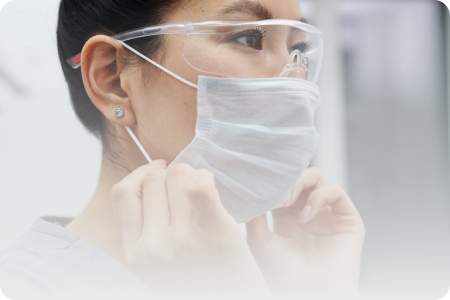
2. You should use gloves, special glasses or masks. It’s strongly recommended to change a mask one hour after using.
3. The disposable gloves are necessary. The double ones should be used if a patient is the source of infection.
4. There should be used medical surgical gowns and hats in case there is suspicion that the patient is infected.
5. It’s recommended to use a huge disposable plastic coverage for the stomatological chair and also to cover the patient with an apron to reduce the area of cleaning.
6. To eliminate the possibility of wounds, a dentist should be extremely cautious while taking the sharp instruments. Such as a scalpel, needles, drills. To put or to remove a sharp device, the doctor must use forceps or blood stopping clips.
Some extra recommendations:
1. For taking imprints from an infected patient or a potentially infected patient, a dentist should use a disposable moulding spoon. A plaster cast should be placed into a plastic bag. A technician, who is casting a copy, works in gloves. The pattern should be washed in natrium hypochloride during an hour after being separated from the copy.
2. Silicon plaster casts on the rubber basis should be previously washed in natrium hypochloride solution.
3. A prosthetic appliance containing no metals (including all the production stages) must be subjected to detergent purification to get rid of organic rests. Then it should be washed in hypochloride solution during 10 minutes before sending it to the laboratory. The stuff should be aware of danger in such cases and to wear gloves and special masks.
4. A special container is necessary for transporting the copies and prosthetic appliances in case they contain chromocobalt or steel, they are washed in chlorheksine, biglukonate or undiluted iodoform after a detergent cleaning.
5. Polishing and cleaning of prosthetic appliances belonging to the AIDs positive needs extra precations. A special scope of brushes and polishing agents should be used. They should be sterilized after each patient. The polishing and trimming lots are covered in plastic after each use
6. All the sterile instruments should be hold aside from the patient to prevent his or her indeliberate infection through infected drips as a result of coughing or sneezing. It has been found out that HIV by normal temperature is active on the dry surfaces for 3 days and on the wet ones for about 7 days.
7. The infected packages with X-ray films should be wiped with hypochloride solution before opening and developing them.
8. There should be used cofferdam for lower blood and mouth water dispersion and reduction of bacterias amount into the air.
9. All the tips used by the infected or those which may have infections must be sterilized.
10. Tooth and crowns polishing should be made with rubber cups and not with brushes to reduce the dispersion of infected particles.
The organization of a premiseof dental orthopedic laboratory
The opinion existing till now that dental orthopedic laboratory being in general polyclinic premises oshould be place in a semibasement or basement, is absolutely wrong.
In designing the construction of polyclinics, dyspensaries, private officies having in their structure a dental orthopedic laboratory for a significant amount of dental technicians, it is better to arrange several premises for 5-10 persons. As to subsidiary premises (casting, gypsum, polishing, modelling and polymerazation) they can be shared by all working in the dental orthopedic laboratory.
The height of the working premise should be not less than 3-3.5 m. Every technician should have not less than 13 m3of the area of the industrial premise and not less than 4 m2 of the area. In presence of local possibilities the cubic capacity of industrial premises per a tachnician can be increased.
Walls of the basic premise of the dental orthopedic laboratory should be smooth (without stucco mouldings). The covering of the walls should provide the possibility of easy approach for washing off of dirt, dust and soot. The walls should be painted in light colours.
Floors should be wooden (parquet is preferable), even and without cracks.
As to the windows it is necessary to take into consideration the following hygienic requirements:
1) the light coefficient (the relation of the glazed surface of the windows to the area of the floor) should be not less 1/3;
2) for more uniform distribution of light the windows should be situated whenever possible at equal distance one from another and from corners of the building;
3) the upper edge of the window should be as closer to the ceiling as possible (20-30 cm);
4) the window sashes should be narrow, more sparsed if possible; integral glasses without sashes are better;
5) the angle of falling of light rays, formed by a bunch of light and a horizontal plane, i.e. its descend should be not less than 25-27on the workplace;
6) workplaces should be located so that light fell on the left side of the workers;
7) the distance of workplaces from the windows in the premises illuminated by lateral natural light, should not exceed triple distance from the floor of the premise up to the upper side of the window; the limited width covered by the windows from two sides of the premise should be 15-18 m.
In planning the basic premise of the dental orthopedic laboratory it is necessary to provide a draft hood for fulfiling work on soldering, thermal processing of moulding, sleeves for crowns, melted wax from flasks for gold moulding, drying of the bridge dentures before soldering, bleaching of metal dentures in solutions of acids, etc.
In order to prevent blocking up of the industrial premise the draft hood should be placed in the wall alcove like a built-in closet. It is expedient to make a draft hood with overlapping in the form of the inclined slope with a double ceiling, the internal ceiling should be foraminous, and external – in one piece. Gas and steam get in interceiling space through holes in the first ceiling and are sucked away from it by special ventilating installation.
In equipment of the basic and subsidiary dental orthopedic premises it is necessary to provide special ventilating installations, supply of hot and cold water with mixing tap.
There must be enclosed electrical wiring of electric lighters and a technical network of the necessary section on each workplace.
The desktop in dental orthodontic laboratory should be of 75-80 cm in height so that it was convenient to work sitting at it. A small semicircular cutout is made in the centre of the desktop which edges are enframed insheet brass or stainless steel; the table surface at the distance of 20-22 cm from the middle of the cutout is also padded with steel; a wooden ledge is attached to the edge of the table .
In the centre of the table there should be one deep box for storage of tools, under this box there should be a plywood plate sliding in and out for collecting filings of gold and other metals as well as wastes of wax. There is the second box under the plate, it is less deep than the first one, it is for collecting wastes of plaster. Sideways there is a bedside-table with shelves where materials and constructed dentures are kept.
ANATOMY OF THE TEETH
By the structure the teeth are most close to the bone tissue, but exceed its hardness and durability. Three parts are distinguished in the tooth. The part which protrudes over the alveolus is called the crown. The part of the tooth hidden in the alveolus is called the root; the root is usually longer than crown almost twice. The border between the crown and root is called the neck.
The substance of the tooth basically consists of dentine, having bone-like structure and covered with enamel in the crown part and with cementum- in the root one. There is a cavity inside the tooth filled by a friable connecting tissue rich in vessels and nerves. This connecting tissue is called the pulp. In the crown part the size of this cavity is bigger, it is called the pulp chamber. The chamber becomes narrowed towards the root, getting a character of the canal. The pulp chamber repeats partly the external form of the tooth.
The following surfaces are distinguished in the crown of each tooth:
1. External, or vestibular(Latin: vestibulum – a threshold – a part of the mouth between the teeth and lips), participating in formation of the convex side of the dental arch. At the frontal teeth it is turned aside lips and consequently it is called labial, and at the lateral – aside cheeks and is called buccal
2. Internal, ororal, turned aside the palate, is called palatal on the upper teeth, and lingual – on the lower ones.
3) Surfaces of the teeth contact are called aproximal. The side turned forward is called medial, and turned backward–distal .
4) The surface participating in chewing or nibbling of food, is called masticatory (occlusal)at the lateral teeth and cutting edge – at the anterior ones.
The teeth contributing to grinding of food, have a wide masticatory surface with 3-5 tubers; these are big molars which were called masticatory teeth, or molars. The small molars contributing to crushing of food, are supplied with two tubers. These teeth are called premolars. The teeth, which role in chewing is reduced only to gripping and nibbling of food, have a masticatory surface in the form of a narrow edge, thanks to that they received the name of incisors. The teeth called canines have a narrow cutting edge in the form of a triangle.
During human life the teeth erupt twice. The first teeth are called decidious (milk) teeth. They erupt 20 iumber and, from 6-7 years of age, are replaced by permanent ones. Permanent teeth are 32 iumber, 16 on each jaw: 4 incisors, 2 canines, 4 premolars, 6 molars, of which the last two are referred to as wisdom teeth. The teeth are paired organs and located symmetrically in the jaw.
For marking teeth the dental formula is used. There are two variants of the widespread dental formulas. The standard formula is accepted on the territory of Ukraine consisting in figure marking of each tooth rendering its serial position in a dentition in relation to the midline. The right side is separated from the left one by a vertical line, and the upper dentition from the lower – by horizontal line:
8 7 6 5 4 3 2 1 1 2 3 4 5 6 7 8
8 7 6 5 4 3 2 1 1 2 3 4 5 6 7 8
In the WHO (World health organization) formula each tooth is marked by double figure. The second figure, as well as in the previous case, means a serial number of the tooth from the midline. The first figure means the angle of the maxillodental system.
1 – the right upper angle of constant bite.
2 – the left upper angle of constant bite.
3 – the left lower angle of constant bite.
4 – the right lower angle of constant bite.
5 – the right upper angle of milk bite.
6 – the left upper angle of milk bite.
7 – the left lower angle of milk bite.
8 – the right lower angle of milk bite.
So, for example, the formula presented above, would look in the WHO variant:
18 17 16 15 14 13 12 11 21 22 23 24 25 26 27 28
48 47 46 45 44 43 42 41 31 32 33 34 35 36 37 38
Separate teeth by their structure differ from each other by a number of peculiarities which should be known by dental technicians for correct modeling, selection and anatomic statement of a denture.
The shape of the teeth.
Incisors.All incisors have crowns of chisel-like shape. The labial surface of the upper incisors is slightly convex in the longitudinal direction and a little more in the transversal one. The palatal surface is closer to the cutting edge, flat or concave, and aside the neck is thickened and forms the convexity sometimes much expressed and called dental tubercle.
Roots of the upper incisors are massive enough and straight. Distinctive signs between the upper incisors of the right and left side are clearly marked. The medial half of the labial surface is more convex than distal; the medial angle of the cutting edge is straight, and distal – is rounded off. The upper lateral incisors differ from central ones by smaller size.
The lower incisors have the same shape as upper ones, but are considerably narrower. According to it their roots are also less flattened from the sides. The size of the lower lateral incisors is more than the central ones. The cutting edges of the lower central incisors are straight, and distal angles are a little rounded off in the lateral incisors.
Canines are the most powerful teeth of all group of the anterior teeth. They are located on the border between the anterior and lateral teeth and experience the masticatory pressure directed at different planes. Their roots are more massive and longer than in other anterior teeth. The labial surface of the canines is sharply convex, especially closer to the neck, and divided by the longitudinal protuberance going from the angle top at the cutting edge into two facets: medial and distal. The medial facet is narrower than distal and more convex in the transversal than in the longitudinal direction. The lingual surface is also convex and divided by the longitudinal protuberance into two slopes: medial and distal. The cutting edge of the canine is of triangular form, and the medial side is shorter than the distal; the top of the triangle is referred to the cutting tuber.Signs of the right or left side of the canines are clearly marked and determined by the cutting edge and facets on the labial side.
The lower canines are similar to the upper ones, but they are of less size, unlike the upper incisors their lingual surface is flat or slightly concave therefore their dental tubercle is expressed less distinctly.
The upper premolars are convex, both by labial and palatal sides in the longitudinal and even more in the transversal direction. The buccal surface of the first premolar is wider and higher than the lingual one and consequently the buccal tuber stands out above the crown level more than the lingual one. The masticatory surface has a quadrangular form, and the lateral side is wider than internal, and angles are slightly rounded off. There are two tubercles on the masticatory surface divided by a transversal sulcus. In the first premolar the sulcus is not symmetrical, and is closer to the palatal tuber that’s why the buccal tuber is bigger on the masticatory surface than on the lingual.
The second premolar differs from the first one by equally expressed tubers.The lower premolars differ from the upper ones both in the shape and size. Their crown in a cross-section looks like the outline of a circle. The lingual tuber of the first lower premolar is poorly developed, buccal one is rounded off and inclined aside the oral cavity. Facets on the buccal side are well expressed, and medial facet is narrower than distal one that allows to distinguish easily the teeth of the right and left side.
The second lower premolars are larger than the first ones, their tubers are equally developed, and the form of the masticatory surface comes nearer to a square.
The premolars have one root, except for the first upper one which in most cases has two roots – buccal and palatal. Sometimes two roots may be in the second upper premolar.
The upper molars have massive crowns of diamond shape, and medially- buccal and distal- palatal angles are sharp, and opposite to them are blunt. Their palatal surface is more convex than buccal. On the buccal surface there are two convexities located in the longitudinal direction (according to two buccal tubers on the masticatory surface), and one transverse convex is located about the middle of the tooth, a little closer to the neck.
On the masticatory surface there are four tubers, the largest is medially-palatal. The palatal tubers are rounded off, and buccal are pointed and turned aside.
The second upper molars are similar in the shape to the first ones, but a little smaller. The upper molars have three roots: two buccal and one palatal.
The lower molars have a cubiform. Their buccal surface is convex both in the longitudinal and transversal direction and is more convex than lingual. The greatest convex is located in the lower third of the tooth (close to the neck).
There are five tubers on the masticatory surface of the first lower molar: three buccal and two lingual. The buccal tubers are rounded off, and lingual ones are sharper. The largest tuber is medially-buccal.
The second lower molar is a little smaller than the first one, and also has four tubers of almost identical size.
The lower molars have two roots: medial and distal. Wisdom teeth are of irregular shape and sometimes are absent. The amount of their roots is variable.
ANATOMY OF DENTAL ARCHES.
Dental arches are teeth and alveolar processes divided by bone septums into separate cells. A conditional line made through certain surfaces of the teeth, alveolar processes, or bone sockets is also called a dental arch. According to this we distinguish: basal dental arch (passes through the tooth neck), occlusal (passes through the occlusal surfaces and cutting edges of the teeth), vestibular dental arch (through equators of the teeth on the vestibular surface), oral dental arch (through equators of the teeth on the oral surface).
Sagittal compensatory curve. A number of occlusal surfaces of the masticatory teeth and their arrangement in the dentition form the curve having sagittal direction and calling occlusal curve Speie, named by the author who has described this phenomenon for the first time.
This curve on the mandible is concave, and on the contrary, on the maxilla it is convex from top to bottom. Uniqueness of this curve consists in pushing forward the mandible before contact of the incisors with cutting edges (anterior occlusion), at least two contacts of the masticatory teeth (on the right and left) are kept. That is there always will be triangle contact. This feature of the curve is called Bonwill triangle. This curve is a part of the conditional circle which centre is in the eye-socket. The circle radius as well as Speie curve is approximately 60 – 70 mm. Expressiveness of this curve depends on a degree of overlapping of the anterior teeth. The more frontal overlapping, the more sharply the dental arch is bent in the sagittal direction. The Speie curve is more flat, the smaller is the angle between a tangent to it and a horizontal plane.
Occlusal curve.It begins at the medially – buccal tuber ofthe first premolar and ends at the distal tuber of the third molar of the mandible. This curve is caused by a deviation of roots to the lateral sides. Accordingly crowns on the maxilla disperse fanlikely, and roots converge in one point. This phenomenon gives additional lateral stability to a dentition. Besides, each tooth gets additional fixation from its neighbour.
Transversal (cross-section) compensatory curves. Simultaneously with presence of the sagittal occlusal curve on each masticatory tooth there are also tubers arranged on the curve in the transversal direction. These curves are called transversal compensatory curves as they provide contacts of dental tubers in lateral movements of the mandible. They are formed as a result of different levels of the buccal and palatal tubers, both on the maxilla and mandible. Such position accounts for inclination of the masticatory tooth crowns towards inside on the mandible, and towards outside – on the maxilla.
Thus, sagittal curvature of the dental arches gives the masticatory teeth stability in the anteroposterior direction, and the inclination of crownsof these teeth in the buccal-palatal direction creates conditions for their stability in the lateral direction. It should be noted that stability of the dental arches is also supported by thickenings (counterforce) of the maxillary bones, by internal and external oblique lines on the mandible, and the thickening going to the zygomatic arch – on the maxilla.
Teeth (singular, tooth) are structures found in the jaws (or mouths) of many vertebrates that are used to tear, scrape, and chew food. Some animals, particularly carnivores, also use teeth for hunting or defense. The roots of teeth are covered by gums.
Teeth are among the most distinctive (and long-lasting) features of mammal species. Paleontologists use teeth to identify fossil species and determine their relationships. The shape of an animal’s teeth is related to its diet. For example, plant matter is hard to digest, so herbivores have many molars for chewing. Carnivores, on the other hand, need canines to kill and tear meat.
Humans are diphyodont, meaning that they develop two sets of teeth. The first set (the “baby,” “milk,” “primary” or “deciduous” set) normally starts to appear at about six months of age, although some babies are born with one or more visible teeth, known as Neonatal teeth. Normal tooth eruption at about six months is known as teething and can be quite painful for an infant.
Dental anatomy is a field of anatomy dedicated to the study of tooth structures. The development, appearance, and classification of teeth fall within its purview, though dental occlusion, or contact among teeth, does not. Dental anatomy is also a taxonomical science as it is concerned with the naming of teeth and their structures. This information serves a practical purpose for dentists, enabling them to easily identify teeth and structures during treatment.
Review and inspection of person
Because of the ethics considering, it follows to conduct the external review of person unnoticed for a patient during a talk. In the process of inspection anatomic descriptions, morphological and functional features of person, are studied. Criteria which make an aesthetically beautiful optimum concerne thus: type of person, symmetry of right and left halves of person, vertical size of lower department of person, expressed chin and nosolabial skinnings furrows, correlation ofoverhead and lower lips, position of corners of mouth, size of baring of crowns of the teeth during broadcasting and smile, degree of opening of mouth.
The face of the grown man has individual lines, on forming of which the developed of cerebral department of skull, bone and muscular systems of masticatoryvehicle influences. It is accepted to select four types of person.
Cerebral – is characterized by considerable development of bones of neurocranium. The high and wide frontal department of persootedly prevails above other departments, as a result a person reminds the form of pyramid with the basis aimed upward.
Respirator – is characterized to predominances of development of middle department of person. Strongly the developed genyantrums, temples arcs relief come forward ahead, and that is why a person has a diamond-shaped form.
Dihestiv – is characterized by considerable development of lower department of person. Overhead and lower jaws are superfluously large, a masticatory musculature is strongly expressed. At presence of narrow frontal part a person reminds the form of trapezoid.
Muscle – is characterized by the approximately equal sizes of overhead and lower departments of person, border of hairs in the area of forehead usually line which gives to the face of square form.
It is needed to mean, that the face of man is disproportionate, however guilty the asymmetry of his halves, predefined by the different degree of development of the symmetric located anatomic educations, is not to be considered as deviation from a physiology norm. Asymmetry of person is obviously expressed is observed at the inflammatory and tumular processes of maxillufacial area, violation of innervation of masticatory and mimic musculature and as a result of traumatic damages.
In the clinic of orthopaedic stomatology dividing of vertical size of person is accepted by three parts: overhead, middle and lower third. The overhead third of person is located between the border of growth of hairs on a forehead and line which connects eyebrows. The middle third of person is distance between a line, which connects eyebrows, and basis of skinning membrane of nose. Basis of skinning part of membrane of nose and lower edge of chin serve as the scopes of lower third of person.
Hem of height of person on three parts it follows to acknowledge conditional, as positions of scopes, which measuring individual enough and during life changes is carried out in accordance with. Yes, the overhead third of person with age can be multiplied due to moving of border of growth of hairs on a forehead. The height of lower third of person also is not permanent and depends on the type of closing and stored of teeth. Least changeable middle third of person.
Without regard to that between the sizes of the indicated parts of person it is heavy to see an appropriate proportion, in most persons they have relative accordance which provides an aesthetically beautiful optimum.
The large practical value is had by the anatomic features of lower departments of person. The expressed of chin-lip furrow allows to assume the presence of supraocclusion, dystal displacement of lower jaw with diminishing of vertical size of lower third of person as a result of loss of lateral teeth or their pathological rubbing off . About the same the formation of jam testifies in the corners of mouth. Falling back of lips testifies to absence of frontal group of teeth, and in combination with the expressed nosolabial furrows – about the complete loss of teeth or considerable degree them rubbing.
Such rejections are set in the process of review obligate to conduct measuring of linear sizes of height of lower department of person, that it is important enough for constructing of removable prosthetic appliances. It is accepted to distinguish two vertical sizes of lower third of person: height of relative physiology rest and occlusal height. The height of relative rest is characterized by that muscles which lift and drop a lower jaw as well as mimic, are in the weak state, and between teeth there is a road clearance. At the dense closing of dental rows muscles which levitate a lower jaw become taut in position of central occlusion (occlusal height).At the physiology types of bite the difference of vertical size of lower department of person in relative physiology rest and centrally-occlusal correlation of jaws makes 2-6 mm.
The attentive review of person allows to set carried before or concomitant general somatic illnesses: presence of scars in the area of overhead lip, which touchthe red framing, testifies to the operation concerning the nonunion of lip. Dryness of skinnings covers and presence of original grasping folds of skin in the area ofoverhead and lower lip with diminishing of size of mouth crack allows to assume a presence at the patient of system scleriasis, scars is investigation of thermal and chemical burns – condition necessity of decision of structural features of dentures and medical vehicles and clear determination of all medical manipulations, beginning from the method of preparing of teeth, features of receipt of imprints to the method of introduction and fixing of prosthetic appliances in the cavity of mouth.
A review and inspection of teeth must be conducted in the set procedure, beginning from the wisdom tooth of one side to the of the same name tooth of the second side. Thus does not have the of principle value, from what jaw to begin a review (overhead or lower), and direction of review (business or on the left) ofexamination teeth is conducted by the surveying set of tools: stomatological mirror, pincers, probe. Application of mirror allows to examine every tooth from every quarter, by pincers determine mobile of teeth, a probe serves for establishment of safety of surface of crown of the tooth, sensitiveness of areas of tooth, depth of tooth – gum groove or perіodontal pocket. The estimation of teeth consists of position-finding tooth in a dental arc, form, color, state of hard fabrics of crown part (presence of stoppings and artificial crowns), firmness of tooth, correlation of retroalveolar and intraalveolar his part. Deviation of tooth from normal position in a dental arc is one of symptoms, what allow in the complex objective and anamnestic data analysis to set, a tooth deviated from the initial position or it is his individual (anomalous) position. Distinguish displacement of teeth in an intact dental row, at the defects of dental rows and as a result of wrong his eruption. Directions of displacement of teeth in the formed tooth – jaw system are varied enough: in vestibular or oral direction, in medial or distal in vertical direction (below or higher occlusal plane of dental row), turn of tooth about vertical axis (rotary displacement). The change of position of tooth set during a review in any direction is the symptom of different illnesses of the tooth – jaw system and needs lead through of additional (special) researches with the purpose of establishment of mechanism of his displacement.
Studying character, topography and degree of defeat of hard fabrics of tooth, it is necessary to lean against the knowledges of anatomic form of every explored tooth, comparing with got during the inspection by information. More frequent in all the form of tooth is changed as a result of cariosity, when demineralizing and softening influence of hard fabrics is with subsequent formation of defect. Localization and frequency of defeat of different teeth is different. The study of localizationof defeat of different groups of teeth (Blac) allowed to find out certain conformities to the law.
Reason of violation of form of teeth can be the uncarious defeats: hypogenesis of enamel, hyperplasia of enamel, displasia.
At a system hypogenesis chisels take barrel likeness shape with the half of moon undercut on a cutting edge (teeth of Furn’e, Hetchynson), and molars – characteristic cone-shaped form (teeth of Pfluger). Hyperplasia of enamel shows up to surplus formations of fabrics of tooth in the area of neck, and also on contact surfaces. Sharply the form of tooth changes at displasia of Staton – Kapdepon. Through the inferior structure of hard fabrics of teeth soon after their eruption an enamel breaks away and there is elimination of teeth.
Frequent reason of change of form of teeth is pathological rubbing, that is characterized to the considerable diminishing of hard fabrics, and wedge – shaped ( V – shaped) defects, which appear in the near neck area of vestibular surface of premolars, canines, chisels. If in the process of review found out the teeth of the changed color, they are subject to the detailed study. The color of natural teeth has individual features which are investigation of stratification of colouring of enamel on colouring of dentine. A dentine has yellow of different tints. Color of enamel is white with yellow, blue, rose, grey by tints or with their combination. That is why the threshold surface of foreteeth has three coloured nuances: the cutting edge of foreteeth, which does not have dentine – layer, is often transparent; middle part which is covered by more thick layer of enamel and does not enable to be translucent to the dentine is less transparent; iear neck part the layer of enamel is thinner and a dentine through him examines with x-rays stronger, that is why this area of crown of the tooth has the expressed rather yellow tint.
At young persons the color of teeth on the whole is lighter, at adults, especially old people, he has more expressed rather yellow or greyish tint. In special cases, in particular in those, who burns, different pigmentations and atypical discolorations teeth appear. The color of tooth can change and depending on the degree of cariosity: disappearance of natural brilliance of enamel, chalky spot, colouring of carious spot from grey to the umber tones. As a result of application of amalgam for treatment of caries the color of tooth can change oavy blue, and from the use of plastic materials – on an umber. The enamel of teeth a vascular-nervous bunch (teeth pulps) is remote in which loses brilliance and acquires a greyish-yellow tint. At a fluorosis the mat appear on teeth, light – or umbers areas of pigmentation. In future there is formation of erosions on these areas of enamel.
For the inspection of teeth widely use the methods of percussion, sounding and palpation.
Percussion is conducted in the opened mouth of patient by the easy pattering by the handle of probe on different areas occlusal (axial percussion) and threshold (angular percussion) surfaces of tooth.
Percussion of healthy tooth is not sickly and is accompanied by a clear sound loud. In case of occurring of changes in mash and perіodont, force and tint of sound change to resorbtion of bone fabric and fibres of perіodont. By this method determine the state of peryapical fabrics after expressed of the pains feelings, which arise up in reply to the easy shots on a tooth, directed to apex or under a corner to his crown part. In the case of origin of pain from the shots of small force it is not needed farther to multiply effort. After sounds which arise up from pattering, it is possible to define the state of endodontium also. Percussion of tooth with the lost mash, pulp with the sealed channel gives the muffled sound, unsealed – tympanic, that reminds a sound from a blow on a drum.
With the purpose of establishment of differences in the pains feelings and voice vibrations conduct comparative percussion, that percussion of the same names teeth on the right and left side of jaw. At presence of the extended perіodontal crack at axial percussion a blunted sound is heard. Circumstance that axial percussionof healthy tooth gives more hard and loud sound, than angular, testifies to the role of fibres of perіodont in the transmission of vibrations on bone fabric, as at angularpercussion the areas of fibres, which work here on tention, are attracted. A blunted sound arises up at violation of circulation of blood in perіodont. Fillings fabrics out as though take in sounds. At the chronic pathological changes in a apical area, as a rule, dulling of sound appears at angular percussion. Dulling of sound and pain from appear in the case of peryapical and margіnal inflammation, death of dense bone fabric of walls of teethridges.
Soundings apply for determination the depths of carious cavity, degree of softening influence of hard fabrics, for the study of the state of parodont after the second index – state of perіodontal crack at presence of under gum stone.
Palpation is applied for determination of mobile of teeth. This manipulation can be carried out by pincers, probe. The presence of mobile of teeth is the sensible indicator of the state of parodont, symptom of row of illnesses (parodontitis, perіodontyt, sharp and chronic trauma). Distinguish physiology and pathological mobile of teeth. First is natural and unnoticeable. its presence is confirmed to eliminations of contact points and formations of blivets. The pathological mobile is characterized to displacements of tooth from small efforts.
De bene esse distinguish four degree of pathological mobile of teeth: And degree is a tooth moves in vestibal -oral direction; II degree is a tooth moves in vestibal-oral and medial-dystal directions; III degree – to the first two is added vertical mobile of tooth; The IV degree is rotary motions of tooth.
The results of review of teeth bring in a dental formula, following the generally accepted denotations.
The estimation of the state of dental rows of overhead and lower jaws consists in determination of form of dental arcs, amount of present teeth, slowness and topography of defects (substituted for teeth by prosthetic appliances or not), position of every tooth in relation to an occlusal plane, and also in setting of type of bite.
The estimation of the state of dental rows of overhead and lower jaws consists in determination of form of dental arcs, amount of present teeth, slowness and topography of defects (substituted for teeth by prosthetic appliances or not), position of every tooth in relation to an occlusal plane, and also in setting of type of bite.
At a direct bite overhead and lower dental rows have the form of semiellipse. For physiology progenia and physiology prognatia on a background the normal semiellipse of structure of dental row of supramaxilla the frontal area of arc has the forerake accordingly and back.
In the correctly formed tooth – jaw system dental rows make unique whole both in the morphological and in functional relations. Unity of dental row is provided by the between teeth contacts, alveolar sprout, parodont and is unique from the basic terms of valuable function of teeth. The extraction of teeth and appearance of defects in a dental arc result in violation of its continuity, and a dental row here disintegrates on the groups of teeth, which keep antagonists, continuing to execute the function (functional group), other, losing antagonists, appear by excluded from the act of mastication (non-working group).
Setting absence of tooth (teeth), it is necessary to find out reason of loss. Violation of continuity of dental row can be predefined by absence of rudiments of thesecond teeth (primary, an adentia is innate), by the presence of defects in the area of teeth which were not cut through (uneruption teeth). Teeth can be remote after eruption for diverse reasons: caries and his complication, parodontitis (parodontosis), trauma, operative interferences on jaws and other On occasion there are the anomalies of amount (supernumerary teeth) or position (excalation of jaws) of teeth. Similarly there can be the set presence in the formed dental row of teeth of temporal bite.
The large value in diagnostics of the state of dental rows is had by information about a slowness and topography of defect, and also about the presence of neighbouring natural teeth. After a slowness distinguish: small defects are absence not more than 3 teeth; middle from 4 to 6 teeth; large defects, when more than 6 teeth are absent. After the presence of teeth neighbouring with a defect: limited by teeth both-side (included) or from one side (eventual). After the location: included in front, lateral or front – lateral areas of dental row. Variants of absent teeth there can be a generous amount.
In order to systematize the most widespread defects of dental rows, estimate the degree of related to them morphological and functional violations, it is offered a lot of classifications. But classification of Cannadi became most acknowledged, topograhpo – anatomic principle is fixed in basis of which. Development of such classification was predefined to aspiring to the fast and exact diagnostics of violations of dental rows with the purpose of determination of testimonies to the choice of constructions of prosthetic appliances at the different types of defects. An author distributed the defects of dental rows on four basic classes.
The class I. Two – sides, toothless areas the jaws located behind from present natural teeth.
Class II. One-sided toothless area of jaw, located behind from present teeth.
Class III. Toothless space of lateral areas of jaw, limited by present teeth at the front and behind.
Class IV. Toothless space located at the front from present teeth, which crosses the middle line of jaw.
With the purpose of clinical evaluation of correlation of teeth in relation to an occlusal plane: at the parted lips by index fingers take the corners of mouth sick so that from of the red framing of overhead lip central chisels came forward no more than on 0,5 sm, fix the look (the eyes of doctor which stands before a patient are at the level of the parted lips of patient) on verge of central chisels. Thus all dental row of maxilla gets in eyeshot. Imaginary conduct a plane, parallel camper horizontal lines (line which de bene esse connects lobe of the ear of ear with the lower edge of wing of nose), estimate present curvature on an occlusal surface and accordance to his norm or determine displacement downward or upwards in relation to this surface in the group of masticatory teeth. This method is used on condition of absence of rubbing of foreteeth.
It is needed to consider the violation of smoothness crooked, caused by displacement of tooth or row of teeth upwards or downward in relation to neighbouring teeth, a diagnostic symptom. It is the phenomenon which is named the phenomenon Popova – Godona, more frequent in all meets as a result of loss of antagonists. Curvature of occlusal surface can come and at intact dental rows, when part of antagonist teeth is added rubbing (a form is noncommunicative) or the closing surface of teeth is stopped by plastic materials. In these terms simultaneously with elimination of hard fabrics or stopping material there is moving of antagonists teeth. The similar symptom of deformation of dental rows can be set at treatment of partial edentia by removable prosthetic appliances from a plastic or in those cases, when occlusal surface metallic to framework of bridge- likeness prosthetic appliance metal-lined by a plastic. For the exposure to deformation of dental rows conduct comparison of levels of location of neighbouring teeth, estimation of all occlusal plane during the review of dental layer from the side of frontal teeth.
Not coincidence of line of center – vertical between the central chisels of overhead and lower jaws – can be the symptom of different illnesses: defeat of right or left temple – lower jaw joint, break of jaws, pathological alteration in dental rows through the partial loss of teeth, presence of masticatory teeth only on one side.Location of cuttings edges of chisels, and sometimes and dog-teeth of supramaxilla below red framing of lips, considerable their baring during a talk testifies to their moving apeak or vestibular as a result of pathological processes which take place in a paradontium. Displacement in vestibular direction, as a rule, is accompanied to formations of diastem and trem, and teeth as though move aside an overhead lip upwards. Such displacement can result in formation of the opened bite or stipulate moving of lower chisels upwards.
The large diagnostic value has determination of stored of occlusal surface and in the group of masticatory teeth. At orhognatical and biprognatical types of bite and physiology progenia is observed smooth curvature of line of dental row, beginning from first premolar (sagital “curve of E. Shpee“, 1890). On a supramaxilla the line conducted on vestibular or oral knolls and intertubercular furrow forms the segment of circle, reverse downward. Accordingly the same curvature appears in the group of masticatory teeth of lower jaw. The level of these curves is different through inclination of crowns of the teeth in relation to the horizontal plane of location of vestibular and oral knolls, that predetermines the presence of transversal of curves (“curves E. Shpee“, 1918). A sagital curve at a direct bite is absent. This it should be remembered and to interpret not as pathology.
At the defects of dental rows of displacement in vertical direction it is possible to set at serried dental rows, when teeth which lost antagonists are below occlusal surface of antagonist of dental row (or below occlusal line of closing of dental rows). In cases of elimination of teeth-antagonists and absence of elimination or considerably less elimination of teeth, deprived antagonists, crossing by these teeth of occlusal line is not proof of displacement of tooth (teeth), as deformation of occlusal surface is diagnosed due to pathological rubbing.
Displacement of teeth serves as the symptom of deformation of dental rows in medio – distal direction at the partial defects of dental rows, which is named convergence.
Such deformations are characterized by the complex of symptoms: by the change of axis of inclination of crown part of tooth, diminishing distances between teeth, which limit a defect, by appearance of trem between teeth, which abut upon a defect (more frequent between teeth, located medial from a defect), violation of occlusal contacts of teeth, which also abut upon a defect. Sometimes defects in dental rows predetermine rotary displacement of teeth, that moving them about long axis from it is enough to variation violations of occlusal contacts. Estimation of articulating and occlusal correlations of dental rows consists of information about character of motions of lower jaw.
Implementation of basic functions of the teeth – jaw system is related to different character of motions of lower jaw. In default of contact between dental rows motions of lower jaw are sent by brief muscles and articulating surfaces of joints. When dental rows are in the contact, and a jaw moves, character of its displacement mainly concernes by correlation of surfaces of masticatory teeth.
Motions of lower jaw are provided by retractive activity of different groups of masseters on the basis of difficult compounded pavlovian and unconditioned reflexes. As a result of work of muscles a lower jaw moves ahead, back, goes down, rises, is displaced sideways and is gone back into previous position.
Studying displacement of lower jaw as a result of opening and closing of mouth, it is needed expressly to determine linearness of displacement is a line between the central chisels of supramaxilla does not deviate from the same line on a lower jaw. Deviation from linear displacement on the stages of the slow opening and closing of mouth testifies to the pathological processes in a joint (disfunctions, arthritis, chronic dislocation, tention connection of joint) or in the muscular system. Partial loss of teeth (especially masticatory), pathological rubbing predetermines violation of occlusal correlations. Inspecting dental rows in relation to occlusia, it is possible to set that the chisel ceiling is megascopic, and in parts of teeth not two, but one antagonist (the canine of lower jaw contacts only with the canine of supramaxilla). In determination of displacement a diagnostic value is had also by diminishing of the chisel ceiling and establishment in the correct (without the occlusal contacts) contrasting of canines lower jaw and other teeth in relation to the antagonists of supramaxilla in position of lower jaw in physiology rest, and at the slow closing of dental rows there is at first closing of group of frontal teeth (contact on the fasings of closing) with subsequent displacement of lower jaw back and multiplying the chisel ceiling.
It is especially important to estimate evenness and simultaneity of closing of dental rows at the central occlusal contact and presence of numerous contacts during occlusal motions of lower jaw. The exposures on the separate teeth of areas, which at occlusia enter the first into the contact, conduct by sight at the slow closing ofdental rows and stage-by-stage displacement of lower jaw from position of central occlusia in lateral or front occlusia.
Information about the areas of concentration of pressure it is possible to get by occlusiogramme. In the case of establishment of unevenness of contacts together with other symptoms it is possible to find out the source of origin of illness or one of factors: parodontitis, perіodontitis, illness of temple – lower jaw joint. The concentration of occlusal contacts (concentration of masticatory pressure) can be created due to the wrong imposed stoppings, off-grade made crowns, bridge – likeness prosthetic appliances. In addition, she arises up at uneven rubbing of natural teeth and rubbing of false plastic teeth in dentures.
INTERVIEWS WITH PATIENTS
(finding out of complaints, collection of anamnesis)
The first stage of diagnostic research is interviews with a patient, during which reasons of his appeal turn out in a clinic (complaints, subjective feelings), firstsigns of illness (anamnesis of illness), state of health and condition of life (anamnesis of life).
At the beginning of conversation it is necessary attentively to hear out the complaints of patient, his explanation of reasons and character of development of the unusual feelings (subjective symptoms). Subjective information is found out from the story of patient help to define the circle of questions which are based on the first suppositions about character of illness. Timely clarification of separate moments due to the concretely put questions and answer on them allows in future to ground authenticity of complaints and feelings of patient, and also confirm or deny arising hypotheses up.
In the process of dialog symptoms which characterize deviation from a physiology norm and its variants appear with a patient. Summing up and logically comprehending found out the phenomena, defining leading symptoms, it is necessary to confront them with symptoms of the known illnesses.
However especially the classic displays of illnesses meet rarely, more frequent there are the different rejections and combinations of symptoms. The individual reaction of organism acts important part in the change of classic charts of symptoms of illnesses. Exactly she predetermines the necessity of receipt of exhaustive information about the origin and development of illness. It is needed to set: when, as well as under act of what reasons, in opinion of patient, illness began, what motion she had in the moment of appeal in a clinic, whether some treatment was used, which was his efficiency. In detail find out the first signs and displays of illness.
During conversation it is important to set the contact with a patient, to make attempt understand him as personality and to conquer the trust. That is why it follows to pay the special attention to the specific of exposition by the patient of complaints. It will help to make the picture of features of his psyche.
Clinical experience testifies that individual reaction on perceptible subjective symptoms and interpretations of visible sick clinical displays of illness predefined, above all things, by natural properties of psyche, that by temperament. Temperament belongs to the borning internalss of personality of man and concernes by the processes of nervous excitement and braking (by their force, even tempers and mobile). Different combinations of these properties allow to select four basic types ofhigher nervous activity: sanguine, phlegmatic, choleric and melancholy.
A sanguine type is characterized by the strong balanced and mobile nervous processes of excitation and braking. Sanguine type is easily included in the contact, in intercourse; as a rule, optimists. These people adequately perceive said, insistingly and expressly execute all advices and settings of doctor.
For a phlegmatic type the characteristic strong are balanced, but inert nervous processes. To the phlegmatic persons peculiar proof mood, quiet motions and the reaction is slow on the different influencing. They are balanced enough people, but heavily enter into the contact. With them it is necessary in detail and convincingly to converse.
A choleric type is characterized by strong and unstable nervous processes with predominance of excitation. Temperamental persons have the strong nervous system, but impatient, sometimes unrestrained and feverish. They are littlepin, difficult in intercourse.
In a talk with them it is necessary to be restraint, to talk, weighing every word. It is important enough for such man foremost patiently to hear out her, blow about its negativism and try to satisfy of its possibilities.
A melancholy type has weak nervous processes, strong dormancy which arises up under act of strong irritants. Melancholic persons are people with a weak and impressionable psyche. They usually need permanent support, is easily added to suggestion.
Application of such receptions of socializing with a patient and influence on him, without regard to the generalized character, in a great deal determines tactic of medical actions in the process of diagnostic research, final success and prognosis of orthopaedic treatment.
On the origin and character subjectively of perceptible social and natural terms, state of health and vital circumstances, influence by the patient of symptoms.These factors can unfavorable to influence both on an organism on the whole and on the tooth- jaw system in particular. That is why the special value is acquired by information about the presence of general symptoms, inherited and carried illnesses, ecological and productions to harmfulness, usual intoxications and harmful habits. The story of patient and his answers to these questions considerably correct the picture of reasons and terms of development of concrete illness, and also dictate the choice of tactic of orthopaedic treatment.
Thus, on the basis of the set subjective and anamnestic information, logically comprehending found out the phenomena, it is necessary to draw previous conclusion about the presence of that or other form of illness, to come to certain suppositions about its character. Arising up as a result of interviews with the patient of supposition (hypotheses) is instrumental in the purposeful leadthrough of subsequent researches and receipt of exhaustive information about illness.
EXAMINATION OF THE PATIENT IN CLINIC OF ORTHOPEDIC DENTISTRY
The increased course of preclinical training in orthopedic dentistry is aimed not only at studying anatomy and physiology of the organs of the dentomaxillary systems, but also at deeper mastering of the practical skills, and thus at general improvement of training quality of dental students.
Orthopedic treatment of patients is given for final restoration of the maxillodental system, reconstructions of the lost form of some organs of this system, their functional interrelations.
The maxillodental system is organs and tissues interconnected functionally by anatomy, performing various but co-ordinated functions. It contains the hard tissues – bones of the facial skeleton, including the maxilla and mandible, masticatory and mimic muscles, salivary glands, temporomandibular joint – a paired organ – mobile connection of the mandible with the temporal bone of the skull.
In the correctly formed maxillodental system the structure of each organ is precisely coordinated with its function. The compensatory process that is compensation of the impaired function due to activity of the intact organs begins to develop in the damaged maxillodental system, for example, influence of the environmental factors on an organism: physical, chemical, biological, social, with genetic defect or under the effect of local factors. But the compensatory process has a limit which is followed by rather steady deviation from the norm, having biologically negative meaning for an organism, resulting in development of a disease.
Each disease is characterized by certain signs or a group of symptoms. There are subjective and objective symptoms.
Subjective symptoms are symptoms revealed while questioning the patient, the unusual sensations which the patient began to experience. For example, difficulty in chewing food, pain, itching in the gums, dryness in the mouth, retention of food between the teeth, etc.
Objective symptoms are found by the dentist during examination: inspection, palpation, instrumental and apparatus investigation.
Sometimes it is necessary to apply functional methods of investigation to find out the function of the maxillodental apparatus: chewing tests, graphic records of movements of the mandible, investigations of the muscle biocurrents, etc.
A disease can be manifested by one or several objective symptoms, one of which is characteristic only of the given kind of the disease, and others may be observed in other diseases. Examination of the patient is also aimed at making clear the symptoms, etiology and pathogenesis, course of the disease, his physical and mental condition, function of themaxillodental apparatus. Careful and thorough clinical examination of the patient will promote correct diagnosis, purposeful orthopedic treatment.
While examining the patient, the dentist should know precisely significance of physiological norms, possible variants of the structure and functioning of separate organs of the maxillodental system, topography and functional interrelations. Thus he should not only detect the signs, but also be able to interpret them logically, determine the leading symptoms, basing on the examination of the patient. So the dentist should know well all sections of dentistry, a clinical picture of every nosologic form of the maxillodental system.
Examination of the patient is made consistently under a certain plan and includes: the anamnesis (questioning of the patient), external survey, survey and examination of organs of the oral cavity; examination of the temporomandibular joint; examination of the muscles of the head and neck, laboratory and instrumental methods of investigation.
SUBJECTIVE METHODS OF INVESTIGATION
Taking the anamnesis is the first investigation phase of the patient. The anamnesis consists of the following sections: 1) complaints and subjective condition of the patient; 2) anamnesis of this disease; 3) anamnesis of life of the patient.
During the first visit of the patient the dentist listens attentively to the story of the patient about unusual sensations (complaints) which he began to experience. It is important to find out the earliest manifestations of the disease, character and peculiarities of its course, to know the cause of unusual sensations in patient’s opinion. In one case the anamnesis may be very brief and there is no necessity to go into detailed history of the patient’s life, in other cases, for example, when the patient has a feeling of burning in the mucous membrane of the oral cavity under the denture , the anamnesis and all investigations will be detailed with the use of apparatus and laboratory methods with participation of doctors of other specialities.
It is necessary to listen to the patient attentively and patiently, at the same time concentrating his attention to the main, from his point of view, sensations, correctly specifying some moments by purposefully asked questions. All this can determine questions which are required for statement of the diagnosis, special or additional methods of investigation.
While listening to the complaints of the patient it is necessary to pay attention to response of the patient in statement of complaints. It will help to get idea about the type of his nervous activity that is of great importance in choice of construction of a denture and the subsequent adaptation to wearing it, to faster establishment of mutual contact between the dentist and patients.
During inspection it is important to obtain data about the onset of the disease, the cause of its development, its course before referring to the dentist, what treatment was applied, if it was, it is necessary to find out a kind and scope of the treatment.
In some diseases it is difficult to establish the cause of their development. So, for example, pain, burning in the mucous membrane of the oral cavity under the denture can be caused by a badly made denture, a mechanical trauma or allergic reaction to the basic material. The same character of pain are observed in glossalgia, impairment of heat exchange in the tissues of the orthopedic bed, diseases of the gastrointestinal tract. Hence, pain may be caused by various causes, the mechanism of its development is also different.
Sometimes during questioning it is possible to establish that deterioration of a condition of the maxillodental system occurred during some general disease or after it. Then there is a question, whether the revealed disease is independent nosologic form or is one of symptoms of other diseases (stomach ulcer, gastritis, diabetes, etc.). Therefore it is important to assess the general condition of the patient.
The anamnesis of life. The anamnesis of life is a“the medical biography” of the patient. It is of great significant for understanding the causes, conditions of development of the present disease. For example, data about feeding (formula feeding, the use of the soft grated food during formation of milk and replaceable bite) can presumably specify the cause of abnormal development of the maxillodental system.
The birthplace, peculiarities of the environment (lack or excess of fluorine in water) may be the cause of noncarious affection of the teeth in some people.
Harmful working conditions, such as work connected with manufacture of acids, alkalis, coal-mining industry can promote development of pathological abrasion of the teeth.
It is important to find out the sustained illnesses and presence of general somatic diseases at the moment of inspection as they also can promote development of pathological changes in the maxillodental system. The knowledge of their course peculiarities will also help the dentist to choose correct tactics in orthopedic treatment. So, in diseases of the cardiovascular system (myocardial infarction, stenocardia, insult) such injuring factor to this system as preparation of the teeth should be eliminated and it is better to recommend prosthesis by removable dentures. In presence of bronchial asthma, it is impossible to apply the materials having smell for taking inpressions (repin, thyodent, dentafol). They also should not be made relocation of the denture directly in the oral cavity. Otherwise it may cause an attack of asthma. Thus, on the basis of the anamnesis and subjective data of the patient, the dentist makes a presumable conclusion about the character and form of the disease. It is a working diagnostic hypothesis, which will promote the further purposeful investigation to specify the assumptions.
OBJECTIVE METHODS OF INVESTIGATION
Detailed inspection of all organs of the maxillodental system is made for specification of the assumption of the disease and for better understanding of the disease. Data of the objective inspection reject or increase reliability of the assumptions of the disease. The objective inspection includes: external survey, survey and examination of organs of the oral cavity, radiological and laboratory (the analysis of blood, urine, saliva, smears and biopsy material, myography, rheography, etc.) methods of investigation.
The objective methods of investigation are used, while going on questioning the patient as it is important to know subjective sensations. For example, whether the patient feels pain in probing, percussion, etc.
External survey of the patient. After questioning survey of the face is started which is made imperceptibly for the patient. By the end of formation of the facial and brain skull, the face of the person gets individual features. The type of the face is influenced by development of the brain skull, respiratory apparatus, masticatory apparatus or musculoskeletal system. Four types of the face are distinguished accordingly: cerebral, respiratory, digestive and muscular .
The cerebral type is characterized by strong development of the brain and skull. The high and wide frontal part of the face sharply predominates other parts therefore the face gets the pyramidal form with the basis directed up.
The respiratory type is characterized by prevailing development of the middle part of the face, therefore the facial part of the head, neck and trunk get a number of prominent features. Cavities of the nose and its sinuses are strongly developed, maxillary sinuses are great, cheekbones protrude a little. The face is diamond-shaped, the nose is strongly developed in length, its back is quite often convex .
a b c d
Fig. 1. Types of the face (by Bauer).
a – cerebral; b – respiratory; c -digestive; d – muscular.
The digestive type is characterized by prevailing development of the lower part of the face. The maxilla and mandible are excessively developed. The distance between angles of the mandible is great. The ramus of the mandible is very wide, massive, its coronoid process is short and wide, chewing muscles are strongly developed. The mouth is bordered by thick lips. The chin is wide and high. Due to strong development of the lower part of the face in relative narrowness of the frontal part sometimes the face gets the characteristic form of a trapeze (Fig. 1,c).
The muscular type: the upper and lower parts of the face are approximately equal, hair border is usually direct, the face of the square form (fig. 1, d).
It should be also noted that the face of the person is disproportional: there is asymmetry in the structure of the left and right side. It is accounted for the fact that the left half of the brain skull is bigger than the right one, and the left half of the face is longer, the back of the nose does not coincide with the midline, the tip of the nose is shifted aside, with distance between the external corner of the eye and the corner of the mouth is not equal on both sides of the face, the right zygomatic bone and the lower half of the maxilla are shifted to the right, the right canine fossa is deeper and narrower, the teeth of the maxilla and the lower part of the nose septum are shifted to the right.
Division of the face into three parts is widely used in clinic of orthopedic dentistry: the upper, middle and lower thirds (Fig. 2). The upper third of the face is located between scalp border on the forehead and a line connecting eyebrows. Borders of the middle part of the face are the line connecting eyebrows, and the basis of the nose septum. The lower third of the face is a part of the face from the basis of the nose septum up to the lower point of the chin.
Division of the face into three parts is conditional as position of the points during life varies. For example, the scalp border of the head in different people is located unequally and moves with the years. The height of the lower third of the face also is changeable and depends on the kind closing and amount of the teeth preserved. Only the middle part of the face has rather stable points. Absence of constant anatomic reference points and strict functional division of various parts is of little value of the offered division of the face for regenerative orthopedics.
Anatomic formations of the lower third of the face are of greater practical value (Fig. 3).
Fig. 2. Division of the face into three parts.
a – the upper part; b- middle third; c- the lower third,
.
Fig.3 Anatomic formations of the low third of the face
1 – nasolabial fold; 2 – the upper lip; 3 – the filter; 4 – a corner of the mouth; 5 – a line of closing the lips; 6 – vermillion border lips; 7 – mental fold.
Expressiveness of the mental folds allows to assume presence of deep bite, distal displacement of the mandible with reduction of the vertical size of the lower third of face due to loss of the lateral teeth or their pathological abrasion. Decrease in the lower third of face is frequently accompanied by formation of perleches in corners of the mouth. Thus they become wet and have hyperemic look. Retraction of the lips speaks about absence of the frontal group of the teeth and if there is expressiveness of the nasolabial folds it is possible to draw a conclusion about complete loss of the teeth.
The establishment of such deviations on survey is evidence of sharp reduction of the interalveolar height in the lower third of the face which are interrelated with absence of teeth-antagonists.
It is important to distinguish two heights of the lower part of the face for the orthopedic purposes: height of relative rest and occlusionheight. The dentitions are not closed in height of relative rest, there is an opening between them from 1 up to 8 millimeters, depending on depth of incisal overlappings, the muscles of the face are in the condition of physiological rest. Occlusion height is characterized by tight closing of thedentitions under the condition of central occlusion, the muscles are in the contracted condition. Knowledge of these characteristics is important in construction of removable dentures.
Survey of the face also allows to establish diseases the patient had before or concomitant general somatic diseases. For example, presence of cicatrices in the area of the upper lip is evidence of operative interventions for creft. Dryness of the skin integuments, presence of the skin folds pulled together in the area of the upper and lower lip with reduction of size of the oral fissure surmises the diagnosis of systemic scleroderma. Presence of cicatrices speaks about consequences of chemical or thermal burns. The face has a characteristic form in a number of endocrine diseases, e.g. acromegaly. Presence of moustaches and beard in women is characteristic of the disease of Ischenko –Cushing.
A close survey of the face accompanied by purposeful questioning of the patient will promote a correct diagnosis both the basic and concomitant.
Inspection of organs of the oral cavity. Inspection of organs of the oral cavity is one of the basic moments as detection of local manifestations of the disease determines further tactics of orthopedic treatment.
Inspection is made in the following sequence: survey of the oral cavity, estimation of the teeth, estimation of the dentitions, presence of defects in them, interrelation of the dentitions, estimation of the mucous membrane of the oral cavity, estimation of the maxillary bones.
First of all, pay attention to a degree of opening of the mouth. Restriction of opening of the mouth is probable iarrowing of the oral aperture as a result of muscular or articular contraction and will prevent carrying out of many manipulations in prosthesis (introduction of trays for taking impressions, imposing of denture, preparation of the teeth).
Inspection of the teeth. Inspection of the teeth is made by a probe, mirror and tweezers. For convenience survey of the teeth is started with the right side of the mandible, then left with transition to the maxilla, continuing survey from the left to the right. On examination the mirror is held in the left hand, and a probe or tweezers – in the right one. The mirror enables to examine the tooth from different directions. Attention is paid to the position of the tooth, its shape, colour, condition of the hard tissues (affection by caries, fluorosis, hypoplasia, etc.), Stability of the tooth, a ratio of its extraalveolar and intraalveolar parts, position in relation to occlusion planes, presence of a filling, crown, their condition. The probe determines integrity of the crown parts, sensitivity of the tooth, depth of the gingival pocket. Simultaneously colour of the tooth is evaluated (reduction or absence of enamel shine, presence of chalk-like or brown spots, sulci). In depulpated teeth enamel has no characteristic shine, it is of a grayish-yellowish shade. The enamel happens to change in smoking, in workers connected with manufacture of acids, alkalis. The form of the teeth also changes in a number of diseases.
The important point in survey of the teeth is determinationof mobility of the tooth. There are physiological and pathologicalmobility of the teeth. The former is natural and is imperceptible to the eye. Its existence is proved by abrasion of contact points andformation of contact areas. Pathological mobilityis characterized by appreciable displacement of the tooth in small effort.
Mobility of the teeth is a sensitive indicator of the parodont condition, its supporting apparatus, that is of great importance for making the diagnosis, estimation of results of treatment or prognosis.
There are four degrees of pathological mobility of the teeth (by Entin). In the first degree displacement is in the vestribulo-oraldirection. In pathological mobility of the seconddegree the tooth is displaced in vestibulo-oral and mesiodistal directions. In the third degree the tooth, plunges in the socket on pressure and then comes back in the initial positionbesides displacement ina vertical direction. In the fourth degreeof pathological mobility the tooth has not only visiblemobility in three specified directions, but also can rotate.
Pathological mobility is always accompanied by presenceof pathological gingival pockets. Presence and their depth are determined by the probe.
Pathological mobility of the teeth is often accompanied by the expressedatrophy of the alveolar process thereforethe extraalveolar part of the tooth prevails over intraalveolar one. This is most typical of single-standing teeth. The increase in the external lever causes a functional overload of the tooth. A special preparationis requiredto use such teeth for prosthesis consisting of shortening of the crown part of the tooth.
The restored dental defect by a filling or cupping (crown) is carefully examined, paying attention to undamaged state of the filling, conformityof the artificial crown to requirements (dense adjacency of edges of the crown to the neck of the tooth, its integrity, change of colour, etc.).
Results of survey of the teeth are written down in the dental formula.Deciduous teeth are designated by Roman figures,permanent – Arabian.
Methods of percussion, probing and palpationare widelyusedwhile inspecting the teeth and making the clinical diagnosis.
Percussionis made by the handle of tweezers or dental surgery probe,slightly tapping on various surfaces of the tooth. On percussion of a healthy tooth the clear loud sound is heard and the patient does not react. In changes of the pulp, parodont there are painfulsensations of different intensity. Percussion is made cautiously, and pain in weak impact does not demand further increase in impact force.The teeth with the lost pulp, depulpated with the filled upcanals give an empty sound. Make percussion of the adjacent teethfor comparison. In extension of the periodontal fissures a muffled sound is audible. Dullness of the sound results from disorder of blood circulation in the periodont, development of edema. Edematious tissues as though absorb the sound. In the pathological process at the topof the root there is marked dullness of the sound on percussion.
Probing is applied to determine depth of the carious cavity, character of the softened tissue as well as to study the conditionof the parodont. The concept of the parodont includes a complex of the formations having genetic and functional unity: the tooth, tissues of the periodont, bone tissue and periosteum, gum. At the neck of the tooth in the gum there is a circular ligament attaching the gum to the tooth and protecting the periodont from external damages. Impaired integrity of this formation leads to inflammation, various formations along the depth of pathological gingival pockets. An angular probe with blunt end is used for determination of the pocket depth, there are millimetric divisions on its surface. The probe is introduced ingingival sulci without effort from different directions of the tooth. If the probeplunges by 1-2 millimeters it is evidence of absence of the pocket or it is called a physiological gingival pocket. In immersing of the probe fromthe anatomic neck by half of the vertical size of the crown part of the tooth or more, we speak about a degree of atrophy of the alveolus.
Presence of the pathological gingival pocket should be differentiated with false gingival pocket which is formed in inflammation and significant edema of the marginal parodont tissues and in hypertrophic gingivitis. In appropriate treatment the mucous membrane of the gums comes to norm and the pocket disappears.
In a number of diseases there is a reduction of the gingival space therefore it is at the certain levelin relation to the tooth root. In this case we speak about clinical neck of the tooth.
Palpation is applied for determination of mobility of the tooth. Mobilityof the tooth is a symptom of many diseases: parodontitis,periodontitis, acute and chronic trauma arising due to inflammatory processes and edema of the surrounding tissues.
During survey and instrumental inspection absence of the teeth is also established. Thus by questioning we find out whether the tooth was extracted orprimary edentia takes place.
Assessment of the condition of dentitions. Inspection of the dentition is made separately. We determine: 1) number of the remained teeth; 2) presence and topography of the defect; 3) replacement of defects by dentures and theirkind; 4) character of contacts with the adjacent teeth; 5) form of the dentalarches; 6) a level and position of each tooth in relation to occlusion planes; 7) a kind of bite.
In the correctly formed maxillodental systemthe dentitions representa single whole both morphologically andfunctionally. The unity of the dentitions is provided with interdentalcontacts, alveolar process and parodont.
Interdental contact points in the frontal teeth are located near the cutting edge, and in the lateral – near the chewingsurface from the approximal sides. There are triangularspaces under them turned by the basis to the alveolar process which are filled in with gingival pupillae. Thus they are protected from damage by food. Besides, the pressure falling on the teeth,is distributed not only to the root of the tooth, but also to the adjacent teeth by interdental contacts, providing unity of the dentition.
With the years contact points are obliterated and contact platforms are formed instead of them. Their abrasion is a proofof physiological mobility of the teeth. A mesial shift of the teeth takes place causing shortening of the dentition up to 1cm.There is no impairment of continuity of the dental arch.
While examining the dentitions we revealabsenceof a tooth (teeth), the cause of its loss. The tooth caot erupt because of absence of the permanentdental germ, then we speak aboutprimary or congenital adentia.If loss of the tooth has occurred after eruption, we speak about secondaryor acquired adentia.
There is a lot of variants of edentulous defects.There was offerred a classification of dentitiondefectsformed as a result of loss of the teeth.The most widespread classification in our country and abroadis that offered by Kennedy which takes into considerationposition of defect in the dentalarch and its extent (Fig.4). Defects of the dental arches are divides into 4 classes.
Fig. 4. Classification of defects of dentitions by Kennedy
The dental archeswith bilateralend defectswhich have formedas a result of lossof chewing teethare related to the first class.
The second class is madeby the dental arches havingunilateralend defect.
The dental arches with intermediatedefectin the lateral part on one side are related to the third class.
In the fourth class only frontal teeth are absent.
If there are some defects of various classesin the dental arch, the dental arch is related to a smaller order class. For example, in the dental formula
0004300 0004560
There is a defect of the fourth and first class, in this case dentalarches are related to the first class.
In physiological norm each tooth has a certainpositionin relation to occlusion planes.Occlusion planeis a plane drawn from the cutting edge of the central incisor of the mandible to the top of the distal buccal tubercle of the second (third) molar. In orthognatic bitethe teeth are located in relation to occlusion surfaces in a certain order: cutting edges of the incisors, canines and distal buccal tubercle of the thirdmolar touch a plane, the first and the second premolars and molars are located below this plane. The central incisors and canines of the maxilla are by 2/3 mm (depth of the incisiveoverlappings) belowthe occlusion plane. Such arrangement of the teeth providescurvatureof the dental arch in anterior-posterior and lateral directions.
Defects of the dentitions not onlybreak morphologicalunity of the dentitions but also leadto its complex reorganizationin the area of the defect at first, and then extends to alldentition.This reorganization is manifested by an inclination of the teeth asidedefect, vertical moving of the teeth deprived of antagonists,turning around the axis and other impairments which result in deformation of the occlusion surface.
There are primary and secondary moving of the teeth.Primarymovingbegins with eruption of the teeth and comes to an endwith formation of the dental arches. It is acceptedto consider change of the positionof the teethafter their eruption andformations of dentitions as secondary movingdue to defectsof the dental arches or as result of parodontitis, tumours of the jaw,traumatic occlusion
Most often there issecondary movingof the teeth which is made in variousdirections.
The following kinds of secondarymovingare most widespread.
The first group.
1. Verticalmovingof the upper teeth unilaterallyor bilaterally.
2. Verticalmovingof the upper and lower teeth unilaterallyor bilaterally.
3. Mutualvertical displacement of the upper and lower teeth unilaterally orbilaterally.
The second group.
1. Distal or mesial displacement of the upper teeth unilaterallyor bilaterally.
2. Distal or mesial displacement of the lower teeth unilaterallyor bilaterally.
The third group.
1. Inclination of the upper teeth to the palatal or buccal side.
2. Inclination of the lower teeth to the palatal or buccal side.
The fourth group.
Turn of the tooth around of the longitudinal axis.
The fifth group.
Combined moving of the teeth.
Secondary movings of the teeth sometimes are brought to the forefront,determining character of all clinical picture, and determinerelativetypicalness of the therapeutic measures in different kindsof secondarymovings. Hence it is important to reveal them during clinical inspection of the patient.
Estimation of the condition of the mucous membrane of the mouth.The healthymucous membraneis pale pink colour in the area of the gums and pinkin other sites. In the pathological processes colour of the mucous membrane varies, there are various elements of affection on it. The most widespread of them: erosion – superficialdefect, aphtae- small sites of ulceration of yellow-grey colourwith bright red rim of inflammation, ulcers – a primary morphological element in the form of defect with rough and undermined edges and the bottom covered with grey coating.
The patient complains of reddening of the mucous membrane, bleeding, edema and burning of the orthopedic bed mucous membrane.
The cause of the specified symptoms can be:a mechanical trauma, disorder of heat exchange of the mucous membranedue tobad heat conductivity of the plastic denture,toxico-chemical influence of plastic components, allergic responseto plastics, systemic diseases (avitaminosises, endocrine diseases, diseases of the gastrointestinal tract, mycosises, etc).