MODULE 1 TECHNOLOGY OF COSMETIC PRODUCTS
Content modules: 1. Technology of cosmetic creams, liquids and
makeup tools
SOFT COSMETIC
PRODUCTS, CREAMS. EMULSIONS.
The following diagrams represent the formation of an emulsion.
In diagrams A–C we see the interaction between two immiscible liquids without
the addition of an emuliser. In diagram D we see how the addition of an
emulisifer leads to the formation of an emulsion.
In diagram A two liquids not yet emulsified form two
separate phases, a layer of oil on top of a layer of water.


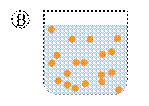
In diagram B the liquids have been agitated (stirred
vigorously), initally the water layer and oil layers have formed an emulsion.
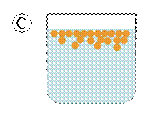
In diagram C the unstable emulsion progressively separates back into two distinct
layers (phases).
Eventually, after some minutes, the two liquids return
to form two separate phases, a layer of oil on top of a layer of water.


It is worth highlighting at this point how important it
is that we have a way of preventing this from happening, otherwise the majority
of our consumer products, including shampoo, toothpaste, cosmetics, ice-cream,
washing detergents and salad dressings, would all end up as seperated layers,
with the active ingredients no longer able to work effectively.
In diagram B the oil and water have been agitated
(stirred vigourously). If we were at this point to add an emulsifer, we would
arrive at a stable emulsion, as shown in diagram D.

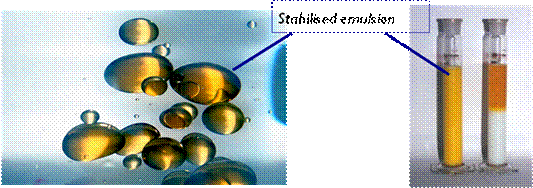
With the addition of an emulsifier
(purple outline around particles) the interfaces between phase II (oil)
and phase I (water) create a stabilised emulsion.

This addition of an emulsifier allows
two otherwise immiscible layers to be mixed uniformly, dispersing an equal
amount of each throughout the entire volume. The mixture is able to exist as a
stable (non-separating) emulsion for a reasonable time (known as shelf-life).
How do emulsifiers work?
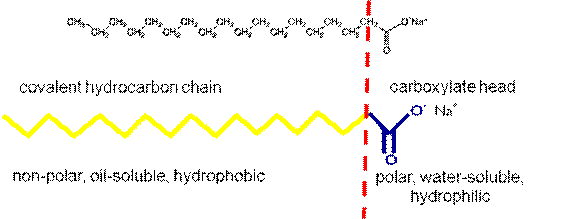
Emulsifiers are soap-like molecules. Soaps
and emulsifiers are composed of
a hydrophilic head and a hydrophobic tail.
Soaps are structured like
this:
In the case of soap/surfactants, they use their hydrophilic head and hydrophobic
tail properties to remove stains in the following process:
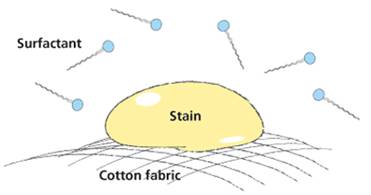
The hydrophobic
tails of the surfactant ‘burrow’ into the droplet of oil or grease stain on the
fabric.

This leaves the
hydrophilic heads to face the surrounding water.

The
oil/grease stain is held inside the ball and suspended in water.
Emulsifiers work in a similar fashion: this
is how they can suspend oil in water, for example. However, it is how they are
made that makes them chemically different from surfactants/soaps.
Making an emulsifier
Emulsifiers are
made from the chemical reaction between glycerol and a single unit of fatty
acid, without the presence of a strong alkali.


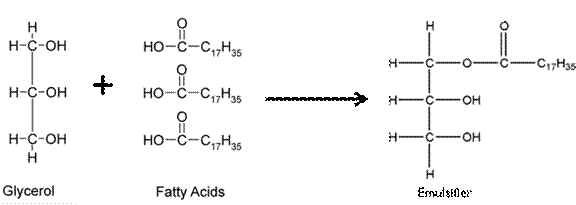
The resulting polar hydrophilic head group is
not charged (as it can be for surfactants). The resulting polarity comes from
the hydrogen bond interactions of the hydroxyl (OH) groups and the surrounding
water molecules.

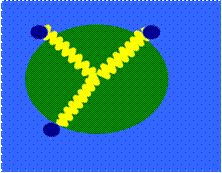
The above ball
(blue for hydrophilic head group) and stick (yellow for hydrophobic tail group)
diagram represents the structure of an emulsifier. Note: The head group (blue) does not carry any charge.
How an emulsion is made
Emulsifiers use their hydrophilic head and
hydrophobic tail properties to prevent oily liquids separating out from the aqueous
liquids (water) in which they are suspended:

In the same way as a surfactant, the
hydrophobic tails burrow into the oil droplet and the hydrophilic head groups
are left on the surface to interact with the water molecules. Thus an oily
substance can be suspended in a water layer for some time without separating
out. The resulting liquid is called an emulsion.

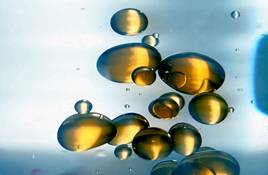
DEFINITION:
An emulsion is a
thermodynamically unstable system consisting of at least two immiscible liquid phases
one of which is dispersed as globules in the other liquid phase stabilized by a
third substance called emulsifying agent. The droplet phase is called the
dispersed phase or internal phase and the liquid in which droplets are
dispersed is called the external (continuous phase).
Appearance of emulsions:
The appearance of emulsion
depends on the wavelength of visible light i.e. globules more than 120 nm
reflect light and appear white to the eye.
TYPES OF EMULSIONS:
1. Macro emulsions (Simple Emulsions)
2. Multiple emulsions
3. Micro emulsions
1. Macro emulsions (Simple Emulsions):
i. Oil in water (o/w): Oil droplets are dispersed in a
continuous aqueous phase. This emulsion is generally formed if the aqueous
phase constitutes more than 45 % of the total weight and a hydrophilic
emulsifier is used. These are referred for oral administration and cosmetics.
These are useful as water washable drug bases.
ii. Water in oil (w/o):
Aqueous droplets are dispersed in continuous oily phase. . This emulsion
is generally formed if the oily phase constitutes more than 45 % of the total
weight and a lipophobic emulsifier is used. These are used for cosmetics. They
are employed for treatment of dry skin and emollient applications.
2. Multiple emulsions:
They are developed with a
view to delay the release of an active ingredient. They have three phases. They
may be oil-in-water-in-oil (o/w/o) or of water-in-oil-in-water (w/o/w). An emulsifier is present to stabilize the emulsions and various ionic and
nonionic surfactants are available for this purpose. Lipophilic (oil-soluble,
low HLB) surfactants are used to stabilize w/o emulsions, whereas hydrophilic
(water-soluble, high HLB) surfactants are used to stabilize o/w systemsIn these emulsions within
emulsions any drug present in innermost phase must now cross two phase boundaries to reach the
external continuous phase.
Such emulsions also can
invert. However, during inversion they form simple emulsions. So a w/o/w
emulsion will get inverted to o/w emulsion.
Preparation of multiple
emulsions:
i.
Aqueous phase is added to oily phase, containing a lipophilic
surfactant. Upon mixing a w/o emulsion is formed.
ii.
This w/o emulsion is
then poured into a second aqueous solution, containing hydrophilic surfactant.
Upon mixing multiple emulsion w/o/w is formed.
Types of multiple emulsions:
w/o/w, o/w/o
.Applications :
The important applications are in
cosmetics ,pharmaceuticals and foods. For example, in cosmetics they have a
fine texture and a smooth touch upon application, and they are aimed for slow
and sustained release of active matter from an internal reservoir into the
continuous phase (mostly water). They can serve as an internal reservoir to
entrap matter from the outer diluted continuous phase into the inner confined
space. They can also improve dissolutions or solubilization of insoluble
materials. Due to these properties, multiple emulsions find applications
related to protecting sensitive and active molecules such as vitamins C and E
from the external phase—a process called antioxidation
3. Micro emulsions:
They may be defined as dispersions of
insoluble liquids in a second liquid that appears clear and homogenous to the
naked eye. They are frequently called solubilised systems because on a macroscopic
basis they seem to behave as true solutions.
Terms as transparent emulsions, micellar solutions, solubilised systems,
and swollen micelle have all been applied to the same or similar systems.
These emulsions appear to be
transparent to the eye. They have globule radius below the range of 10-75 nm.
The appearance of emulsion depends on the wavelength of visible light i.e.
globules less than 120 nm do not reflect light and appear transparent to the
eye. As in micro emulsions the globule size is less than 120 nm, they appear to
be transparent.
Blending of a small amount of oil and
water results in a two phase system because “water and oil do not mix “If the
same small amount of oil is added to an aqueous solution of a suitable
surfactant in the micellar state, the oil may preferentially dissolve in the
interior of the micelle because of its hydrophobic nature. This type of
micellar micro emulsion is also called an o/w micellar solution. Similarly, w/o
solubilization – especially that by a nonionic surfactant – has been attributed
to swollen micelles. In these systems, sometimes called reverse micelle
solutions, water molecules are found in the polar central portion of a
surfactant micelle. the non portion of which is in contact with the continuous
lipid phase. A third type of micro emulsion is formed by ionic surfactants
(e.g. sodium stearate) in the presence of co-surfactant) e.g. pentanol or
dioxyethylene dodecyl ether) with hydrocarbons (e.g. hexadecane) and water.
In general micro emulsions
are believed to be thermodynamically stable. These micro emulsions are used for
drug administration and toiletry products.
Determination of type of emulsion:
1. Dilution test:
An emulsion can only be
diluted with its continuous phase. O/w
can be diluted with water and w/o can be diluted with oil. So when oil is added
to o/w emulsion or water is added to o/w emulsion, separation of dispersed and
continuous phase occurs. This test is useful for liquid emulsions.
2. Dye Solubility test:
Water soluble dye
(methylene blue) will be taken up by the aqueous phase where as oil soluble dye
will be taken by oily phase. When microscopically it is observed that water
soluble dye is taken up by the continuous phase, it is o/w emulsion. If the dye is not taken
up by the continuous phase, test is repeated with oil soluble dye. Coloring of
continuous phase confirms w/o emulsion. This test can fail if ionic emulsions
are present.
3. Conductivity test:
An emulsion with continuous
phase will possess more conductivity than an emulsion where oil is the
continuous phase. So when a pair of electrodes, connected to a lamp and an
electrical source are dipped into o/w emulsion, the lamp lights because of
passage of current between two electrodes. If the lamp does not light, it is
assumed to be w/o emulsion.
4. CoCl2 filter test:
Filter paper impregnated
with CoCl2 and dried
(blue) changes to pink when o/w emulsion is added. It may fail if emulsion is
unstable or breaks in presence of electrolyte.
5. Fluorescence test:
Since some oils fluoresce
under UV light, 0/w emulsions exhibit dot pattern, w/o emulsion fluoresce
through out. But this test is applicable
if oil has the property of fluorescence.
Factors affecting the type of emulsion:
Type of emulsion produced
(o/w or w/o) depends upon following factors:
i.
Type of emulsifying agent :
Type of emulsion is a function of relative solubility of emulsifying
agent. The phase in which it is soluble becomes the continuous phase
ii. The phase volume ratio i.e. the relative amount of oil and
water.
This determines the relative number of droplets formed and hence the
probability of number of collision. The greater the number of droplets, greater
is the chance for collision. Thus the phase present in greater amount becomes
the external phase.
The polar portions of the emulsifying agents are better barriers to
coalescence than hydrocarbon counterparts. So o/w emulsions can be formed with
relatively high internal phase volume.
In w/o emulsion (in which the
barrier is of hydrocarbon nature) if the amount of internal phase is increased
more than 40 %, it inverts to o/w emulsion because hydrocarbon part of
surfactant can not form a strong barrier.
iii. Viscosity of each phase :
An increase in viscosity of a phase helps in making that phase the
external phase.
USES (APPLICATIONS) OF EMULSIONS:
Emulsions can be used for
oral, parenteral or topical pharmaceutical dosage forms.
i. Oral Products
Emulsions are used for
administering drugs orally due to following reasons:
a. More palatable:
Objectionable taste or texture of medicinal agents gets masked.
b. Better absorption: Due
to small globule size, the medicinal agent gets absorbed faster.
ii. Topical products:
O/w emulsions are more acceptable
as water washable drug bases for cosmetic purposes.
w/o emulsions are used for
treatment of dry skin. Emulsions have following advantages when used for
topical purpose:
a. Patient acceptance:
Emulsions are accepted by patients due to their elegance, easily
b. washable character,
c. acceptable viscosity,
d. less greasiness.
iii. Parenteral Emulsions:
a. i.v rout:
Lipid nutrients are
emulsified and given to patients by i/v rout. Such emulsions have particle size
less than 100 nm.
b. Depot injections:
W/o emulsions are used to
disperse water soluble antigenic materials in mineral oil for i/m depot
injection.
iv. Diagnostic purposes :
Radio opaque emulsions
have been used in X-ray examination.
THEORY OF EMULSIFICATION:
When oil and water are
mixed and agitated, droplets of different sizes are produced. However, two
immiscible phases tend to have different attractive forces for a molecule at
the interface. A molecule of phase A is attracted to phase A but is repelled by
Phase B. This produces interfacial tension between two immiscible liquids.
(Interfacial tension at a liquid is defined as the work required to create 1 cm2
of new interface.
A fine dispersion of oil
and water necessitates a large area of interfacial contact. Its production
requires an amount of work equal to the product of interfacial tension and the
area change. Thermodynamically speaking, this work is the interfacial free
energy imparted to the system. A high interfacial energy favors a reduction of
interfacial area, first by making the droplets to get spherical shape( minimum
surface area for a given volume) and
then by causing them to coalesce (decrease in number of droplets). This is the
reason for including the words “Thermodynamically unstable” in definition of
opaque emulsions. To make a stable emulsion droplets have to be stabilized so
that they do not coalesce.
Droplet Stabilization: (Mechanism of action of emulsifying
agents)
Droplets can be stabilized
by making use of emulsifying agents. Emulsifying agents assist in the formation
of emulsion by two mechanisms.
i.
By lowering the
interfacial tension And/or
Interfacial tension can be reduced by using surfactants.
ii.
By preventing the coalescence of droplets
i. By lowering the interfacial tension (Reduction in
interfacial tension – thermodynamic stabilization):
The increased surface
energy associated with formation of droplets, and hence surface area in an
emulsion can be reduced by lowering of interfacial tension. Assuming the
droplets to be spherical
∆ F = 6 γV/d
∆ F = energy in put
required
γ = interfacial
tension
V = volume of dispersed
phase in ml
d = mean dia of particles
If V= 100 ml of oil, d = 1
μm (10-4 cm), γ o/w = 50 dynes / cm,
∆ F = 6 x 50 x 100 /
(1 x 10⁻⁴) = 30 x 107 ergs = 30 joules or 30 / 4.184 = 7.2 cal.
In the above example, addition of emulsifier which reduces γ from 50
to 5 dynes / cm will reduce the surface free energy from 7.2 to 0.7 cal. Such
reduction in surface free energy can help to maintain the surface area
generated during the dispersion system by
ii. Preventing the coalescence of droplets Coalescence of droplets can be
prevented by two methods - (a) By formation of rigid film, (b) By formation of
electrical double layer.
A. By formation of rigid
interfacial film – mechanical barrier to coalescence. Coalescence of droplets
can be prevented by formation of films around each droplet of dispersed
material. This film forms a barrier that prevents the coalescence of droplets.
This film should possess some degree of surface elasticity, so that it does not
break when compressed between two droplets. If broken it should form again
rapidly. These films are of three types:
i. Monomolecular films:
The surface active agents form a monolayer at the oil water interface.
This monolayer serves two purposes:
1. Reduces the surface free
energy.
2. Forms a barrier between
droplets so that they can not coalesce.
ii.
Multimolecular films :
Hydrated lyophilic colloids and finely divided solids form multimolecular
films around droplets of dispersed oil. They do not reduce the interfacial
tension but form a coating around droplets and prevent coalescing. The
hydrocolloid which is not absorbed on the surface of droplet, increase the
viscosity of continuous phase hence stabilizes the emulsion.
iii. solid particle films
Small solid particles which are wetted to some extent by both oily and
aqueous phase, can act as emulsifying agent. If the particles are too
hydrophilic, they get dispersed in aqueous phase. If the are too hydrophobic,
they get dispersed in oily phase. Other requirement is that the particles
should be smaller than the droplet size.
b.
By forming electrical
double layer
Presence of a well
developed charge on the droplet surface increases stability by causing repulsion
between approaching drops. This charge is likely to be greater if ionized
emulsifying agent is employed. i/v fat emulsions are stabilized with lecithin
due to the electrical repulsion.
In an o/w emulsion
stabilized by sodium soap, the hydrocarbon tail is dissolved in the oily phase
and ionic heads are facing the continuous aqueous phase. As a result the
surface of the droplet is studded with –vely charged carboxylic group. This
produces a surface charge on the droplet... The cations of opposite charge are
oriented near the surface, producing a double layer of charge. The potential
produced by double layer creates a repulsive effect between the oil droplets
and thus hinder coalescence.